Tweedledum and Tweedledee
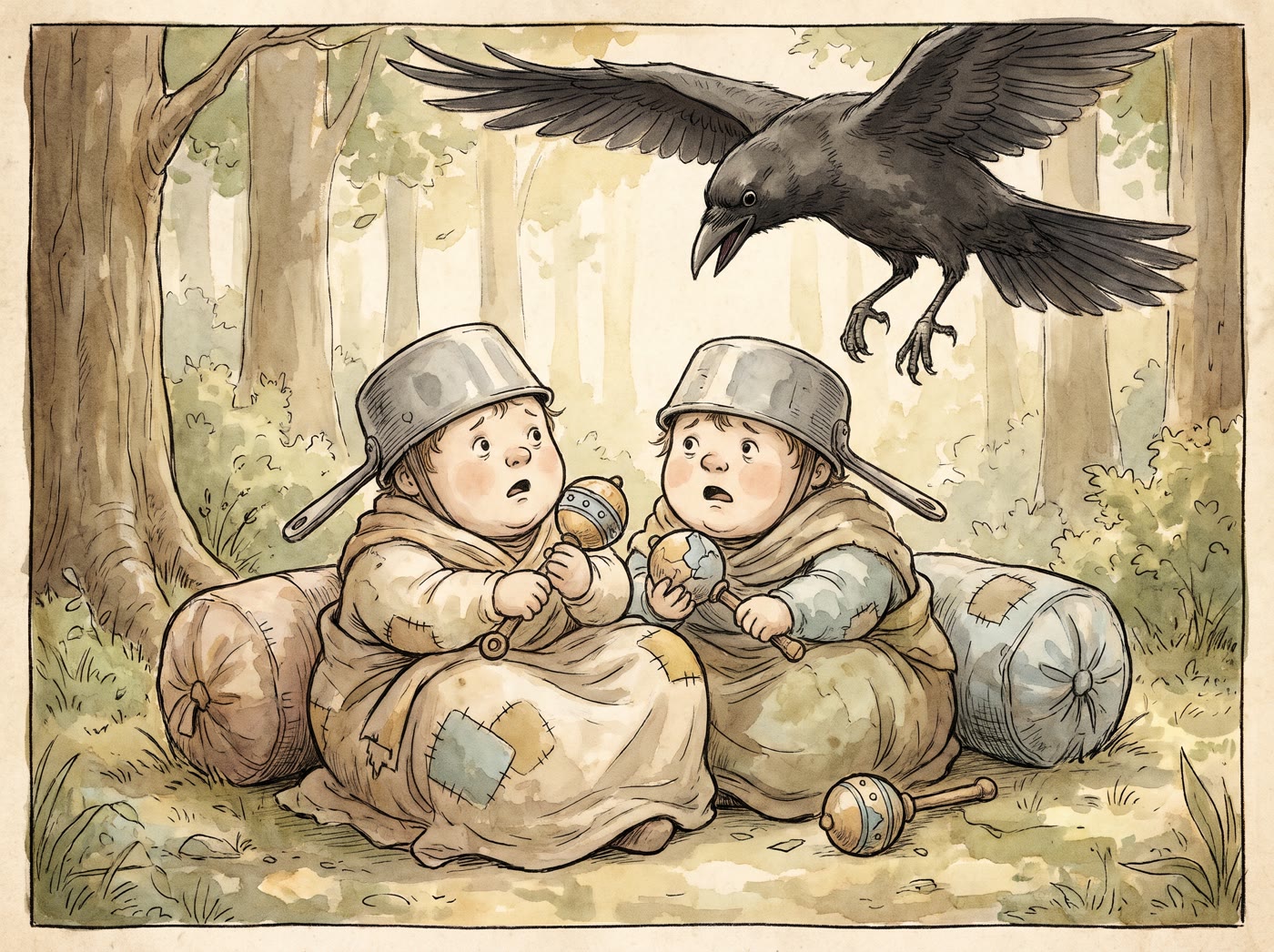
Tweedledum and Tweedledee
Agreed to have a battle;
For Tweedledum said Tweedledee
Had spoiled his nice new rattle.
Just then flew down a monstrous crow,
As black as a tar-barrel;
Which frightened both the heroes so,
They quite forgot their quarrel.
Where the rhyme comes from
The two halves of this story have different histories, and it helps to keep them apart. The names come first. “Tweedle-dum and Tweedle-dee” appear in print in an epigram by the poet John Byrom (1692–1763), published in The London Journal in 1725, which poked fun at the quarrel between the supporters of two composers in London, Handel and Bononcini. The version usually quoted is the one in Byrom’s Miscellaneous Poems of 1773 (the newspaper text of 1725 words it a little differently):
“Some say, compar’d to Bononcini,
That Mynheer Handel’s but a Ninny;
Others aver, that he to Handel
Is scarcely fit to hold a Candle:
Strange all this Difference should be,
’Twixt Tweedle-dum and Tweedle-dee!”
The point of the joke is that the two men, in the poet’s eyes, were hardly different at all. The last two lines have also been credited to Swift and to Pope, but the epigram as a whole is Byrom’s.
The battle rhyme itself is first found in a nursery collection around 1805, in Original Ditties for the Nursery, according to later scholars; we have not seen that book ourselves. Who wrote it is not known. Whether Byrom borrowed his names from an older rhyme is an open possibility put forward by later writers, but no evidence either way has been found.
In Lewis Carroll’s Through the Looking-Glass (1871) Alice meets them standing each with an arm round the other’s neck, with “DUM” and “DEE” embroidered on their collars, and the words of “the old song” keep ringing through her head — Carroll’s own phrase, which tells us he thought of the rhyme as already familiar. The brothers dance with her, Tweedledee recites The Walrus and the Carpenter, and the pair plan a fight over a spoiled rattle, with saucepans and bolsters for armour, only to be scattered by the monstrous crow, which Carroll describes as a thick black cloud with wings. John Tenniel’s drawings for the book show the pair as twins.
What does it mean?
Two people who are almost the same. This is the meaning the names carry today. Byrom’s epigram made them a byword for a fierce dispute between two parties who differ very little, and the phrase has since come to describe any two people or things that are practically indistinguishable.
A comic tale of a petty quarrel. The rhyme itself needs little decoding: a row over a broken toy, much blustering preparation, and a fright that makes everyone forget what they were cross about. If you are asked who the twins represent, the honest answer is that no one is known to be hidden in the rhyme. The names were attached to Handel and Bononcini in 1725, but there is no confirmed hidden meaning in the nursery verses.
Sharing it with children
The mirror game. Two children stand face to face, one leading and one copying every movement as exactly as they can — a rattle shaken, a foot stamped, a puffed-out “battle” chest. Swap leaders, and see how long the twins can stay identical.
Quarrel and make up. Act out the first stanza with two soft toys, or two children, arguing grandly over a rattle. Then talk about what each could have done to put it right. The rhyme is a gentle way to talk about squabbles, because the crow makes the whole thing look rather silly.
The crow swoop. Let an adult be the crow, arms spread, hovering over the children while the second stanza is recited. On “monstrous crow” swoop; on “quarrel” the twins freeze, then hug.
Extra verses to sing
These verses aren’t traditional — they’re ours. Sing them if you would like the twins to make friends again.
Tweedledum and Tweedledee
Mended up the rattle;
Took it turn and turn about,
And never fought a battle.
Back came down the great black crow
And cocked his head to see;
“May I shake it?” asked the bird.
“Of course,” said Dum and Dee.