Humpty Dumpty
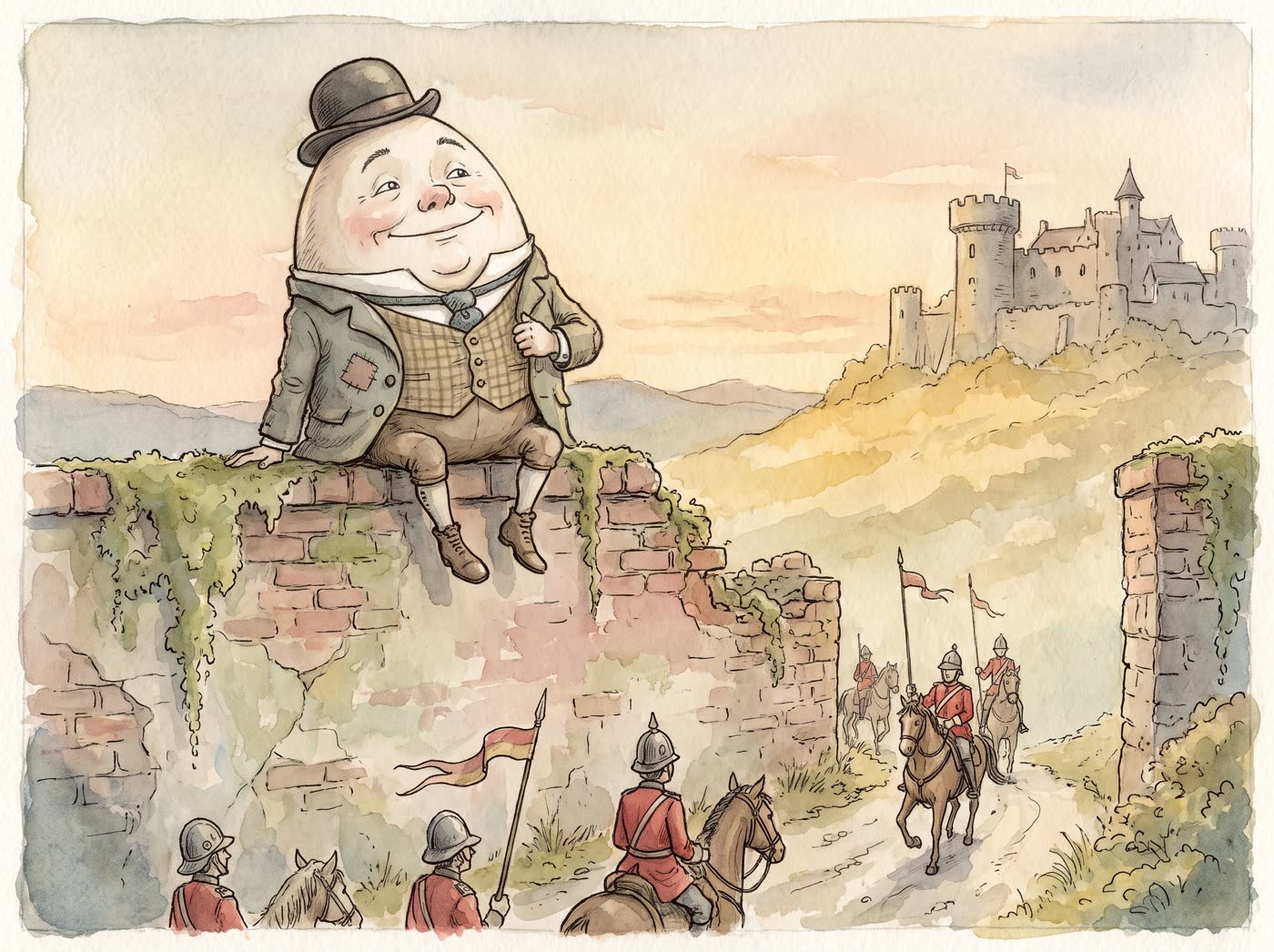
Humpty Dumpty sat on a wall,
Humpty Dumpty had a great fall.
All the king’s horses and all the king’s men
Couldn’t put Humpty together again.
Where the rhyme comes from
Humpty Dumpty first appeared in print in Samuel Arnold’s Juvenile Amusements in 1797, with slightly different words — “Four-score Men and Four-score more, / Could not make Humpty Dumpty where he was before”. No horses, no king’s men: those arrive later.
The rhyme then travels, and the wording shifts at every stop. Someone has written the near-modern version by hand into a copy of Mother Goose’s Melody published in 1803, ending “Could not set Humpty Dumpty up again”. In 1810 Joseph Ritson’s Gammer Gurton’s Garland prints it with the numbers halved — “Threescore men and threescore more, / Cannot place Humpty dumpty as he was before”. James Orchard Halliwell, gathering rhymes for The Nursery Rhymes of England in 1842, found a version that has wandered further still: “Humpty Dumpty lay in a beck, / With all his sinews around his neck”, with forty doctors and forty wrights failing where the king’s men now fail. The tune children sing today is younger than any of them: it was first written down by the collector James William Elliott in his National Nursery Rhymes and Nursery Songs (London, 1870).
The rhyme is widely believed to have begun as a riddle: the listener is meant to guess what sat on the wall, and the answer — an egg — explains why no one could put him together again. The misdirection is recorded before the rhyme is. Francis Grose’s Classical Dictionary of the Vulgar Tongue (1785) lists “humpty dumpty” as a short clumsy person of either sex, and also as ale boiled with brandy — and mentions no rhyme at all. A tipsy little man might survive a tumble from a wall; an egg could not. That the words really were posed as a puzzle is not merely a guess: writing in the American children’s magazine The Orion in 1844, William Carey Richards gave the rhyme as a riddle, with the answer an egg. Folklorists have collected the same riddle in other languages — “Boule Boule” in French, “Lille Trille” in Danish and Norwegian, “Hümpelken-Pümpelken” in parts of Germany. Once the answer became universally known the riddle simply carried on as a rhyme, and Lewis Carroll’s Through the Looking-Glass (1871) fixed Humpty’s egg-shaped image forever.
What does it mean?
Three colourful theories are often repeated, though the evidence for all of them is thin:
The cannon of Colchester. A popular story holds that Humpty Dumpty was a large cannon defending the town walls of Colchester during the English Civil War siege of 1648; when Parliamentarian shot brought the wall down, the cannon fell and could not be remounted. It is a wonderful tale — but nothing in writing connects it to the rhyme before the twentieth century. It was carried on the Colchester tourist board’s website from 1996 and popularised by Albert Jack’s Pop Goes the Weasel (2008), which quotes two further verses in support of it without saying where they came from. Those verses are not in the idiom of the seventeenth century, and they do not fit the earliest printed texts, which mention neither horses nor men.
The siege engine at Gloucester. The version that came first is stranger. In The Oxford Magazine of 16 February 1956, Professor David Daube proposed that Humpty Dumpty was a “tortoise” siege engine used against the Parliamentary-held city of Gloucester in 1643. It was a deliberate spoof — and it was taken up in earnest anyway, the siege reading later migrating from Gloucester to Colchester, where most retellings now place it. Iona Opie’s verdict on this kind of invention is hard to improve on: “ingenuity for ingenuity’s sake”.
Richard III. Others have suggested the rhyme mocks King Richard III, who fell at the Battle of Bosworth Field in 1485 when all his horses and all his men could not save him. The idea was put forward by Katherine Elwes Thomas in 1930 and spread by Robert Ripley; again, there is no contemporary evidence — the riddle explanation remains the most likely.
Sharing it with children
Humpty is a wonderful lap rhyme. Sit a child on your knees and rock gently through the first two lines — then open your knees for a (safely caught!) “great fall” on line two. Older toddlers love acting it out with a real hard-boiled egg drawn with a face, and discovering why the king’s men really couldn’t put him together again makes a lovely first kitchen-science moment. Children old enough to enjoy a puzzle can meet the rhyme the way eighteenth-century children did: recite it without the name and let them guess what sat on the wall.
Extra verses to sing
These verses aren’t traditional — they’re ours. Sing them if the story needs a happier ending.
Humpty Dumpty sat up and said,
“My shell may be cracked, but I’m not dead!”
The king’s men cheered and the horses too,
And they mended his shell with sticky glue.
Humpty Dumpty climbed up once more,
Higher and prouder than ever before.
But now when he sits where the tall winds blow,
He keeps a soft haystack ready below.