The Grand Old Duke of York
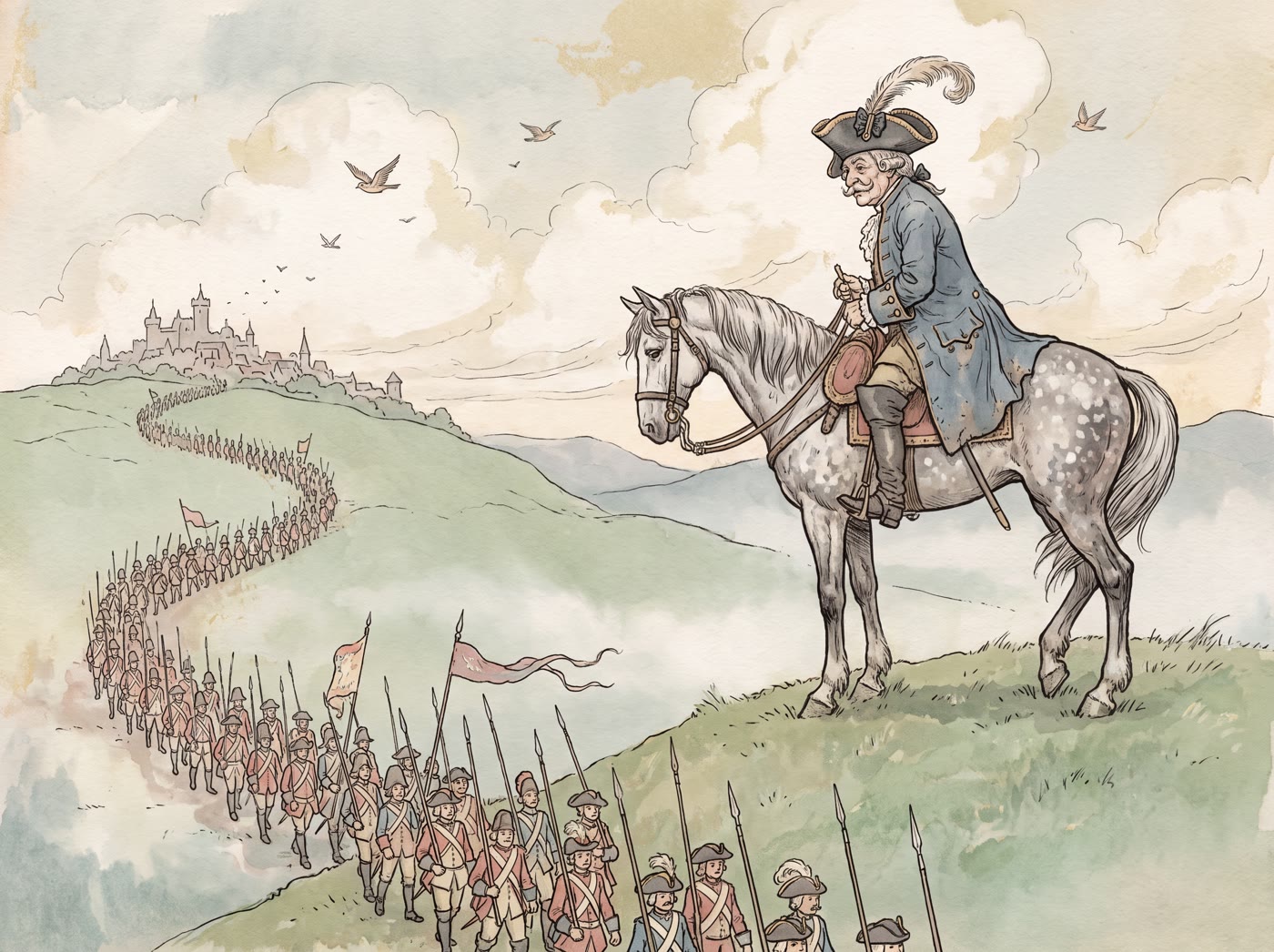
The Grand old Duke of York,
He had ten thousand men,
He marched them up to the top of the hill,
Then he marched them down again.
And when they were up they were up,
And when they were down they were down,
And when they were only half way up
They were neither up nor down.
Where the rhyme comes from
The oldest surviving ancestor of this rhyme was printed in 1642 as “Old Tarlton’s song”, attributed to the Elizabethan stage clown Richard Tarlton (c. 1530–1588). It had no duke in it at all: “The King of France with forty thousand men, / Came up a hill and so came downe againe.” A still earlier couplet from around 1630 has the King of France drawing his swords and putting them up again.
For centuries the joke was simply attached to whichever leader deserved mocking. Iona and Peter Opie, in the Oxford Dictionary of Nursery Rhymes, record that in Warwickshire in 1892 the song was sung of both the Duke of York and the King of France, and that by 1894 it was being sung of Napoleon. The familiar modern words about the Duke of York were not printed in their present form until relatively late — in Arthur Rackham’s Mother Goose of 1913.
What does it mean?
The rhyme has become proverbial for pointless effort: a great deal of marching, and nothing whatever achieved. Which duke, if any, it was aimed at is much less certain, and every candidate below is a theory rather than a documented fact.
Prince Frederick, Duke of York and Albany (1763–1827). The most popular attribution. The second son of George III commanded the British Army and led the Flanders Campaign of 1793–95, which ended in defeat at Tourcoing and his recall home. Flanders is famously flat, so the “hill” is sometimes said to be the town of Cassel, which stands about 176 metres above the plain. It is a neat story, but no contemporary source ties the song to him.
Richard, Duke of York (1411–1460). An older tradition, long repeated on this page and elsewhere, holds that the rhyme remembers Richard of York, who quartered his army in Sandal Castle on its high mound, marched down, and was killed at the Battle of Wakefield on 30 December 1460 during the Wars of the Roses. His son became Edward IV the following year. This is folklore rather than evidence: the rhyme is not recorded in any form for nearly two centuries afterwards.
Others. James II and Napoleon have both been proposed too. Given that the 1642 version is about a French king and later singers happily swapped the name to suit the politics of the day, the likeliest truth is the dullest: it is an old, portable joke about futile marching that eventually settled on a duke.
Sharing it with children
This is one of the great action rhymes, and hardly anyone sings it sitting still. With a baby on your lap, lift them gently up on “up” and lower them on “down”, holding them wobbling in mid-air for “neither up nor down” — the pause before the drop is the whole joke. Toddlers can stand and stretch tall on the ups, crouch small on the downs, and freeze half-bent in the middle.
A roomful of children will happily march the length of a hallway and back, and speeding the last verse up until everyone collapses is traditional in every playgroup. It is also a quietly useful rhyme: up, down and halfway are among the first position words small children need, and this song teaches all three with the whole body.
Extra verses to sing
These verses aren’t traditional — they’re ours. Sing them when the hill needs climbing twice.
The Grand old Duke of York,
He counted every one,
He marched them up to look at the moon,
Then down to find the sun.
The Grand old Duke of York,
He sat down on the green,
And all ten thousand sat down as well
And ate their tea between.