Jack and Jill
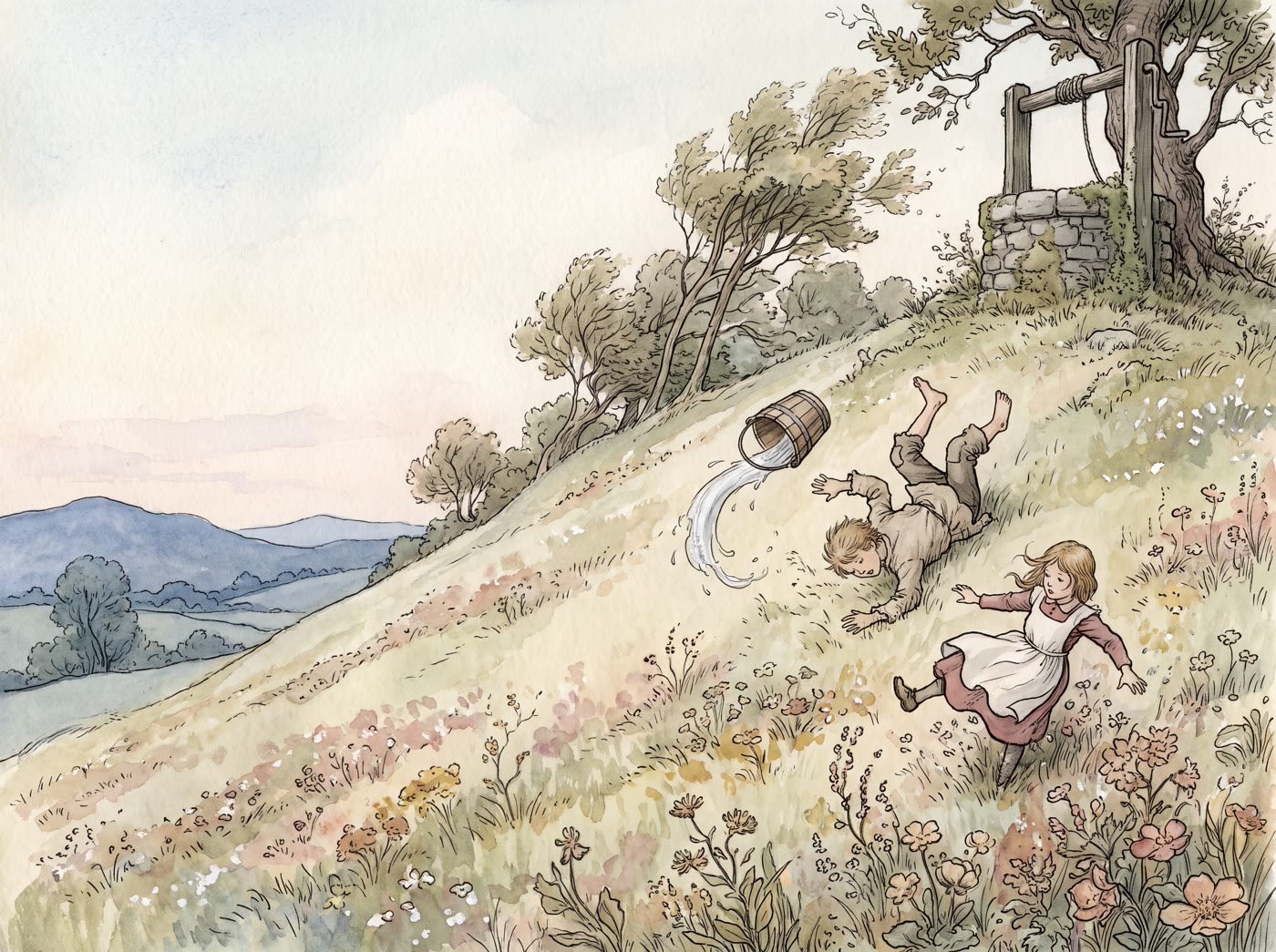
Jack and Jill went up the hill,
To fetch a pail of water,
Jack fell down and broke his crown,
And Jill came tumbling after.
Up Jack got and home did trot,
As fast as he could caper,
He went to bed and wrapped his head,
In vinegar and brown paper.
Where the rhyme comes from
The earliest known printing of Jack and Jill appears in a reprint of John Newbery’s Mother Goose’s Melody, thought to have been first published in London around 1765. That first version carried only the opening verse; the second verse — the vinegar and brown paper — was added later, as the rhyme was stretched into chapbook form. By the early 1800s, printers such as the 1806 chapbook Jack and Jill and Old Dame Gill had expanded the tale to a dozen verses or more.
The rhyme is almost certainly older than its first printing. Iona and Peter Opie, in The Oxford Dictionary of Nursery Rhymes, noted that the rhyming of “water” with “after” only works in an older pronunciation, and suggested the first verse may date from the first half of the 17th century. In the earliest woodcuts the pair are spelled “Jack and Gill” and drawn as two boys — Gill was then a boy’s name. A musical setting by Charles Burney was published in 1777, and the tune most people sing today was recorded by James William Elliott in his National Nursery Rhymes and Nursery Songs (1870).
What does it mean?
On the face of it, the rhyme is simply a small cautionary tale about a spill on a steep hill. Several richer explanations are often repeated, but the evidence for them is thin:
A joke about foolishness. “Jack” and “Jill” were stock names for an ordinary lad and lass long before the rhyme was printed — the pairing turns up in Shakespeare and in a court entertainment of the 1560s. Since water collects in valleys rather than on hilltops, some readers take the rhyme as a gentle dig at human silliness. This is a reading rather than a documented origin.
The French Revolution. A popular story holds that Jack is Louis XVI and Jill is Marie Antoinette, both of whom lost their crowns and then their heads. It is a tidy tale, but the rhyme was in print around 1765 and the pair were executed in 1793 — so the chronology rules it out. Treat it as folklore.
Charles I and the beer measures. Another theory, popularised in Albert Jack’s The Secret Meanings of Nursery Rhymes, claims the verse satirises a tax dodge in which the “jack” (an eighth of a pint) was shrunk while its price held, with the “gill” (a quarter pint) tumbling after. It is ingenious, and unsupported by any contemporary source.
The Kilmersdon legend. The Somerset village of Kilmersdon claims its own hill as the setting, complete with a local story of a young couple who came to grief there. The village celebrates the connection warmly, but it is community tradition, not documented history.
The plain truth is that nobody knows. What we do know is that the vinegar and brown paper of the second verse were a genuine folk remedy, wrapped round a bruise to draw it out — a real detail from a real kitchen.
Sharing it with children
Jack and Jill makes a splendid lap rhyme. Sit a child facing you on your knees and walk them “up the hill” by lifting your heels a little higher on each of the first two lines — then open your knees for a safely caught tumble on “Jack fell down”, and a second, sillier one on “came tumbling after”. The double fall is the whole joke, and toddlers will demand it again and again.
Older children enjoy acting it out on a real slope with an empty bucket, or rolling two wooden pegs down a cushion ramp. The second verse is a lovely excuse for a bandaging game: a strip of brown paper and a scarf turns any teddy into a patient, and it opens the door to a first conversation about how people looked after bumps before there were plasters.
Extra verses to sing
These verses aren’t traditional — they’re ours. Sing them if the tumble needs a kinder ending.
Jill sat down upon the ground,
And laughed until she shook,
“The pail is dry, but so am I —
Let’s fetch it from the brook!”
Jack and Jill went down the hill,
More carefully than after,
And every drop they carried home
Was full of light and laughter.