Jack Be Nimble
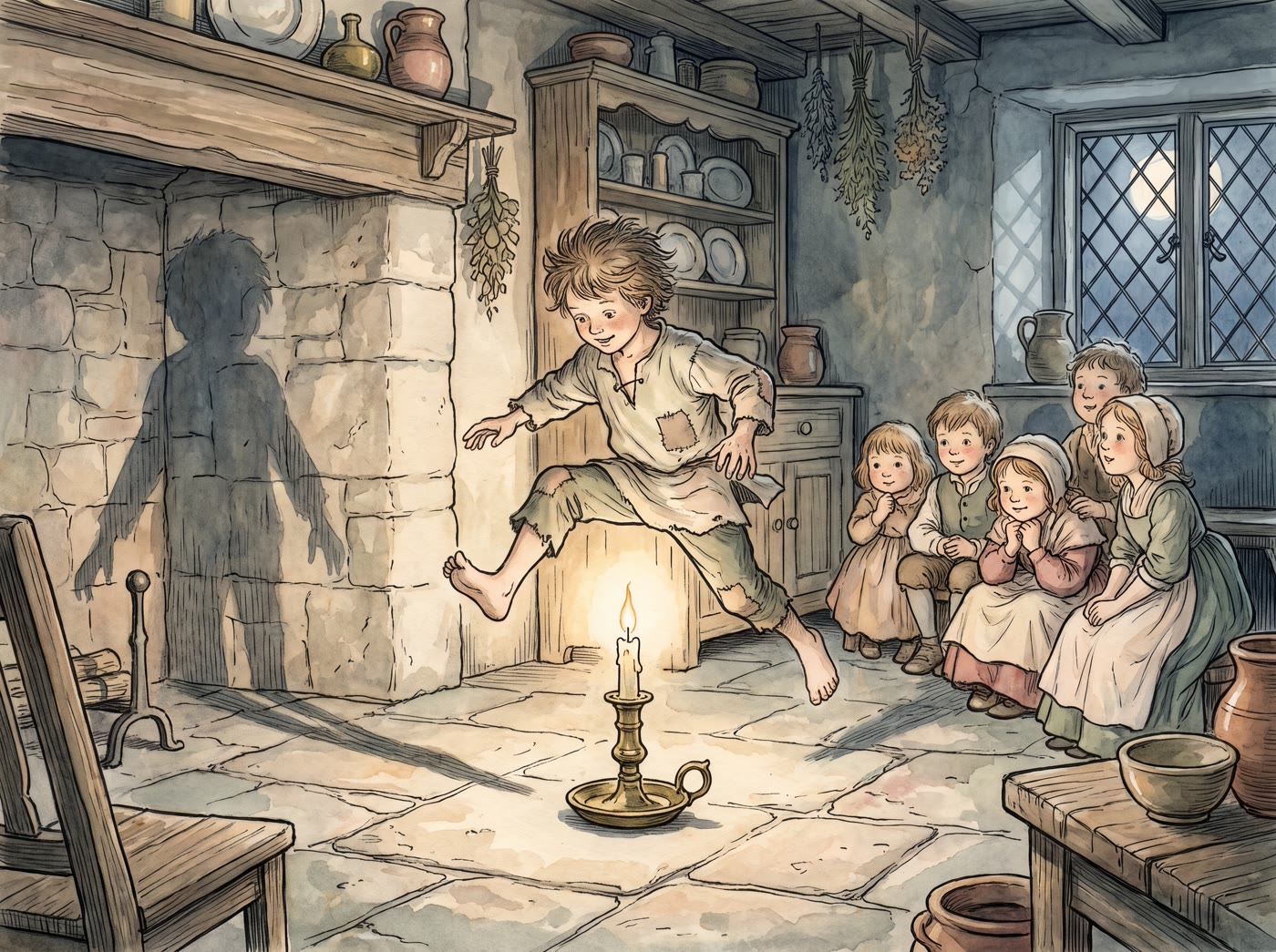
Jack be nimble,
Jack be quick,
Jack jump over
The candlestick.
Where the rhyme comes from
For a rhyme this famous, Jack Be Nimble surfaces remarkably late. Iona and Peter Opie, in the Oxford Dictionary of Nursery Rhymes, trace it no further back than a manuscript of about 1815 — words written by hand, not printed. It is often said to have been added to a copy of Gammer Gurton’s Garland, the collection Joseph Ritson began issuing in the 1780s; the record is a manuscript of about 1815, and the “1815 edition of Gammer Gurton’s Garland” frequently given elsewhere is not borne out by the printed collections of those years, which do not carry the rhyme. The rhyme reached a wide readership when James Orchard Halliwell gathered it into The Nursery Rhymes of England in the eighteen forties, and it has stayed in print ever since. It carries the number 13902 in the Roud Folk Song Index.
The candlestick, though, is much older than the verse. Candle-leaping was a real amusement, and it is documented more than a century before Jack is. Writing in the latter part of the seventeenth century in his Remaines of Gentilisme and Judaisme, John Aubrey described a sport played by “the young girls in and about Oxford” called Leap-Candle: a candle was set in the middle of the room in its candlestick, the players drew their coats up into the shape of breeches, and they danced over the flame back and forth to a chant — not ours, but a doggerel about the one-eyed tailor of Bicester. The same game, Aubrey noted, was called Dancing the Candle Rush in other parts of the country. Halliwell reprinted the passage in Popular Rhymes and Nursery Tales in 1849. Clearing the flame without putting it out was counted lucky; extinguishing it was not.
The custom outlived Aubrey by two hundred years, and by the nineteenth century our rhyme had attached itself to it. In the lace-making counties — Buckinghamshire, Bedfordshire, Northamptonshire — St Catherine’s Day, 25 November, was the lace-makers’ holiday and their “candle day”, the evening from which it was worth lighting the candle block to work by. Accounts of the lace schools collected by historians of the trade, among them Thomas Wright in The Romance of the Lace Pillow (1919), describe children leaping the lighted candlestick that night while the rhyme was chanted with a different child’s name put in each time. That is a use of the rhyme we can evidence. Whether the game produced the rhyme, or the rhyme simply found a game already waiting for it, the record does not say.
What does it mean?
The plainest reading is almost certainly the right one: “Jack” is a generic name for any lad — as he is in Jack and Jill, Jack Sprat and half the rhymes in the canon — and the verse is a cheerful dare to jump the candle and win the luck. Two showier explanations are sometimes repeated, and both should be treated as folklore rather than history:
Black Jack the pirate. A popular story identifies Jack with a pirate famous for slipping out of the authorities’ grasp. Retellings cannot agree on which pirate: some name a sixteenth-century Englishman, others the eighteenth-century Calico Jack Rackham. Nothing contemporary links any of them to the rhyme, and the disagreement is itself a warning.
The lace-makers’ candle. This one has the most behind it, and still falls short of an origin. The lace schools really did leap the candlestick to these words, as above — but every record of them doing so is nineteenth century or later, which puts the custom alongside the rhyme rather than before it.
Where the words themselves came from, and who first said them, is simply not known.
Sharing it with children
This is a rhyme that wants to be acted out, and never with a real flame. Stand a cardboard tube or a rolled sock on the floor as your “candlestick” and let a toddler jump it on the last line, with a hand held for balance. For babies on the lap, bounce gently through the first two lines and lift them up high on “jump over.” Because it is only four lines long it survives endless repetition: line up three or four soft obstacles and take them in turn, or lay a ribbon on the floor and raise it a little each round.
Swap the name, as the lace schools did — “Rosie be nimble, Rosie be quick” — and let each child jump on hearing their own. It is a good first turn-taking game, and the anticipation is half the fun. Older children enjoy hunting for words that rhyme with quick: stick, brick, thick, tick, and then making a line of their own to end on one. Many families sing a second verse — “Jack jumped high, Jack jumped low, Jack jumped over and burnt his toe” — which is sung widely today but is no part of the traditional four lines; where it came from is not known.
Extra verses to sing
These verses aren’t traditional — they’re ours. Sing them when one jump isn’t enough.
Jack be steady,
Jack be light,
Jack keep the little
Flame alight.
Jack be merry,
Jack be bold,
Jack jump over
And land in gold.