Doctor Foster
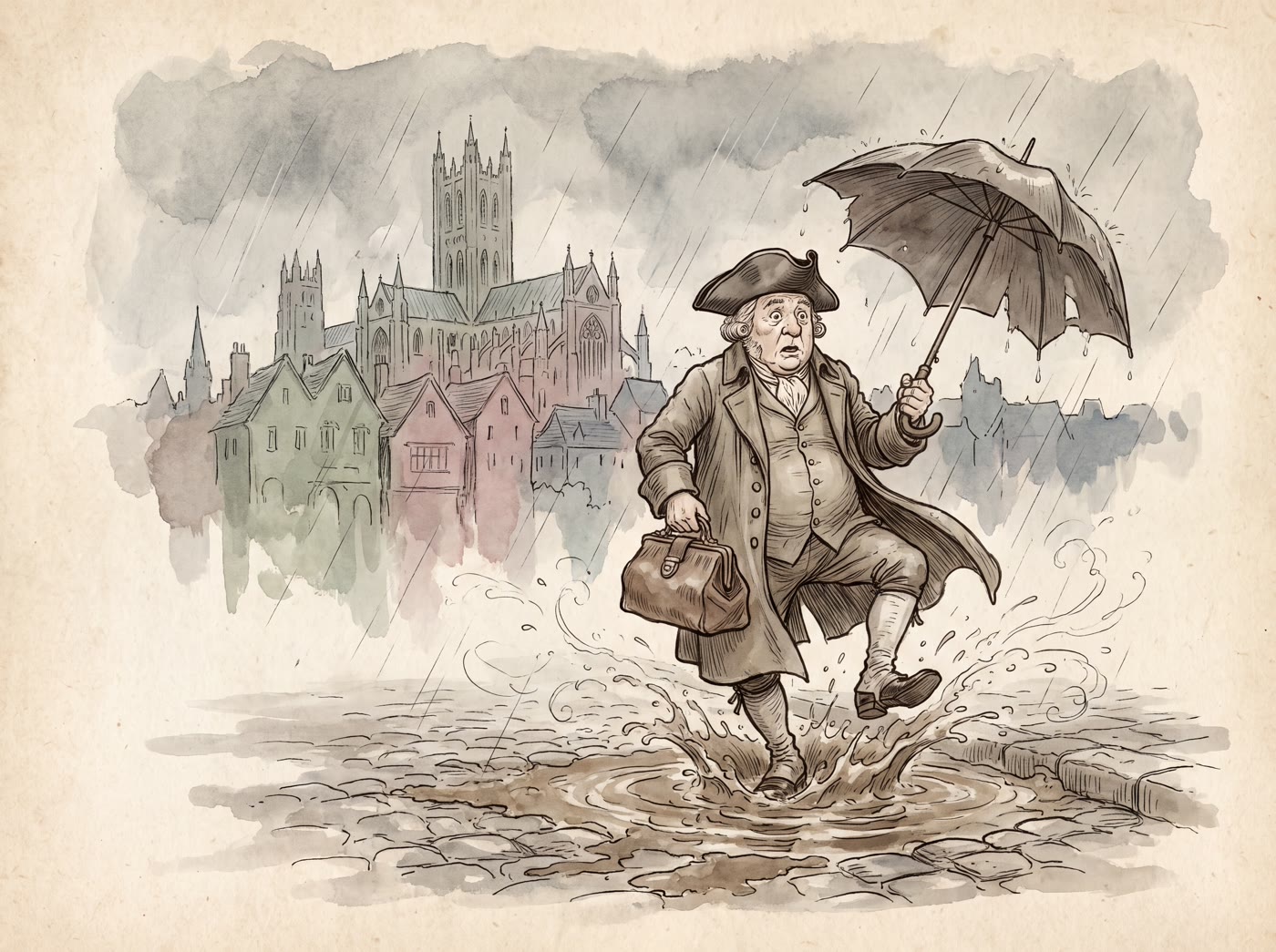
Doctor Foster went to Gloucester,
In a shower of rain;
He stepped in a puddle,
Right up to his middle,
And never went there again.
Where the rhyme comes from
Doctor Foster first appeared in print in the form we know in 1844 — the date the Opies give in The Oxford Dictionary of Nursery Rhymes. That makes it a relatively late arrival on paper, though like most rhymes it was almost certainly spoken and sung long before anyone thought to write it down.
The doctor reaches print before the puddle does. The 1810 London edition of Joseph Ritson’s Gammer Gurton’s Garland prints a quite different verse under the title “The Sedate Preacher”: “Old Dr. Forster, / Went to Glo’ster, / To preach the word of God: / When he came there, / He sate in his chair, / And gave all the people a nod.” The same little book has a second Doctor Foster, who “was a good man” and “whipped his scholars, now and then” — a rhyme James Orchard Halliwell’s collection gives with Doctor Faustus in the doctor’s place. Whoever he was, the name and the journey to Gloucester were in print a generation before the shower of rain.
Much of its charm is simply the sound of it. Gloucester is said “Gloster” — Ritson spells it Glo’ster — so “Foster” and “Gloucester” are a full rhyme to an English ear, however odd they look on the page. “Puddle” and “middle” are another matter: they only half rhyme. The Opies noted that the word may once have been “piddle”, an old word for a stream, which would mend the rhyme and hint that the verse is older than its first printing. Anyone who had travelled unmade roads in wet weather would have needed very little explaining.
What does it mean?
No one knows who Doctor Foster was, and the popular explanations are theories rather than history:
King Edward I. The best-known story claims the rhyme remembers a visit by Edward I to Gloucester, during which he fell into a puddle and swore never to return. It is a good tale, but according to the Opies it was first suggested by Boyd Smith, in 1920, more than six centuries after the supposed event, and there is no contemporary evidence for it. The 1810 preacher, who reaches Gloucester and merely nods, makes a royal original less likely still. Treat it as folklore.
Archbishop Laud’s messenger. Writing in Gloucestershire History in 1994, P. Brown suggested that Doctor Foster was an emissary of William Laud, Archbishop of Canterbury, sent to Gloucester with orders that communion tables be moved to the east end of the church, who could not reach Deerhurst because the Severn was in flood. It is an ingenious fit for a travelling churchman, but it is a modern proposal, not a recorded event.
Doctor Faustus. Others point to Christopher Marlowe’s play Doctor Faustus, in which a man soaked crossing a river on a conjured horse — it turns back into straw in midstream — calls the magician “Doctor Fauster”. The swap of Foster for Faustus in the whipping rhyme shows the two names did travel together; whether this rhyme is one of their journeys is guesswork.
A local doctor, or no one at all. He may have been a real physician of that name, or “doctor” may be gentle mockery of a learned man undone by ordinary weather. The simplest explanation may be the truest: the verse is a nonsense joke built for its rhymes, with a punchline any child instantly enjoys.
Sharing it with children
Doctor Foster is a lovely lap rhyme for a rainy day. Sit a child on your knees and walk them along briskly for the first two lines, wiggle your fingers overhead for the shower of rain, then drop your knees on “right up to his middle” and finish with a firm, funny shake of the head on the last line. Older children like stamping it out in wellingtons, and it is a natural cue for splashing in a real puddle — or for talking about how deep water can look shallow.
Once a child has the words, try a “how deep?” version. Change the fourth line each time — right up to his ankles, his knees, his middle, his chin — and let the child point to each place as you sing it. It is a gentle body-parts game, and the puddle gets funnier every time it grows.
Extra verses to sing
These verses aren’t traditional — they’re ours. Sing them if the doctor deserves a drier day.
Doctor Foster dripped to breakfast,
Squelching down the lane;
He wrung out his stocking,
His boots were quite shocking,
And still it went on raining.
Doctor Foster bought some wellies,
Tall and shiny green;
Now he splashes gladly,
And hums away madly —
The muddiest man ever seen.