Ride a Cock Horse
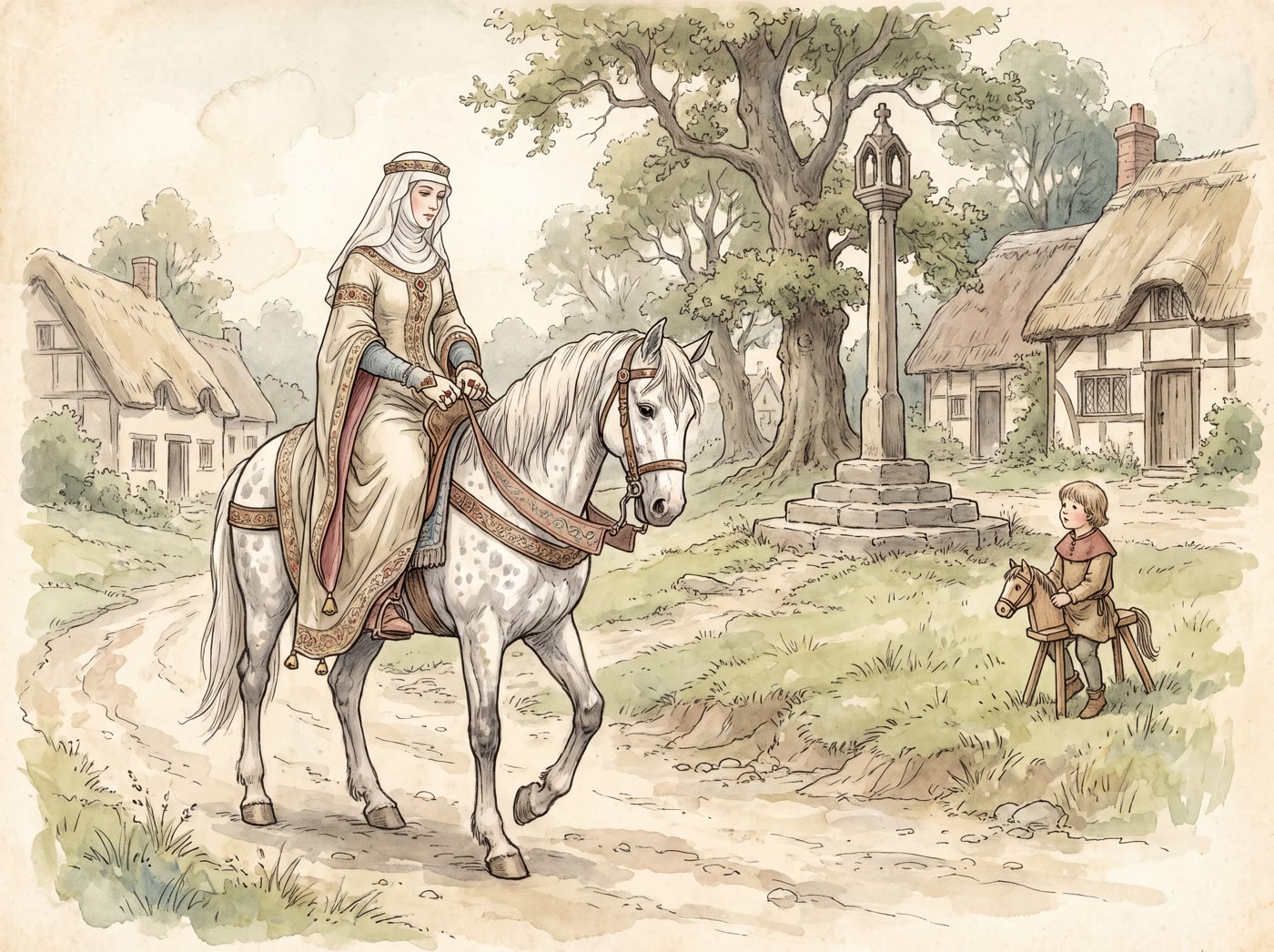
Ride a cock-horse to Banbury Cross,
To see a fine lady upon a white horse;
Rings on her fingers and bells on her toes,
And she shall have music wherever she goes.
Where the rhyme comes from
Several English rhymes begin with the line “Ride a cock-horse to Banbury Cross”, and the familiar one about the fine lady is the youngest of the family. The earliest printed relative appears in Tommy Thumb’s Pretty Song Book (about 1744), where the journey is a shopping trip: “To see what Tommy can buy; a penny white loaf, a penny white cake, and a two-penny apple-pie.” A passing reference in 1725 to “Now on Cock-horse does he ride” is the earliest hint that any such verse existed.
The oldest surviving version of the rhyme we sing today was printed in London in 1784, in Gammer Gurton’s Garland, or The Nursery Parnassus — though there the rider is not a fine lady at all but “an old woman”. The wording settled into its modern shape over the following decades, and by the nineteenth century it was firmly established, appearing in James Orchard Halliwell’s collections and, in 1901, in W. W. Denslow’s much-loved illustrations.
A “cock-horse” is not a breed. The word covered a child’s hobby horse — a horse’s head on a stick — a grown-up’s knee or foot used for bouncing a child, and also an extra horse hitched on to help a carriage up a steep hill. Banbury, in Oxfordshire, really did have stone crosses; the main one was pulled down by Puritans around 1600, and the cross standing in the town today was designed by John Gibbs and put up in 1859.
What does it mean?
At heart this is a bouncing rhyme, not a coded message — but the fine lady has attracted plenty of guesses, and none of them can be evidenced.
An ancient, medieval rhyme. It is often said that the “bells on her toes” must date the verse to the fifteenth century, when bells were worn on the long tapering points of fashionable shoes; the destruction of Banbury Cross around 1600 is then used to argue the rhyme is older still. The folklorists Iona and Peter Opie were unconvinced: the bells are missing from most of the early printed versions, other crosses stood in the town, and place names outlive the things they name. Treat the medieval dating as an appealing theory rather than a fact.
A famous rider. The lady has been identified at various times with Queen Elizabeth I, with Lady Godiva, and with the seventeenth-century traveller Celia Fiennes, whose family lived nearby and who rode the length of England on horseback. These are folklore, offered long after the fact and with no contemporary support. In 2005 Banbury put up a bronze statue near the cross showing the lady as a May Queen on a white horse — a charming answer to a question nobody can settle.
Sharing it with children
This is one of the great knee rhymes, and it was made for it — the Victorian prime minister William Gladstone is said to have jogged his children on his foot to it every day. Sit a child facing you on your knees and trot them steadily through the first two lines, then jingle their fingers on “rings on her fingers” and wiggle their toes on “bells on her toes”, finishing with a gallop on the last line.
Older children enjoy the words themselves: ask them what a cock-horse might be, then let them ride a broomstick horse across the room. A ribbon of little bells tied loosely to an ankle turns the whole rhyme into a music-making game, and it makes a lovely first conversation about how a rhyme can keep the name of a real town alive for hundreds of years.
Extra verses to sing
These verses aren’t traditional — they’re ours. Sing them if the ride should go on a little longer.
Ride a cock-horse down Banbury lane,
To see the fine lady come riding again;
Bells at her heel and a ring in her glove,
And a song for the market she’s ridden to love.
Ride a cock-horse till the daylight is done,
Home past the cross with the low western sun;
Hang up the bridle and hang up the bells,
And the fine lady sleeps where the quiet street dwells.