See Saw Margery Daw
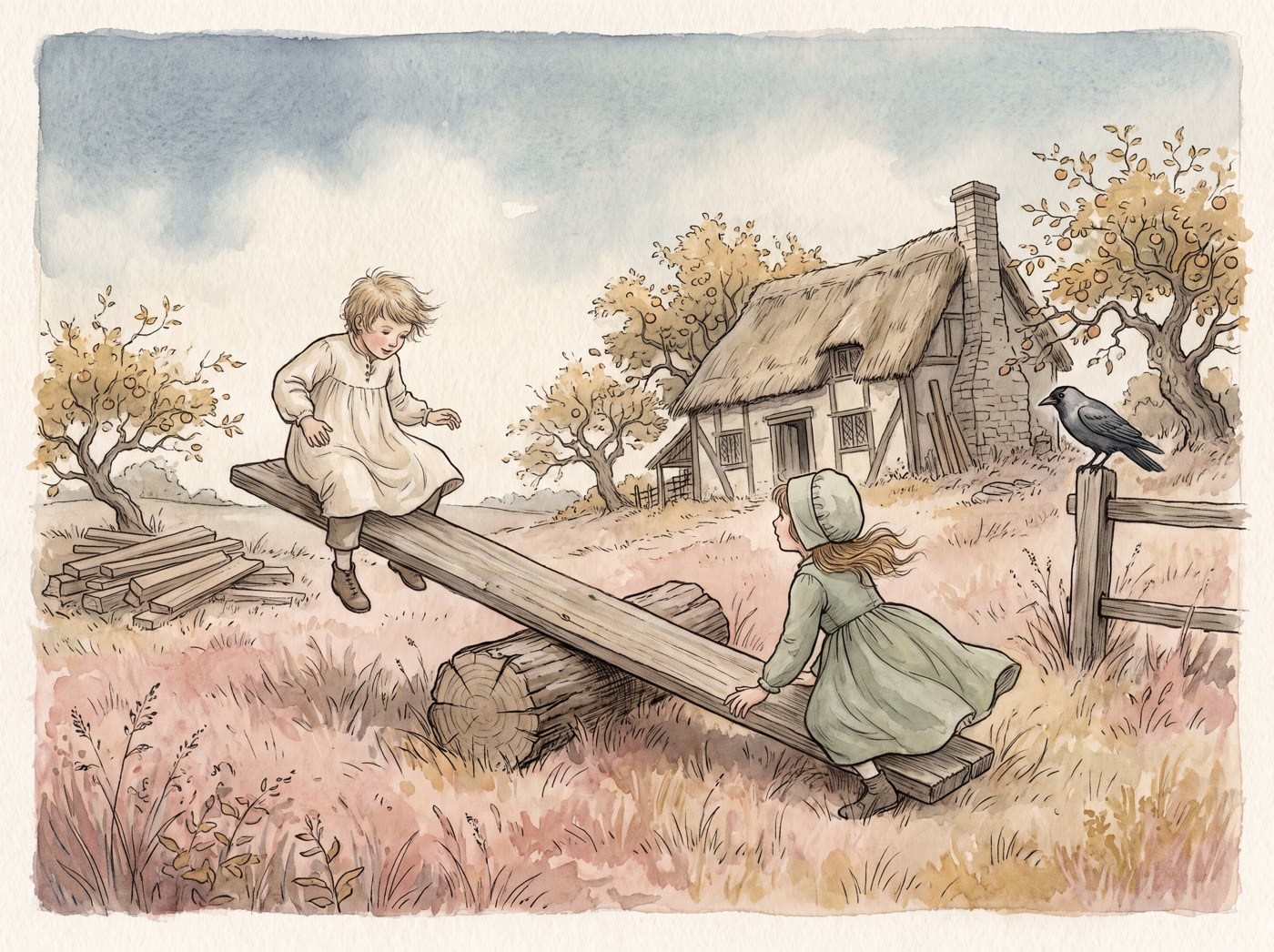
See saw, Margery Daw,
Johnny shall have a new master;
He shall earn but a penny a day,
Because he can’t work any faster.
Where the rhyme comes from
“See Saw Margery Daw” first appeared in print in something close to its modern form in Mother Goose’s Melody, published in London around 1765 by the house of John Newbery. The 18th-century wording ran “Jacky shall have a new master” — the boy’s name has drifted between Jacky, Jackie and Johnny in different households ever since. The rhyme carries the number 13028 in the Roud Folk Song Index, and the tune most people sing today was first written down by the composer and collector James William Elliott in his National Nursery Rhymes and Nursery Songs of 1870.
Like most nursery rhymes, it was almost certainly sung for a long time before anyone bothered to print it. James Orchard Halliwell reprinted the 1765 words in The Nursery Rhymes of England (1842) alongside rougher regional variants — one of which has Margery selling her bed and lying upon straw. The seesaw itself is among the oldest playthings there is: a plank and a log are all it takes, which may be why so many chanting, swinging rhymes attach themselves to it.
What does it mean?
Several explanations circulate. The plainest one is probably the truest:
A rhythm for rocking. The likeliest reading is that this is simply a see-saw chant — words shaped to the up-and-down of the plank, the way a skipping rhyme is shaped to the rope. “See saw” imitates the motion and the sound, and no one has ever identified a real Margery Daw; the name looks chosen purely because it rhymes.
The sawyers’ song. A popular theory holds that the words began as a work chant sung by sawyers to keep two men pulling a saw in time. It is plausible — and a see-saw-like phrase does turn up in Richard Brome’s play The Antipodes (1640) — but there is no direct evidence linking that trade chant to this nursery rhyme, so it should be treated as an attractive theory rather than established history.
Child labour and low pay. Many retellings say the rhyme protests the working conditions of poor children. The verse certainly reflects a world in which a boy was apprenticed to a master for a penny a day, and the dismissive reason given — that he cannot work faster — has a bleak comedy to it. But the rhyme predates the worst of the industrial revolution, and there is no sign it was ever intended as protest; it reads more as a wry snapshot of ordinary 18th-century life.
What is a “daw”? Iona and Peter Opie note that “daw” meant a lazy person — and in Scots, a slovenly or untidy woman. That is folklore about a word rather than proof of a person, but it does suggest “Margery Daw” was a stock name for an idler, in the same way “Jacky” was a stock name for any lad.
Sharing it with children
This is a lap rhyme before it is anything else. Sit facing a small child, hold both hands, and rock gently backwards and forwards in time with the words — you lean back on “See,” they lean back on “saw.” Babies who can sit up love the steady sway; toddlers love it faster, then very slow, then faster again. On a real seesaw, chant it to keep the rhythm even and the ride kind.
It is also a lovely first rhyme for talking about balance: try a ruler over a pencil with coins on each end, and let a child discover why the heavy side goes down. Older children enjoy hearing that a penny a day was a real wage once, and working out what a penny buys today.
Extra verses to sing
These verses aren’t traditional — they’re ours. Sing them when the plank is still going and the first verse has run out.
See saw, Margery Daw,
Johnny has finished his labour;
He shall earn tuppence tomorrow instead,
For helping the sheep of his neighbour.
See saw, Margery Daw,
Up to the clouds and back under;
Slowly for babies and fast for the brave,
And down with a bump like the thunder.