Rock-a-bye Baby
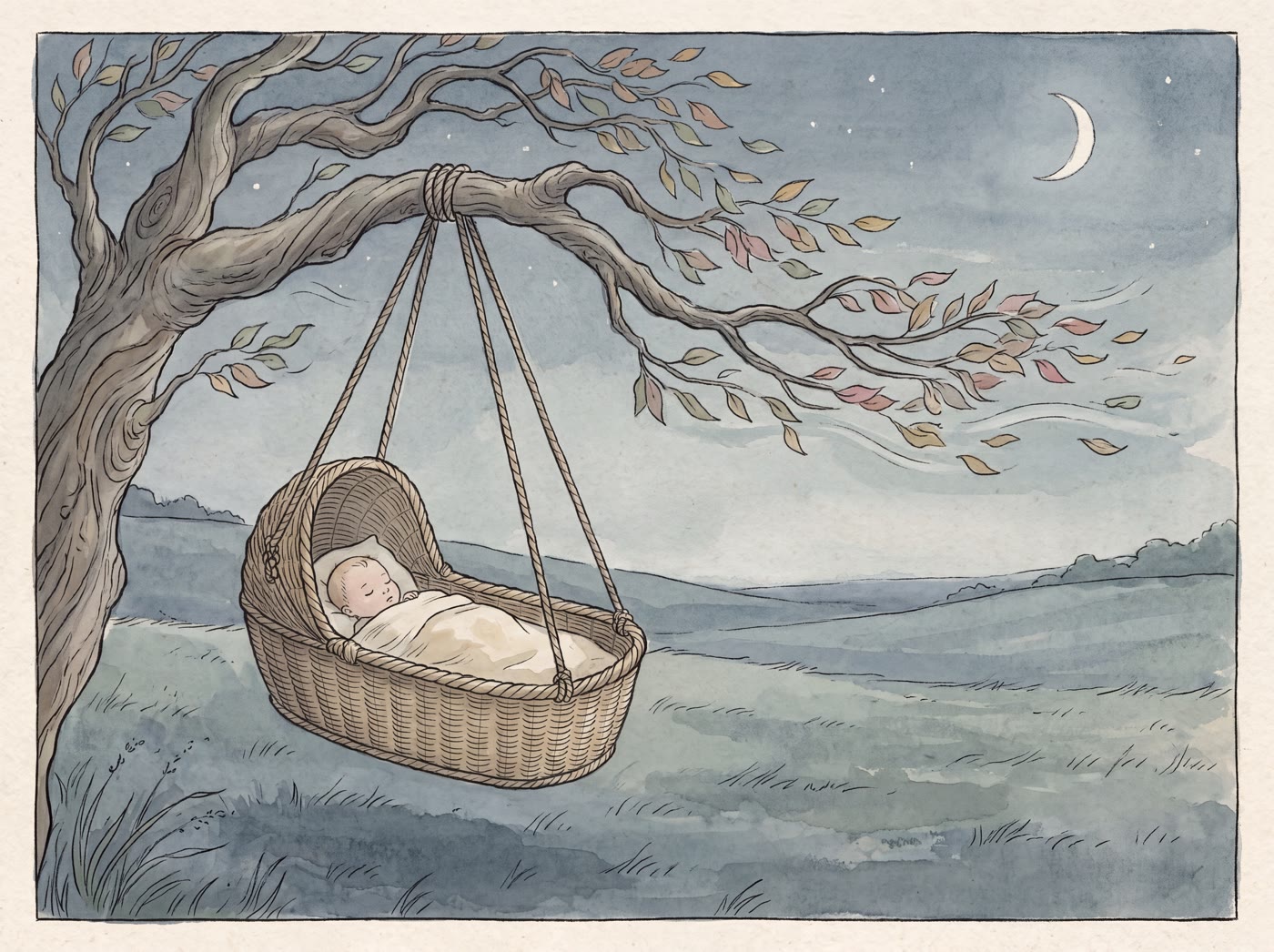
Rock-a-bye baby,
In the tree tops,
When the wind blows,
The cradle will rock,
When the bough breaks,
The cradle will fall,
And down will come baby,
Cradle and all.
Where the rhyme comes from
The words are believed to have first appeared in print in Mother Goose’s Melody, published in London around 1765 — a collection printed by John Newbery, who gathered existing rhymes rather than writing them himself. No copy of that first edition survives, but the rhyme was reprinted in Boston in 1785, and a surviving 1791 London edition begins “Hush-a-by baby” rather than “Rock-a-bye”. The familiar modern opening was fixed by Benjamin Tabart’s Songs for the Nursery in 1805.
The tune most people sing today is much younger than the words. It was composed by the American musician Effie I. Canning and published in 1886, more than a century after the verse first reached print. Notably, the editors of Mother Goose’s Melody added their own footnote to the rhyme: it should serve, they wrote, as “a warning to the proud and ambitious, who climb so high that they generally fall at last”.
What does it mean?
That 1765 footnote is the only near-contemporary comment we have, and it reads the rhyme simply as a moral about over-reaching. Every other explanation is later guesswork. Three are repeated often:
Cradles in the branches. One theory holds that the rhyme describes English women working in the hop fields or orchards, who tied their babies’ cradles to low branches so the wind would rock them while their hands were busy. It is plausible and homely, but no contemporary record connects the practice to the rhyme.
The Pilgrim boy and the birch-bark cradle. An old and widely repeated story — and the one given on this page for many years — claims the verse was written by a young boy who sailed to America with the Pilgrims, after he watched Native American mothers hanging birch-bark cradleboards from tree limbs. There is no written evidence for it whatsoever, and the tale appears to be a much later invention. It should be treated as folklore, not history.
The Glorious Revolution. Others read the rhyme politically: the “baby” is the infant son of James II, whose birth in 1688 raised the prospect of a Catholic dynasty, and the breaking bough is the fall of his house. This fits the moralising footnote rather neatly, but it too is a theory advanced long after the fact, with no supporting evidence from the time.
The honest answer is that nobody knows. What is certain is that it is a lullaby: the words are dark, but the rocking rhythm is what soothes a child, and the small shock of the ending has delighted listeners for two and a half centuries.
Sharing it with children
This is a lap rhyme made for gentle motion. Cradle a baby in your arms, or sit a toddler on your knees, and sway slowly and steadily from side to side through the first four lines — the rocking matters more than the tune. On “when the bough breaks” pause for a heartbeat, then let your knees dip for a small, safely caught “fall” on the last line. Toddlers will ask for it again and again, purely for that moment.
Older children enjoy acting it out with a doll in a basket, or hanging a toy cradle from a low branch or a chair back and blowing to make the wind. It is also a lovely first conversation about wind: go outside, watch real branches move, and sing the verse while they sway.
Extra verses to sing
These verses aren’t traditional — they’re ours. Sing them if the ending needs softening at bedtime.
Rock-a-bye baby,
The grass is deep,
Soft as a pillow
And made for sleep,
Down came the cradle,
But safe and slow,
Caught by the meadow
Waiting below.
Rock-a-bye baby,
The moon is high,
Sailing her boat
Through a quiet sky,
Mend up the bough
And tie the rope tight,
Back in the treetops
And safe for the night.