Wee Willie Winkie
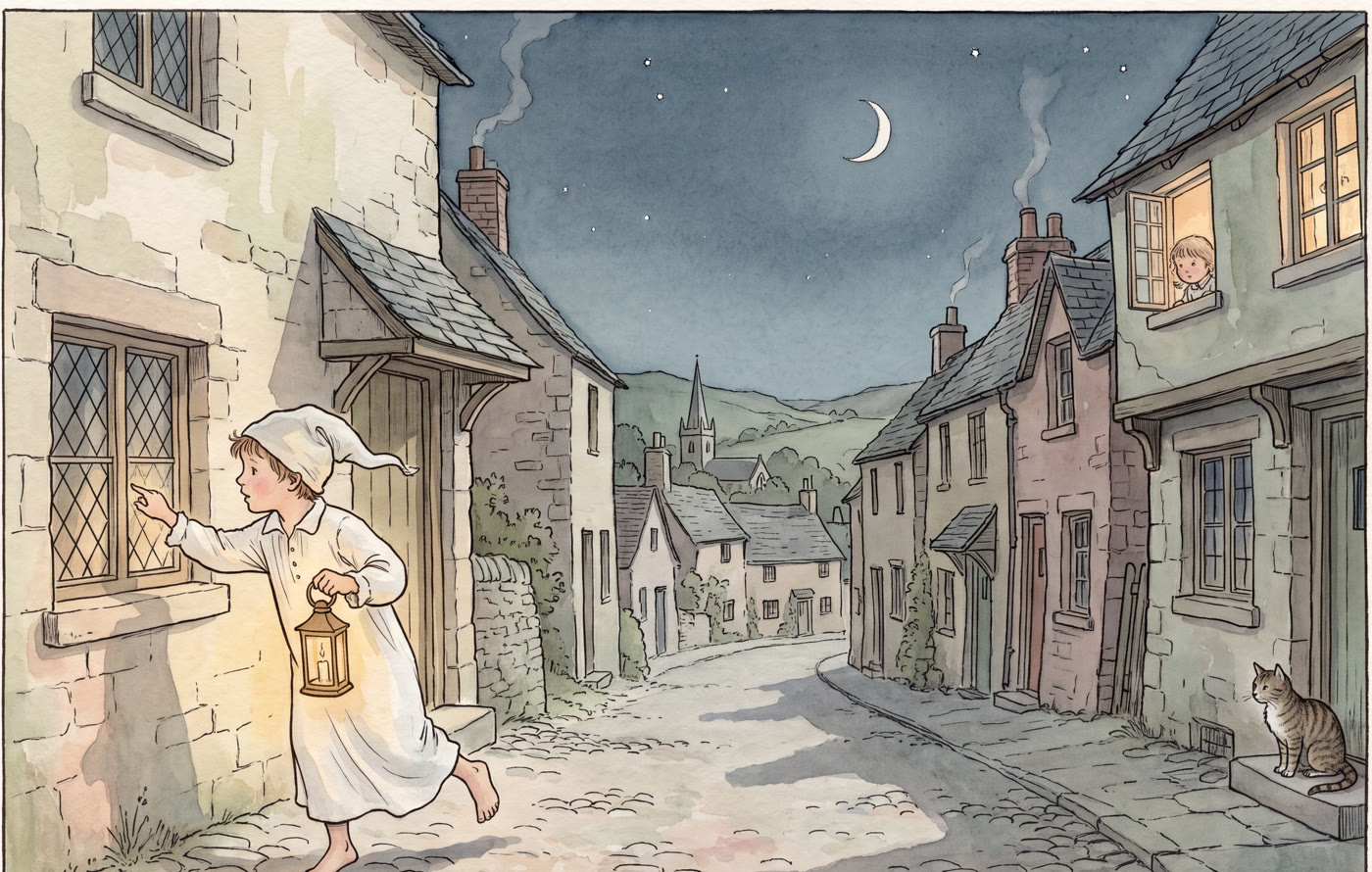
Wee Willie Winkie runs through the town,
Upstairs and downstairs in his nightgown,
Crying through the windows,
Rapping on the lock,
“Are all the children in their beds?
It’s past eight o’clock.”
Where the rhyme comes from
Wee Willie Winkie is Scottish, and unusually for a nursery rhyme we know who wrote it. The Glasgow poet William Miller (1810–1872) — a wood turner by trade, later nicknamed “the laureate of the nursery” — published a five-verse poem called “Willie Winkie” in the anthology Whistle-binkie: Stories for the Fireside in 1841. It was written in broad Scots: “Wee Willie Winkie rins through the toun, / Up stairs and doon stairs in his nicht-goun.”
Miller seems to have taken up a verse that was already in the air rather than inventing Willie from nothing — a single stanza beginning “little Willie Winkie” appears in the chapbook The Cries of Banbury and London of about 1820. What Miller did was expand it, and his version is the one that survived. An anglicised text appeared in 1844, and it is that smoothed-out English rendering — usually just the first stanza — that most children learn today. The hour drifts about between versions: Miller’s Willie calls ten o’clock, while many printed nursery collections, including the one this page preserves, settle on the more bedtime-friendly eight.
What does it mean?
On the surface the meaning is refreshingly plain. Willie Winkie is a personification of sleep: a small figure in a nightgown who patrols the streets at bedtime like a children’s town crier, tapping at windows and calling the hour to see whether the little ones are safely tucked up. In Miller’s longer poem the joke is warmer still — the later verses are all about one thoroughly awake child rattling a spoon in a jug and wriggling off his mother’s knee, and they end on a tired mother’s kiss rather than a scolding.
The King William theory. It is sometimes claimed that Willie Winkie is really King William III of England. The name was genuinely used of him in Jacobite songs of the period, such as “The Last Will and Testament of Willie Winkie,” so the nickname existed. But there is no evidence Miller intended political satire, and folklorists — including Iona and Peter Opie in The Oxford Dictionary of Nursery Rhymes — take the view that he was simply borrowing a familiar, pleasantly alliterative name for a bedtime character. Treat the royal reading as a coincidence of names rather than a hidden message.
A curfew memory. Others suggest Willie echoes the real night watchmen and town criers who once called the hours and sent people indoors. That is a plausible piece of background colour for why the image felt natural to Miller’s readers, but it is a theory about atmosphere, not a documented origin.
Sharing it with children
This is the ideal last rhyme of the day. Say it softly and let the pace fall away line by line, so the rhyme itself winds down towards sleep. For a lap version, walk two fingers up a child’s arm on “upstairs” and back down on “downstairs,” give a gentle tap-tap on the shoulder for “rapping on the lock,” then whisper the last two lines with a finger to your lips.
Older toddlers enjoy being Willie themselves: give them a torch for a lantern and let them do a bedtime round of the house, knocking on doors and checking that the teddies and dolls are all in bed before they get in themselves. It turns the bit children resist most into the part they are in charge of. The rhyme is also a lovely first way to talk about clocks — find eight o’clock on a real clock face together, and let Willie be the one who says it is time.
Extra verses to sing
These verses aren’t traditional — they’re ours. Sing them when one more round of the town is needed.
Wee Willie Winkie peers down every stair,
Counting the slippers and candles to spare,
Whispering to the kittens,
Nodding to the mouse,
“The moon is on the chimney pots
And quiet is the house.”
Wee Willie Winkie blows out his small light,
Folds up his nightcap and bids us goodnight,
Softly down the cobbles,
Home before the dawn,
“Sleep till the morning comes again”
— and Willie Winkie’s gone.