Girls and Boys Come Out to Play
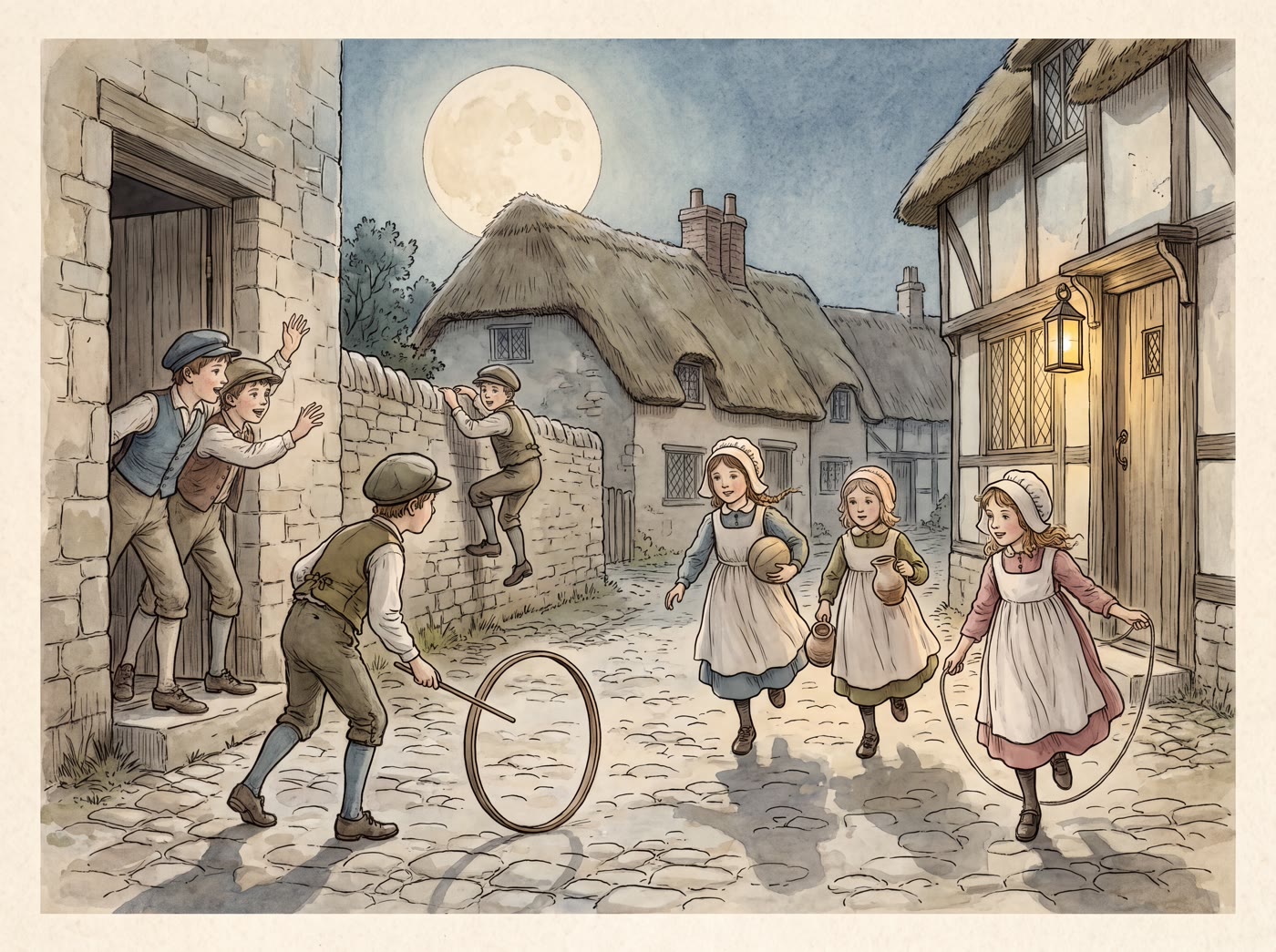
Girls and boys, come out to play,
The moon doth shine as bright as day;
Leave your supper, and leave your sleep,
And come with your playfellows into the street.
Come with a whoop, come with a call,
Come with a good will or not at all.
Up the ladder and down the wall,
A halfpenny roll will serve us all.
You find milk, and I’ll find flour,
And we’ll have a pudding in half an hour.
Where the rhyme comes from
This is one of the oldest English nursery rhymes still sung today. Its opening couplet was already in circulation by 1708, when it turns up in a dance book — and it reappears in further dance books of 1719 and 1728, in satires of 1709 and 1725, and in a political broadside of 1711. A tune that everyone recognised was clearly useful to writers who wanted a familiar refrain.
The rhyme then earned a place in Tommy Thumb’s Pretty Song Book, printed in London around 1744 and the earliest surviving collection of nursery rhymes in English. The longer text most of us know today — with the halfpenny roll and the pudding — closely follows the version collected by the folklorist James Orchard Halliwell in the mid-nineteenth century. Walter Crane illustrated it in The Baby’s Opera (c. 1877), and it is catalogued as Roud Folk Song Index number 5452. You will also meet it as “Boys and Girls Come Out to Play”; the two openings have swapped places back and forth for centuries.
What does it mean?
Unlike many old rhymes, this one carries no hidden royal scandal — and no persuasive candidate has ever been proposed. It reads as exactly what it appears to be: a summons to come outside and play.
A call to evening play. The most widely repeated explanation is that the verse belongs to a time when children worked through the daylight hours, so play was reserved for the end of the day — hence the moon shining “as bright as day” and the invitation to leave supper and sleep behind. This is a reasonable reading of the words, and it fits what we know of working childhoods in the seventeenth and eighteenth centuries, but it is an interpretation rather than a documented origin. The rhyme itself never says why the children are out so late.
A game-starting chant. Nineteenth-century collectors noted that the lines were chanted as a general call to gather players before a game began — much as children today still shout for friends at the start of playtime. That practical use may well be older than any printed copy of it.
Sharing what little there is. The closing lines are quietly touching: a halfpenny roll stretched between everyone, one child bringing milk and another flour so that all can have pudding. Whatever its origin, the rhyme ends on cooperation rather than mischief.
Sharing it with children
This one wants to be sung standing up. Cup your hands around your mouth for “come with a whoop, come with a call” and let children answer with a whoop of their own — it is often the first line they learn. Walk fingers up a child’s arm for “up the ladder” and run them back down for “down the wall,” or climb and tumble the whole child if you have the energy for it.
For a calmer bedtime version, sit by the window and look for the real moon while you sing. Older children enjoy the puzzle of the halfpenny roll: what could a halfpenny buy, and would it truly feed everybody? Stirring a pretend pudding together for the last two lines — one child bringing the milk, another the flour — turns the ending into a small game of sharing.
Extra verses to sing
These verses aren’t traditional — they’re ours. Sing them on for a longer moonlit game.
Girls and boys, the lanterns are lit,
The cobbles are cool and the stars are knit;
Bring out your hoop and bring out your ball,
There’s room in the moonlight for one and all.
When the clock in the steeple has counted to ten,
We’ll say our goodnights and be homeward again;
But leave the door open and leave the latch free,
For tomorrow the moon will come calling for me.