Ring a Ring o’ Roses
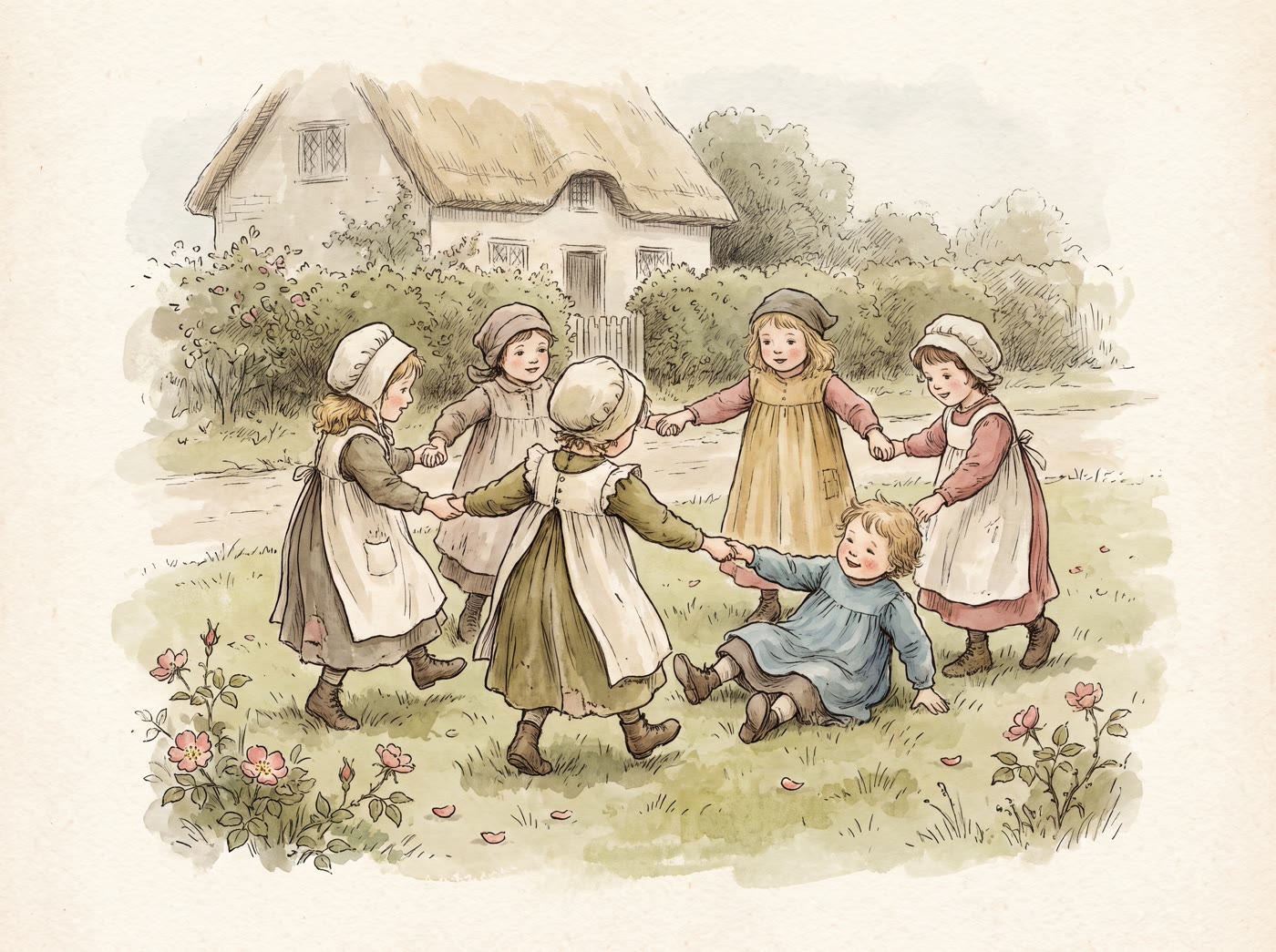
Ring-a-ring o’ roses,
A pocket full of posies,
A-tishoo! A-tishoo!
We all fall down.
Where the rhyme comes from
The first appearance of the complete rhyme in English is in Kate Greenaway’s Mother Goose; or, the Old Nursery Rhymes, published in London in 1881, where it is printed with a picture of children circling hand in hand. Greenaway’s text runs “Ring-a-ring-a-roses, / A pocket full of posies” — the familiar “a-tishoo” sneeze is one of many later variations rather than the original wording.
The game itself is older than the printing. Ring-dances of this kind were collected across Europe through the 19th century, and a very close German cousin, Ringel, Ringel, Reihen, was in print by 1796: children join hands, circle, and drop to the ground at the end. Similar versions survive in Swiss, Italian and American collections — the American folklorist William Wells Newell recorded several in the 1880s. What all of them share is the circle and the fall; almost nothing else stays the same from village to village.
What does it mean?
The plague theory. The story most people have heard is that the rhyme describes the Great Plague of 1665 or the Black Death: a rosy rash, posies of herbs carried as protection, sneezing as a symptom, and everybody falling down dead. It is a memorable explanation — but folklorists do not accept it, and it is worth saying plainly why. The interpretation cannot be traced back further than the middle of the 20th century; Iona and Peter Opie noted that it only began circulating in the 1950s. Writers who discussed the rhyme before the Second World War never mention plague at all. The rash, the posies and the sneeze appear in only a handful of the many recorded versions — American children sing “Ashes! Ashes!” and others “Hush! Hush!” — and bubonic plague does not in fact produce a ring-shaped rosy rash. Folklorists have a name for a modern story like this that attaches itself to an old piece of folklore: metafolklore, folklore about folklore.
The simpler explanation. The likeliest answer is that there is no hidden meaning to find. Ring games were enormously popular among children in the 18th and 19th centuries, and many Protestant communities frowned on dancing — so children sang and circled and called it a game instead. The roses and posies are just pretty things to sing about, and the fall at the end is the whole point: it is the bit that makes everybody laugh.
Sharing it with children
This one belongs on its feet rather than on a lap. Hold hands in a circle — three people is plenty — and shuffle round in time with the words, then sink to the floor together on “we all fall down.” Very small children usually cannot manage the circling and the singing at once, so sing it for them and let them concentrate on the fall.
Toddlers love an exaggerated “a-tishoo!”, and it is a genuinely useful moment for practising covering a sneeze. Try slowing the whole verse to a crawl and then racing it, or taking turns to choose whether everybody falls down like a feather or like a sack of potatoes. For a quieter version, sit in the circle and let only your hands do the dancing, with fingers walking round and flopping over at the end.
Extra verses to sing
These verses aren’t traditional — they’re ours. Sing them when one fall down isn’t enough.
Ring-a-ring o’ daisies,
A pocket full of maybes,
A-tishoo! A-tishoo!
We all jump up.
Ring-a-ring o’ clover,
The dance is nearly over,
A-tishoo! A-tishoo!
We all sit down.