London Bridge is Falling Down
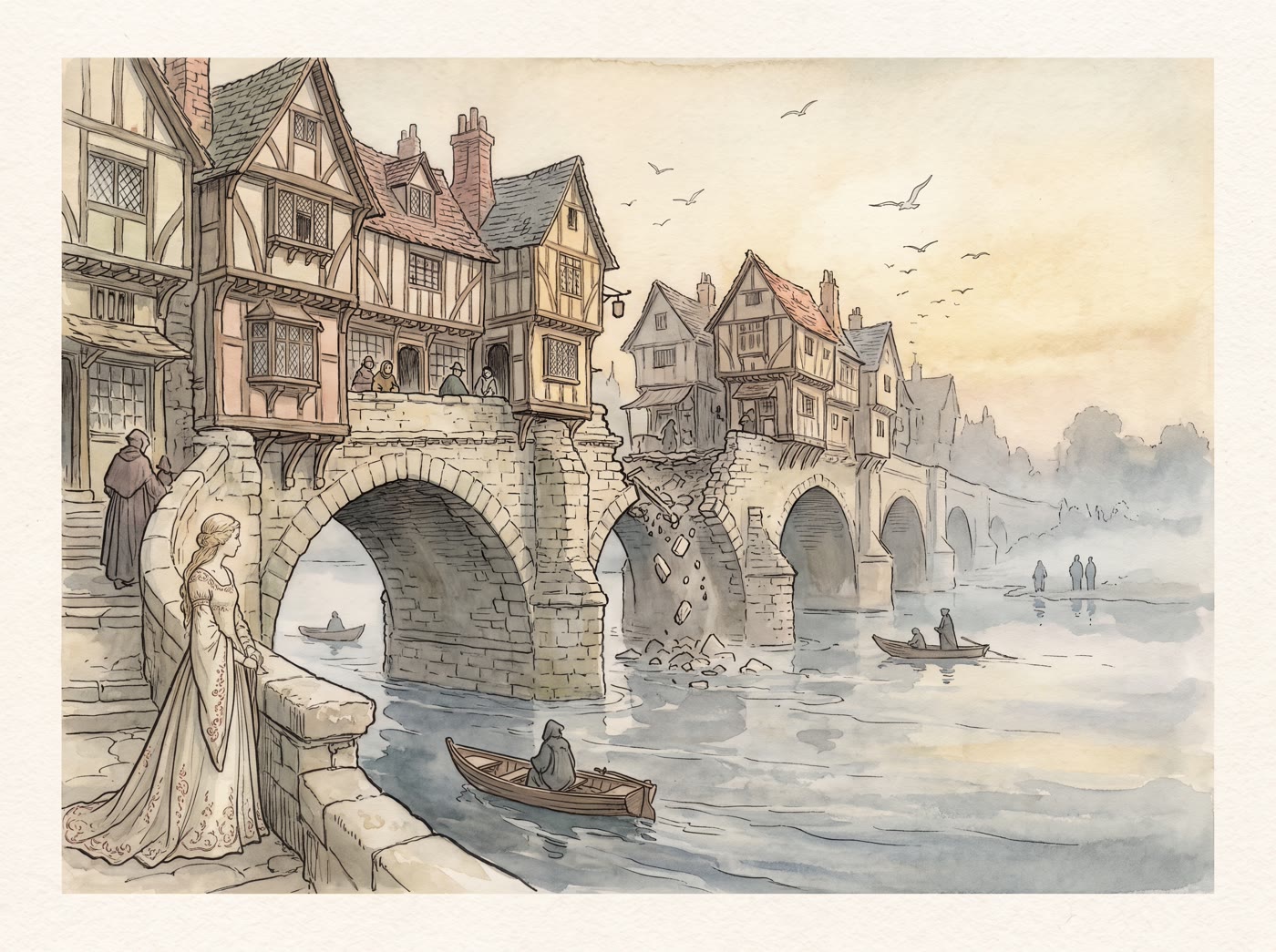
London Bridge is falling down,
Falling down, falling down,
London Bridge is falling down,
My fair Lady.
Build it up with wood and clay,
Wood and clay, wood and clay,
Build it up with wood and clay,
My fair Lady.
Wood and clay will wash away,
Wash away, wash away,
Wood and clay will wash away,
My fair Lady.
Build it up with bricks and mortar,
Bricks and mortar, bricks and mortar,
Build it up with bricks and mortar,
My fair Lady.
Bricks and mortar will not stay,
Will not stay, will not stay,
Bricks and mortar will not stay,
My fair Lady.
Build it up with iron and steel,
Iron and steel, iron and steel,
Build it up with iron and steel,
My fair Lady.
Iron and steel will bend and bow,
Bend and bow, bend and bow,
Iron and steel will bend and bow,
My fair Lady.
Build it up with silver and gold,
Silver and gold, silver and gold,
Build it up with silver and gold,
My fair Lady.
Silver and gold will be stolen away,
Stolen away, stolen away,
Silver and gold will be stolen away,
My fair Lady.
Set a man to watch all night,
Watch all night, watch all night,
Set a man to watch all night,
My fair Lady.
Suppose the man should fall asleep,
Fall asleep, fall asleep,
Suppose the man should fall asleep?
My fair Lady.
Give him a pipe to smoke all night,
Smoke all night, smoke all night,
Give him a pipe to smoke all night,
My fair Lady.
Where the rhyme comes from
The earliest printed English words appear in Tommy Thumb’s Pretty Song Book, published in London around 1744 — the oldest surviving collection of English nursery rhymes. The version there is shorter and stranger than ours: “London Bridge is broken down, Dance over my Lady Lee; London Bridge is broken down, With a gay Lady.” The familiar “my fair Lady” refrain and the long chain of building materials came later, as generations of children added verses.
The rhyme is probably older than its first printing. A possible glance at it appears in the 1657 comedy The London Chaunticleres, and Henry Carey mocks it in his satirical poem Namby Pamby (1725). A tune called “London Bridge” was noted in an edition of John Playford’s The Dancing Master in 1718, though with no words and a different melody. The tune everyone sings today was not recorded until 1879, in the United States. The rhyme carries Roud Folk Song Index number 502.
The real bridge gives the song plenty to work with. A wooden crossing stood on the site for centuries; the great stone bridge begun in 1176 was finished around 1209, and grew to carry more than a hundred shops and houses on its back — a crushing weight that kept its arches in constant need of repair. That bridge was finally replaced in the 1820s, and its Victorian successor was famously sold and shipped to Lake Havasu City, Arizona, in 1968.
What does it mean?
Several explanations circulate. Only one of them is really supported by the evidence:
Simple structural trouble. The plainest reading is also the likeliest. Old London Bridge sagged, burned, iced up and crumbled with such regularity that its repairs were a national joke. A song about a bridge that keeps falling down, rebuilt in ever grander and ever more useless materials, needs no hidden history at all.
The Viking attack of 1014. A much-repeated story says the rhyme remembers the Norse assault in which Olaf of Norway, fighting for the exiled King Æthelred, is said to have pulled the bridge down to split the Danish forces. The tale comes from the Old Norse Heimskringla, written some two centuries after the event, and many historians doubt it happened at all. Treat the link to the rhyme as folklore, not fact.
Human sacrifice. The darkest theory, popular with Victorian folklorists such as Alice Bertha Gomme, holds that the “watchman” recalls an ancient custom of burying a person in a bridge’s foundations to keep it standing. No body has ever been found in London Bridge, and Iona and Peter Opie dismissed the idea; it remains a theory with no evidence behind it.
Who is the fair lady? Candidates offered over the years include Matilda of Scotland, who built bridges in the early 1100s; Eleanor of Provence, who held the bridge revenues in the 13th century; and a member of the Leigh family of Stoneleigh Park, chosen to explain the older “Lady Lee” line. None can be proved, and she may simply be the partner in the singing game.
Sharing it with children
This is a rhyme built for playing. Two grown-ups (or two taller children) join hands and raise them into an arch; everyone else files underneath in a line while the song is sung. On “my fair Lady” the arch comes down and gently catches whoever is passing through — a moment of delighted shrieking that never gets old. With a baby on your lap, simply make the arch with your own arms and lower them softly for the catch.
The building verses are a gift for older children. Lay out wooden blocks, damp sand, coins and paper, and test each material in turn: which really would wash away, bend, or be stolen? Let them invent a new verse for a material of their own — jelly and custard is a perennial favourite — and you have a singing game, a science lesson and a giggling fit in one.
Extra verses to sing
These verses aren’t traditional — they’re ours. Sing them when the builders need one more idea.
Build it up with rope and string,
Rope and string, rope and string,
Build it up with rope and string,
My fair Lady.
Build it up with stone and song,
Stone and song, stone and song,
Stone will hold and song lasts long,
My fair Lady.