Pop Goes the Weasel
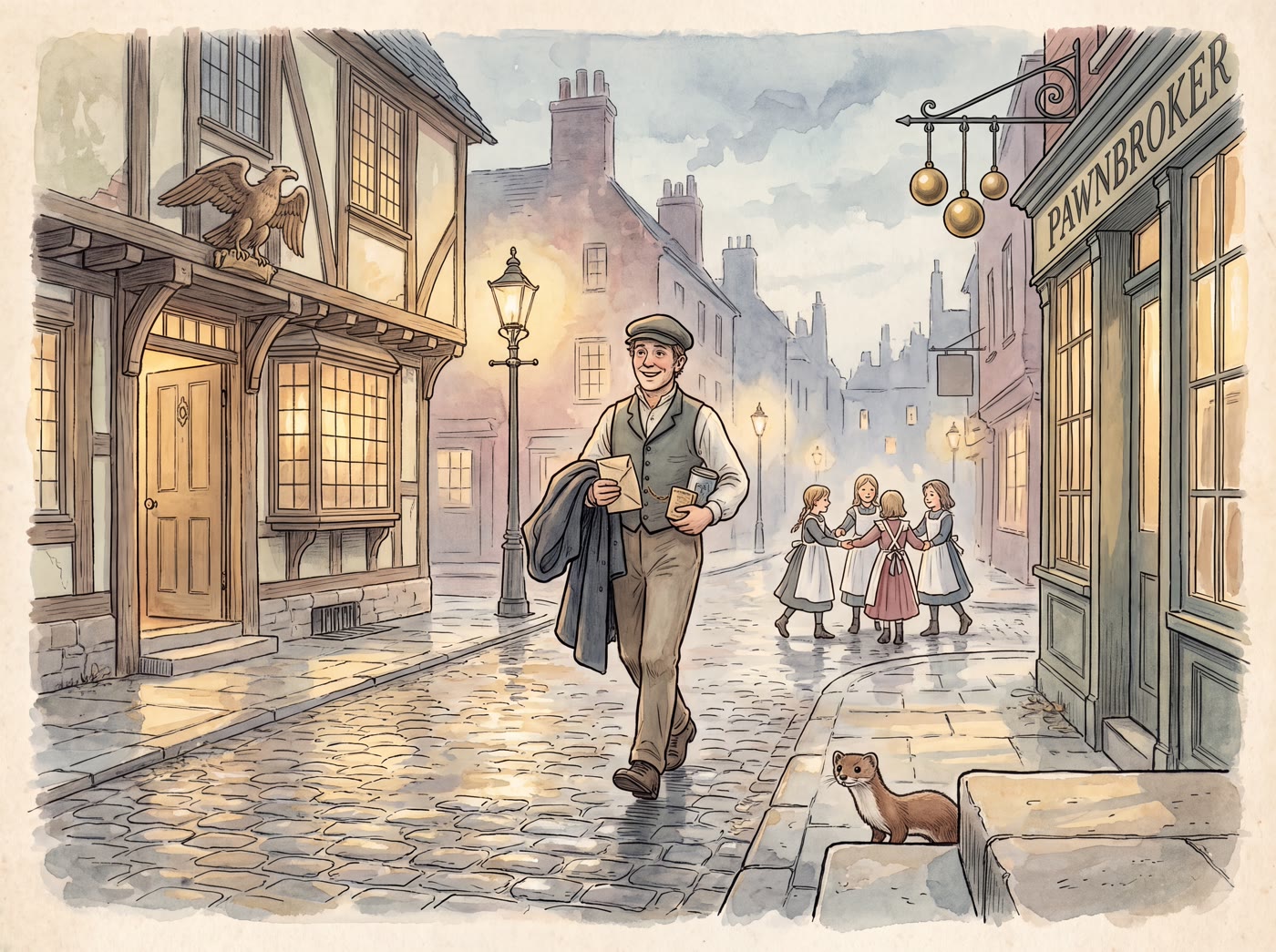
Half a pound of tuppenny rice,
Half a pound of treacle,
That’s the way the money goes,
Pop! goes the weasel.
Up and down the City Road,
In and out the Eagle,
That’s the way the money goes,
Pop! goes the weasel.
Where the rhyme comes from
Pop Goes the Weasel burst into print in the early 1850s, not as a nursery rhyme at all but as a dance craze. Sheet music published in London in 1853 advertised it as “an old English dance”, complete with figures and instructions, and it was performed at fashionable venues before sweeping through the music halls. Within a season or two the tune had crossed the Atlantic, where American publishers were printing their own arrangements — one Baltimore edition offered it “for fun and frolic”.
The words we sing in Britain are firmly rooted in working-class Victorian London. Tuppenny rice and treacle were the cheapest of store-cupboard staples; the City Road is a real thoroughfare in north London; and the Eagle was a real tavern and music hall standing on it. A pub of that name still trades on the corner today, with the lines of the rhyme carved on its wall. The tune itself may be older than the words — it is thought to have circulated as a country dance before anyone attached these particular verses to it — and the rhyme is catalogued in the Roud Folk Song Index as number 5249.
What does it mean?
Iona and Peter Opie, the great scholars of children’s rhymes, made the honest observation that even at the height of the 1850s craze nobody seemed able to say what “pop goes the weasel” actually meant. It may always have been agreeable nonsense — a catchphrase that sounded good shouted on the beat. Several explanations are nevertheless offered, and they are theories rather than documented fact:
Pawning the coat. The best-known reading takes “pop” as Victorian slang for pawning — which it genuinely was — and “weasel” as Cockney rhyming slang, from “weasel and stoat” meaning coat. A man who has spent his wages on rice, treacle and beer at the Eagle must pop his coat on Monday to get through the week. It fits the verses beautifully; the difficulty is that the rhyming-slang link is not recorded early enough to prove it, so it remains a very plausible theory.
The spinner’s weasel. Another suggestion is that the weasel was a real tool: a yarn-measuring frame whose wooden gears gave an audible pop when a full skein had been wound. Weavers’ work was long and dull, the mind wandered, and then — pop. It is a charming idea, and the London Museum notes it alongside the pawnshop story, but there is no contemporary evidence tying the tool to the song.
A warning about the Eagle. The second verse is often read as gentle moralising about drink swallowing a family’s wages. That reading is reasonable, though the song was first of all a dance tune, and its tone is far more cheerful than preachy.
Sharing it with children
This is the great surprise rhyme, and small children adore it. Sit a baby on your lap and bounce steadily through the first three lines, then lift them up with a big “Pop!” on the last. They will learn the timing astonishingly quickly and start anticipating the lift, which is exactly the fun of it. Toddlers can crouch down small through the verse and spring up on the pop.
Older children can play the traditional ring game: everyone dances in a circle singing, and on “Pop!” each child dashes to sit down — with one place fewer than there are players. It is also the tune inside almost every jack-in-the-box, so winding one slowly while singing makes the connection delightfully clear.
Extra verses to sing
These verses aren’t traditional — they’re ours. Sing them when two verses simply aren’t enough.
Half a pound of currant buns,
A farthing for the kettle,
That’s the way the money goes,
Pop! goes the weasel.
Round the lamp and down the lane,
Home before the steeple,
That’s the way the evening goes,
Pop! goes the weasel.