Sing a Song of Sixpence
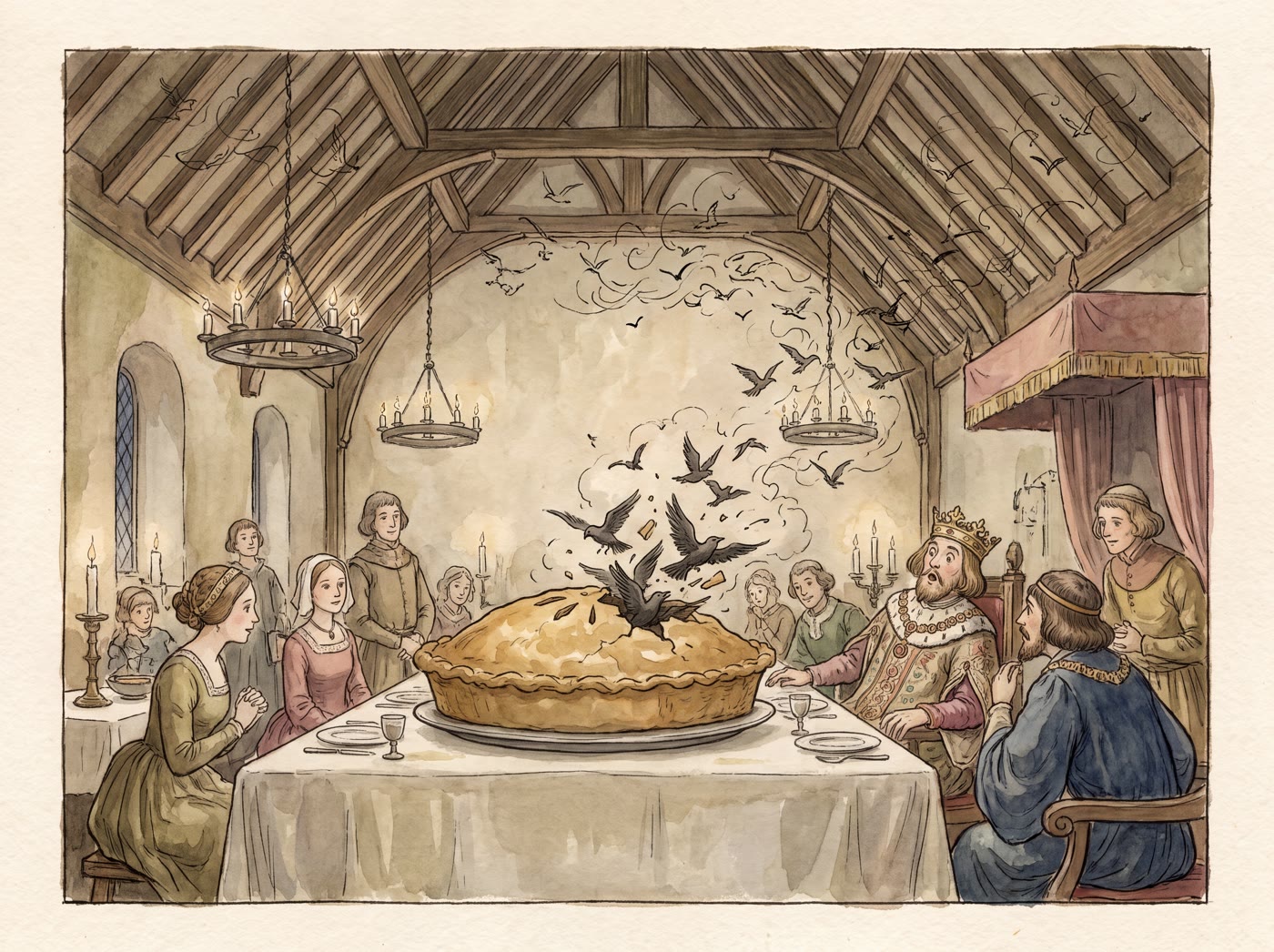
Sing a song of sixpence,
A pocket full of rye.
Four and twenty blackbirds,
Baked in a pie.
When the pie was opened,
The birds began to sing,
Wasn’t that a dainty dish,
To set before the king?
The king was in his counting house,
Counting out his money,
The queen was in the parlour,
Eating bread and honey.
The maid was in the garden,
Hanging out the clothes,
When down came a blackbird
And pecked off her nose.
Where the rhyme comes from
The first verse appeared in print in Tommy Thumb’s Pretty Song Book, published in London around 1744 — but in a startling form. That earliest text has “four and twenty naughty boys” baked in the pie rather than blackbirds. The birds arrive in a version printed around 1780, and something close to the four verses we sing today first survives in Gammer Gurton’s Garland, or The Nursery Parnassus (1784), where it is a magpie, not a blackbird, that attacks the unfortunate maid.
The words were plainly floating about long before that. Shakespeare’s Twelfth Night has Sir Toby Belch call for a tune with “Come on; there is sixpence for you: let’s have a song,” and Beaumont and Fletcher’s Bonduca (1614) contains the line “Whoa, here’s a stir now! Sing a song o’ sixpence!” Sixpence, it seems, was the going rate for a song. Gentler fifth verses that mend the maid’s nose only began to be tacked on in the middle of the 19th century, and Randolph Caldecott’s illustrated Sing a Song for Sixpence (1880) fixed the king, the queen and the pie in the public imagination.
What does it mean?
The least fanciful explanation is also the most likely: the rhyme is a joke about a real piece of showing-off at table. Late-medieval and Tudor cooks did serve “subtleties” — spectacle dishes — and live birds were genuinely hidden under a pre-baked crust so that they would burst out when it was cut. A 16th-century Italian cookery book gives instructions for exactly that. The blackbirds, in other words, may need no decoding at all.
Grander readings are often repeated, and all of them are theory rather than record:
Henry VIII and the monasteries. A popular claim casts the king as Henry VIII, the queen as Catherine of Aragon, the maid as Anne Boleyn, and the blackbirds as black-robed monks — or as the deeds to monastic estates — swept up in the Dissolution of the Monasteries. The blackbird pecking off the maid’s nose is then read as Anne’s execution. There is no contemporary evidence for any of it, and the reading only works if we ignore the fact that the earliest printed version has naughty boys in the pie and no queen or maid at all.
A picture of the day. Iona and Peter Opie record an older folkloric reading in which the king is the sun, the queen the moon, and the four and twenty blackbirds the hours of the day. It is pretty, and equally unevidenced.
Blackbeard’s recruiting code. The internet favourite — that pirates used the rhyme to enlist crew — is not folklore at all but a hoax, invented for an April Fools feature in the 1990s and repeated ever since as fact.
Sharing it with children
This is a rhyme built for hands. Cup your palms over a child’s head or over a cushion to make the pie, then fling them open on “the birds began to sing” and flutter your fingers upward. The last line is the traditional pay-off: a very gentle tweak of the child’s nose on “pecked off her nose,” which reliably produces shrieks and demands to start again.
Older children enjoy the four characters — king, queen, maid, blackbird — as parts to act out, one line each. It is also a quiet chance to count: four and twenty is twenty-four, and counting out the king’s money with a pile of coppers turns the second verse into a maths game. An upturned pie dish with paper birds tucked underneath makes a five-minute craft with a very good ending.
Extra verses to sing
These verses aren’t traditional — they’re ours. Sing them if the maid deserves a kinder ending.
The maid ran to the kitchen,
As fast as she could go,
The cook came out with honey
And stuck it back on so.
The blackbird said he’d sorry,
He only meant to play,
And brought her back a daisy
To wear on washing day.
The king came from his counting,
The queen came from her tea,
They set the birds a table
Beneath the apple tree.
And now on summer evenings,
When all the work is done,
The blackbirds sing for sixpence
And never charge a one.