Three Blind Mice
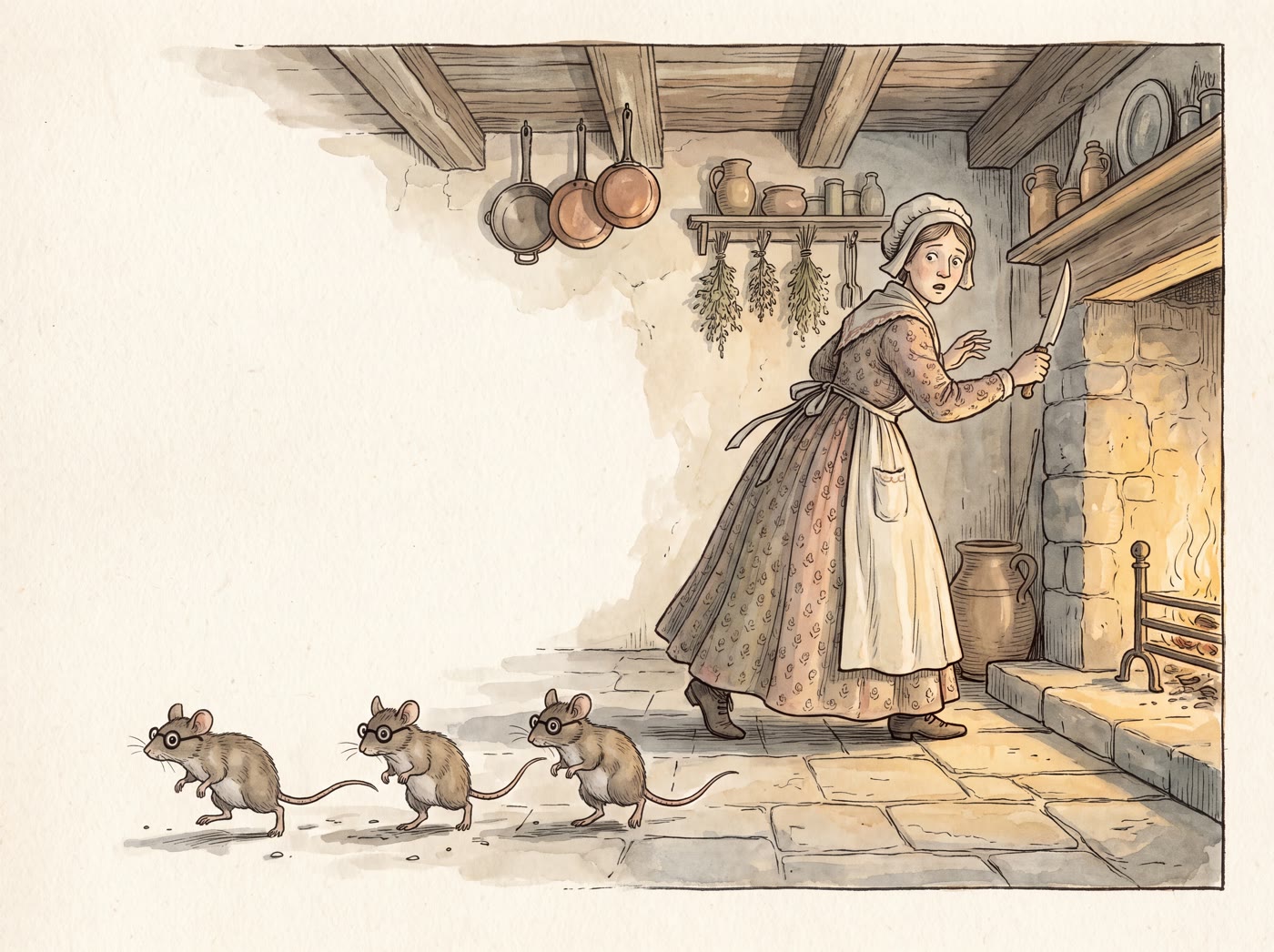
Three blind mice. Three blind mice.
See how they run. See how they run.
They all ran after the farmer’s wife,
Who cut off their tails with a carving knife,
Did you ever see such a thing in your life,
As three blind mice?
Where the rhyme comes from
Three Blind Mice is one of the oldest English rhymes still sung, and one of the very few that arrived in print with its tune attached. A version appeared in Deuteromelia, or The Seconde part of Musicks melodie in 1609, a collection of rounds and catches edited by the young composer Thomas Ravenscroft, who may have written it himself. It was set as a round for three voices in a minor key — a song for grown men in taverns rather than for the nursery.
The 1609 words are strikingly different from ours: “Three Blinde Mice, three Blinde Mice, Dame Iulian, Dame Iulian, the Miller and his merry olde Wife, she scrapte her tripe licke thou the knife.” There is no farmer’s wife, and no tail is cut off. The familiar words we sing today — the running, the carving knife, the tails — belong to the 19th century, and were fixed in the nursery canon by collectors such as James Orchard Halliwell, whose The Nursery Rhymes of England (1842) carried the rhyme to a wide Victorian readership.
In 1904 John W. Ivimey published The Complete Version of Ye Three Blind Mice, a picture book that invented a whole backstory for the mice — they are blinded by a bramble bush before ever reaching the kitchen. That story is Edwardian storytelling, not tradition, but many people remember it as though it were part of the original.
What does it mean?
The rhyme most likely means nothing at all beyond its own nonsense. As a round, its job was to be catchy, singable in overlapping parts, and a little bit gruesome — qualities that carried it happily through four centuries. But one theory is repeated so often that it deserves an honest look.
Bloody Mary and the Oxford Martyrs. The popular story holds that the farmer’s wife is Mary I, who restored Catholicism to England, and that the three blind mice are the Protestant bishops Hugh Latimer, Nicholas Ridley and Archbishop Thomas Cranmer, “blind” to the true faith and punished for it. It is a neat story, but the evidence is against it. The martyrs were burned at the stake in 1555 and 1556 — they were not blinded, and nothing was cut off. The earliest known version of the rhyme was printed in 1609, more than fifty years later, and that version mentions neither blindness as a theme nor any harm done to the mice. No contemporary document links the two. Historians treat the Mary I reading as folklore attached to the rhyme long afterwards, not as its origin.
Who was Dame Julian? The 1609 “Dame Iulian” has tempted some readers towards Julian of Norwich, though her writings were not published until 1670. A more plausible candidate is Dame Juliana Berners, the supposed author of popular hunting and hawking texts well known in Ravenscroft’s day. Both suggestions remain guesswork.
Sharing it with children
Three Blind Mice is made for fingers. Hold up three fingers for the mice and walk them along a child’s arm on “see how they run”, running a little faster each time until the mice scamper up to a tickle at the neck. Sit a child on your lap and bounce steadily through the long middle lines — they are a lovely, rolling mouthful for a growing mouth to practise.
Because it began life as a round, it is also one of the easiest first part-songs a family can try. Start one singer, bring in a second at “see how they run”, and a third a line later; even wobbly attempts sound magical. If the carving knife troubles a tender listener, many families simply sing our gentler extra verses below, or swap the line for the mice running home to their mother instead.
Extra verses to sing
These verses aren’t traditional — they’re ours. Sing them when the mice deserve a kinder ending.
Three brave mice. Three brave mice.
See how they hide. See how they hide.
They crept away to the barn next door,
Where the straw is warm and there’s corn on the floor,
And nobody scolds them for wanting more,
Those three brave mice.
Three proud mice. Three proud mice.
See how they sing. See how they sing.
Their mother has sewn them three tails of wool,
One grey, one gold and one beautiful,
And now every mouse in the field looks full
Of envy tonight.