Ding Dong Bell
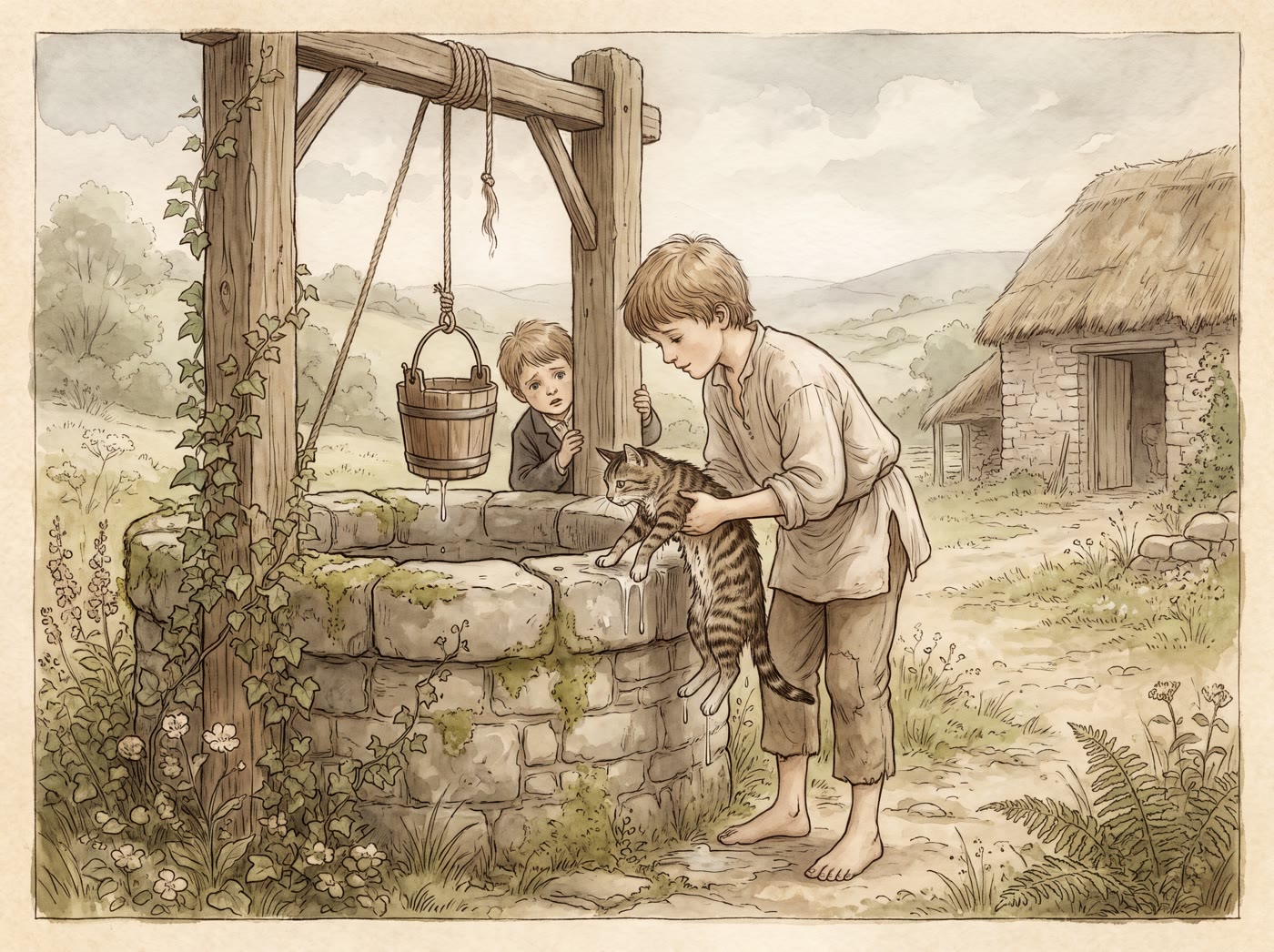
Ding, dong, bell,
Pussy’s in the well.
Who put her in?
Little Johnny Flynn.
Who pulled her out?
Little Tommy Stout.
What a naughty boy was that,
To try to drown poor pussy cat,
Who ne’er did him any harm,
But killed all the mice in the farmer’s barn.
Where the rhyme comes from
Ding Dong Bell is one of the oldest rhymes we still sing. The earliest known record of it dates from 1580, in a manuscript kept by John Lant — sometimes given as Lange — organist of Winchester Cathedral, who noted down the lines: “Jacke boy, ho boy newes, the cat is in the well, let us ring now for her knell, ding dong ding dong bell.” It was printed in Thomas Ravenscroft’s Pammelia, Musicks Miscellanie in 1609, arranged as a round for four voices, and William Stonard (1585–1630) set a similar text as a four-part round too.
In that Tudor form the cat does not survive: the bell is her funeral knell. The kinder ending we know today came later. Printed collections of the 18th and 19th centuries gradually reshaped the verse, and it is in James Orchard Halliwell’s Nursery Rhymes of England that the rescue appears — there the cat is hauled out by a “dog with long snout.” The naughty boy has gone under many names across the versions, including Tommy O’ Linne (1797), Tommy Quin (about 1840), Johnny Green and, as in our version above, Johnny Flynn; the rescuer is almost always Little Tommy Stout. Iona and Peter Opie, in the Oxford Dictionary of Nursery Rhymes, suggested the culprit’s name may trace back to Tom o’ Lin, the hero of another old rhyme.
The phrase “ding dong bell” itself was familiar enough in Shakespeare’s day to turn up in his songs — in The Tempest (“Sea nymphs hourly ring his knell: ding-dong, bell”) and in The Merchant of Venice.
What does it mean?
Unlike some nursery rhymes, Ding Dong Bell carries no widely accepted hidden history. There is no evidence of a political or satirical message behind it, and historians generally read it as exactly what it looks like: a village incident set to a bell-like refrain, the sort of small scandal that becomes a singing game.
A moral lesson. The version we sing today is often described as a lesson in kindness to animals, and that reading is fair — but it describes the rhyme’s later life rather than its origin. The moralising lines about the poor cat who “ne’er did him any harm” were added by Victorian editors uncomfortable with the older, bleaker song.
A funeral bell. The oldest text frames the whole thing as a mock knell, ringing the cat to her grave — a piece of dark village humour rather than a lament. Some writers connect this to the practical value of a barn cat, whose loss really would be felt on a farm; the closing couplet about the mice supports that reading, though it is a much later addition.
Well folklore. A theory occasionally repeated links the rhyme to old customs of casting animals into wells for luck or to test the water. This is folklore rather than documented history, and nothing in the early sources supports it.
Sharing it with children
This is a lovely lap rhyme because it is built out of questions and answers. Sit a child on your knees and swing them gently side to side on “Ding, dong, bell” like a swinging bell rope. Then take turns: you ask “Who put her in?” and let the child shout the answer. Older toddlers enjoy wagging a finger for “What a naughty boy was that” and giving a big cuddle to a toy cat at the end.
It is a fine first rhyme for talking about kindness to animals, and about looking after each other — and because the older version has a sadder ending, it is also a gentle way to show an older child that stories can be retold better. Try singing it as a round, the way Ravenscroft printed it in 1609, with one grown-up starting a line behind the other.
Extra verses to sing
These verses aren’t traditional — they’re ours. Sing them if the cat deserves a warm ending.
Ding, dong, bell,
Pussy’s out and well.
Who dried her fur?
Little Sally Burr.
Who brought the cream?
The girl beside the stream.
What a kindly pair were they,
To warm a wet cat through the day.
Ding, dong, bell,
Now there’s a tale to tell.
Johnny said sorry, and mended the wall,
And Tommy tied ropes round the bucket and all.
And Pussy sits high on the hay in the barn,
Where mice may be caught, but no cat comes to harm.