Pussy Cat, Pussy Cat
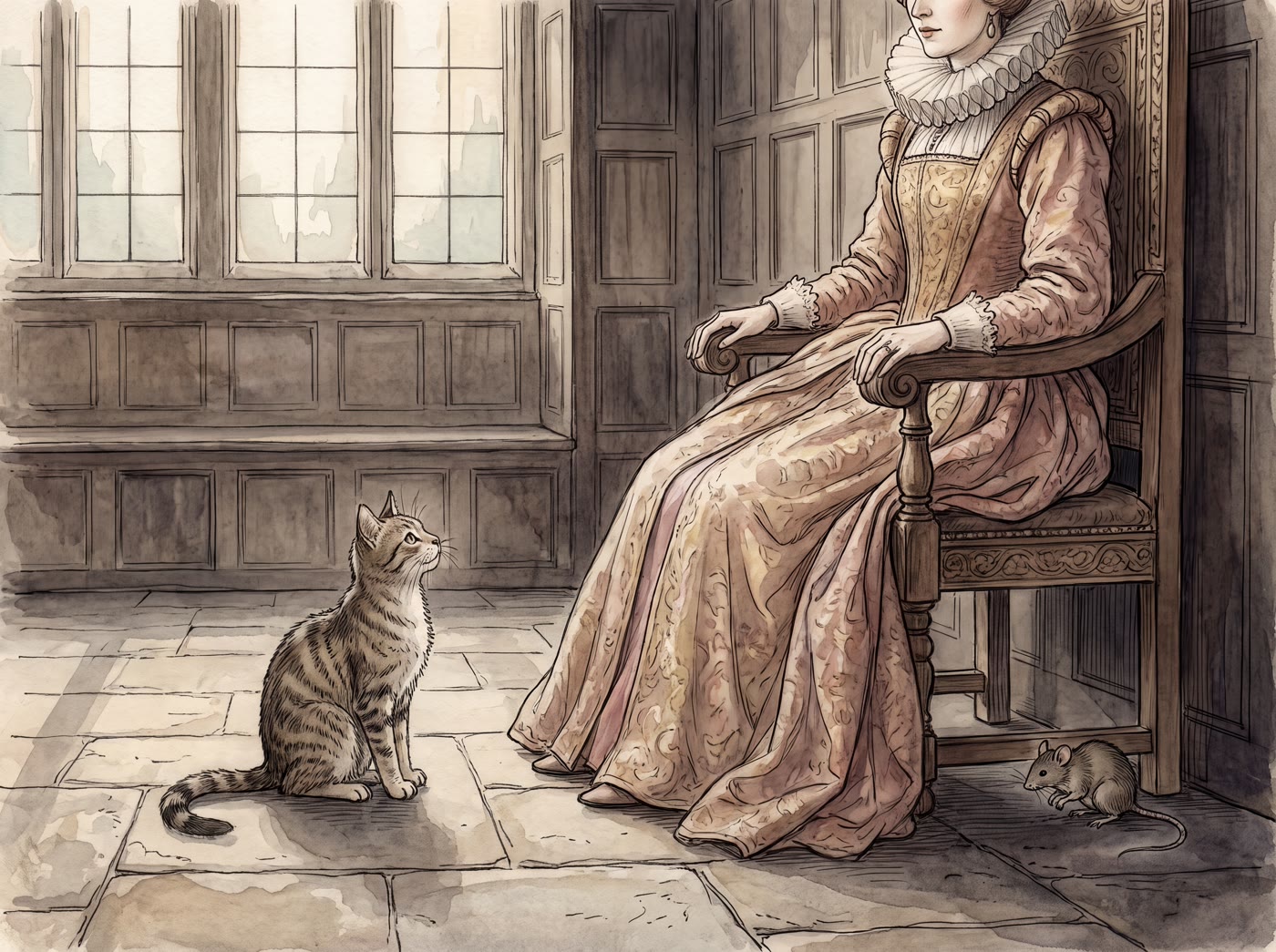
Pussy cat, pussy cat, where have you been?
I’ve been to London to look at the Queen.
Pussy cat, pussy cat, what did you do there?
I frightened a little mouse, under the chair.
Where the rhyme comes from
The earliest printing of Pussy Cat, Pussy Cat recorded by Peter and Iona Opie, in their Oxford Dictionary of Nursery Rhymes, is in Songs for the Nursery, published in London in 1805. Nothing earlier has been identified, so 1805 is the date to give — though “earliest known” is not the same as “first”, and what came before the printed page is simply not recorded.
The rhyme has changed only a little since. The 1805 version has no “do” in the second question — “what did you there?” — and the words now vary from book to book: the cat may “visit”, “look at” or “see” the Queen, and the mouse may be frightened under “her chair” or “the chair”. The version above is one common form of it. A nineteenth-century collection, Sabine Baring-Gould’s A Book of Nursery Songs and Rhymes (1895), gives it as “I’ve been to London to see the Queen”, with “what did you there?” and “under the chair”.
The tune most often sung today is a later arrival. According to the standard reference on well-known melodies, it was first noted down by James William Elliott in his National Nursery Rhymes and Nursery Songs of 1870 — about sixty-five years after the words appeared in print. A Scots rhyme opening “Poussie, poussie, baudrons, where hae ye been?” was printed by Robert Chambers in The Popular Rhymes of Scotland in 1870, and the Ballad Index files it alongside this one; whether the two are really the same rhyme is not established.
What does it mean?
No meaning beyond the joke is recorded. The humour is the cat’s magnificent indifference: taken all the way to a royal court, it notices nothing but a mouse. Children understand that punchline instantly, and it needs no hidden history to work.
A cat may look at a king. The old proverb is sometimes offered as a companion to the rhyme, a cat being entitled to stare at royalty. The nineteenth-century collector James Orchard Halliwell, writing in 1843, raised the idea himself, and was candid that it was uncertain whether the proverb or a particular queen lay behind the song. The link between the two is a suggestion, not a finding.
The Elizabeth I story. Illustrators most often draw the Queen as Elizabeth I, and popular retellings say the rhyme preserves an incident from her court involving a cat. It is a charming tale, but there is no known contemporary record of it. The stories attached to it differ from one telling to the next: in 1899 the writer Percy Green linked the rhyme instead to a mouse said to have frightened Elizabeth, and even he presented that only as something supposed to have happened. The rhyme was not printed until more than two hundred years after Elizabeth’s death, so it is best treated as folklore rather than history.
Caroline of Brunswick. The Opies note that Caroline of Brunswick, wife of the future George IV, has also been suggested as the Queen. This is a guess too: the evidence for it is as thin as for Elizabeth, and the honest answer to “which Queen?” is that the rhyme does not say.
Sharing it with children
This is a natural lap rhyme, because it is a conversation. Ask the two questions yourself in a warm, curious voice, and let the child answer as the cat — even very small children pick up “London” and “mouse” long before they can say the rest. Walk two fingers up an arm on the first line, then let them dart away like a startled mouse on the last.
Older toddlers enjoy swapping the ending: where else might the cat have been, and what did it do there? It is a gentle first taste of rhyme-making, and a good excuse to practise a very grand bow or curtsy to an imaginary queen.
Try swapping the roles, too: let the child ask the questions and you answer as the cat, with a long, unhurried pause before the mouse. Because the rhyme has only four lines, it also suits older children learning to recite — speak the questions in a stately voice and the answers in a small, pleased one, and the two halves of the rhyme almost perform themselves.
Extra verses to sing
These verses aren’t traditional — they’re ours. Sing them if the cat has more travelling to do.
Pussy cat, pussy cat, where did you go?
I’ve been to the palace where trumpeters blow.
Pussy cat, pussy cat, what did you see?
A cushion of velvet — and I sat on it, me!
Pussy cat, pussy cat, home again soon?
I’m walking back slowly by light of the moon.
Pussy cat, pussy cat, what will you do?
Curl up by the fire — and dream about you.