Hey Diddle Diddle
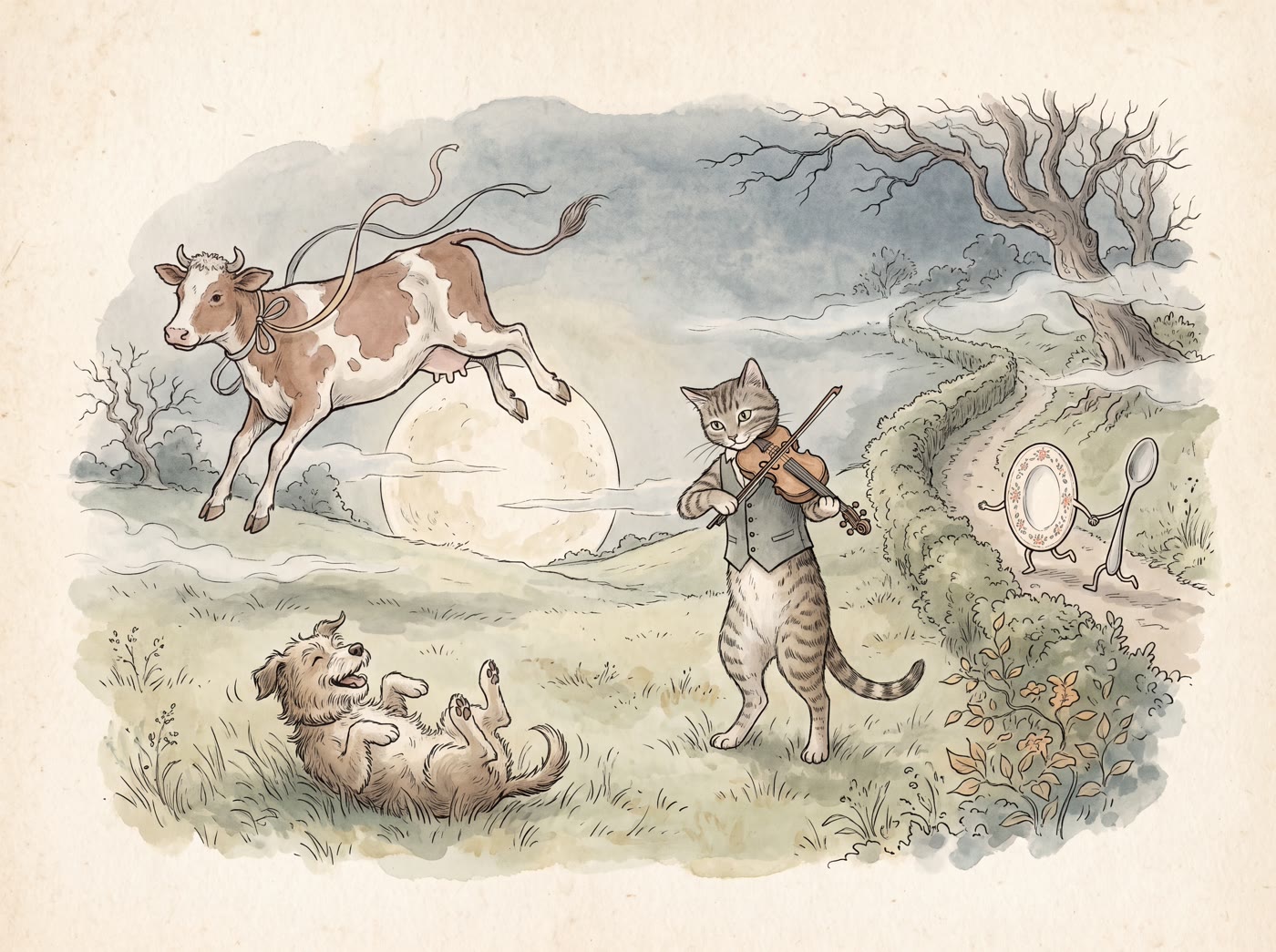
Hey diddle diddle,
The cat and the fiddle,
The cow jumped over the moon,
The little dog laughed to see such sport,
And the dish ran away with the spoon.
Where the rhyme comes from
The earliest printed version close to the one we sing appeared in London around 1765, in Mother Goose’s Melody. Its words were slightly different: “High diddle diddle, The cat and the fiddle, The cow jump’d over the moon; The little dog laugh’d to see such craft, And the dish ran away with the spoon.” The book even added a dry editorial note — that it must have been a little dog that laughed, since a great dog would be ashamed to laugh at such nonsense.
The phrase itself is older than the printed rhyme. Thomas Preston’s play Cambises, King of Percia, printed in 1569, mentions players who “can play a new dance called hey-diddle-diddle” — so the words were already an Elizabethan tune or catchphrase, though whether that dance is the ancestor of our rhyme is unproven. The melody children sing today was first set down by the composer and collector James William Elliott in National Nursery Rhymes and Nursery Songs (1870). The rhyme also gave English the expression “over the moon”, meaning thrilled or delighted.
What does it mean?
Almost certainly nothing. Iona and Peter Opie, the great scholars of nursery rhymes, treated it as deliberate nonsense verse, and most commentators agree. That has never stopped people proposing hidden meanings, and it is worth knowing them — as folklore rather than history:
The stars overhead. One theory maps the characters onto constellations — Taurus the bull for the leaping cow, Canis Minor for the little dog, Lyra for the fiddle. It is an appealing picture, but there is no evidence anyone intended it.
Royal cast lists. Various writers have claimed the cat is Elizabeth I, or that the rhyme satirises Catherine of Aragon, Catherine the Great, or the wives of Henry VIII. These identifications were made centuries after the fact, with no contemporary support, and folklorists dismiss them.
The inn and the pub game. More plausibly, “The Cat and the Fiddle” was a common English inn name, and old tavern games used a ball or piece of wood called a “cat”, played to fiddle music. The rhyme may simply have grown out of that noisy, cheerful world — but this too remains a theory.
Sharing it with children
This is a lovely rhyme for a lap and a set of actions. Saw an imaginary fiddle across your arm for the cat, sweep the child up in a big arc for the cow jumping over the moon, tickle for the laughing dog, and let two hands run away together for the dish and the spoon. Because every image is impossible, it is also a brilliant first joke: ask a toddler whether a cow really can jump over the moon, and enjoy the delighted “no!” Older children love inventing swaps of their own — the hamster and the trumpet, the horse jumping over the sun.
Extra verses to sing
These verses aren’t traditional — they’re ours. Sing them on when the nonsense is going well.
Hey diddle daddle,
The duck and the paddle,
The sheep sailed away in a shoe,
The little cat clapped to see such a thing,
And the teapot danced with the stew.
Hey diddle dumble,
The moon gave a grumble,
“Whatever has got in the sky?”
The little dog laughed till he rolled in the grass,
And the cow took another go by.