Hickory Dickory Dock
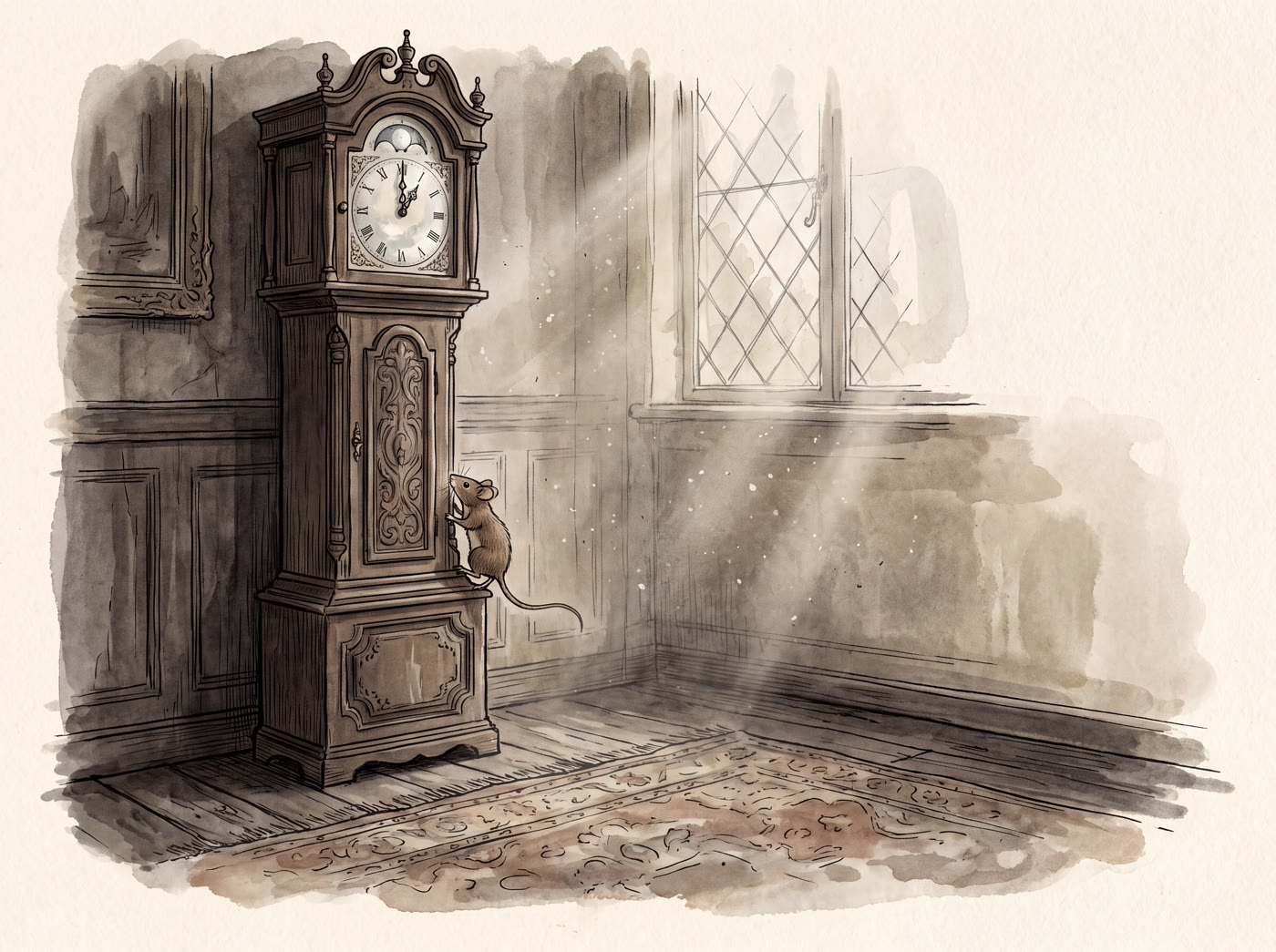
Hickory, dickory, dock,
The mouse ran up the clock.
The clock struck one,
The mouse ran down,
Hickory, dickory, dock.
Where the rhyme comes from
Hickory Dickory Dock first appeared in print in Tommy Thumb’s Pretty Song Book, published in London in 1744 — the earliest surviving collection of English nursery rhymes. There the opening line is spelled “Hickere, Dickere Dock”, and the mouse comes to grief rather than scampering home: “The Clock Struck One, / The Mouse fell down”. A second early version turns up in Mother Goose’s Melody (about 1765), which begins “Dickery, Dickery Dock”.
Iona and Peter Opie include the rhyme in The Oxford Dictionary of Nursery Rhymes, the standard scholarly account of the canon, and note that it was “formerly used for counting-out” — the playground business of deciding who is “it”. It is catalogued in the Roud Folk Song Index as number 6489. Singers have never quite agreed on the mouse’s exit: versions have him go “down the mouse ran”, “down the mouse run”, “and down he ran” or “and down he run” — all of them recorded variants.
What does it mean?
Nobody knows for certain, and the honest answer is that the rhyme may mean very little at all — the opening line is playful nonsense that imitates the tick and chime of a clock. Three theories are often repeated:
A counting rhyme. Two separate ideas travel under this heading, and they deserve different degrees of confidence. The first is well attested: on the Opies’ authority, children used the rhyme to count each other out for games. The second is a theory about where the words themselves came from. Shepherds in Westmorland in the nineteenth century counted with a score derived from the Cumbric language, in which hevera, devera and dick stood for eight, nine and ten. Some commentators think “hickory, dickory, dock” is an echo of those numbers, worn smooth in children’s mouths. It is a plausible idea, but an unproven one — the resemblance is suggestive rather than conclusive. (A looser version, repeated on many rhyme sites, claims that “hickory, dickory, dock” are themselves ancient Celtic numerals; that goes well beyond anything the evidence supports.)
The Exeter Cathedral clock. A popular story links the rhyme to the astronomical clock at Exeter Cathedral, which has a small hole cut in the door beneath the face so that the cathedral cat could get in to hunt mice. The usual citation for it is Richard Surman’s Cathedral Cats (2004), a popular book rather than a work of scholarship, and no eighteenth-century evidence tying the clock to the rhyme has come to light. It is a delightful picture — treat it as modern folklore.
A rhyme for telling the time. Whatever its origin, the rhyme makes a natural first lesson in clocks and hours, and many later versions extend it to count through all twelve hours, with a new verse for every hour. That is a well-known elaboration rather than part of the original — the mouse of 1744 hears the clock strike one, falls down, and there the rhyme ends.
Sharing it with children
This is a lovely lap rhyme. Sit a child on your knees and “run” two fingers up their arm from wrist to shoulder as the mouse runs up the clock, clap once on “the clock struck one”, then scurry your fingers back down for a tickle. Older children enjoy standing tall as the clock, arms swinging like a pendulum on the “hickory, dickory” lines. Because the rhyme names an hour, it is also a natural moment to point at a real clock face and count the chimes together.
For a clock-face counting game, draw a big clock on paper (or borrow a toy one) and let a fingertip or a small toy mouse do the running. Call out an hour, count the chimes aloud together, and move the mouse to the right number before he scurries down again — forwards from one to twelve, then backwards once that feels easy. When the clock has struck enough, turn it into a rhyming game: what else could run up the clock? A frog on a log, a cat in a hat, a bee shouting “whee” — anything will do, as long as it rhymes.
Extra verses to sing
These verses aren’t traditional — they’re ours. Sing them when one small hour isn’t enough.
Hickory, dickory, dare,
The mouse climbed up the stair.
The clock struck two,
Away he flew,
Hickory, dickory, dare.
Hickory, dickory, dee,
The mouse ran home for tea.
The clock struck three,
And so did he,
Hickory, dickory, dee.