Diddle Diddle Dumpling
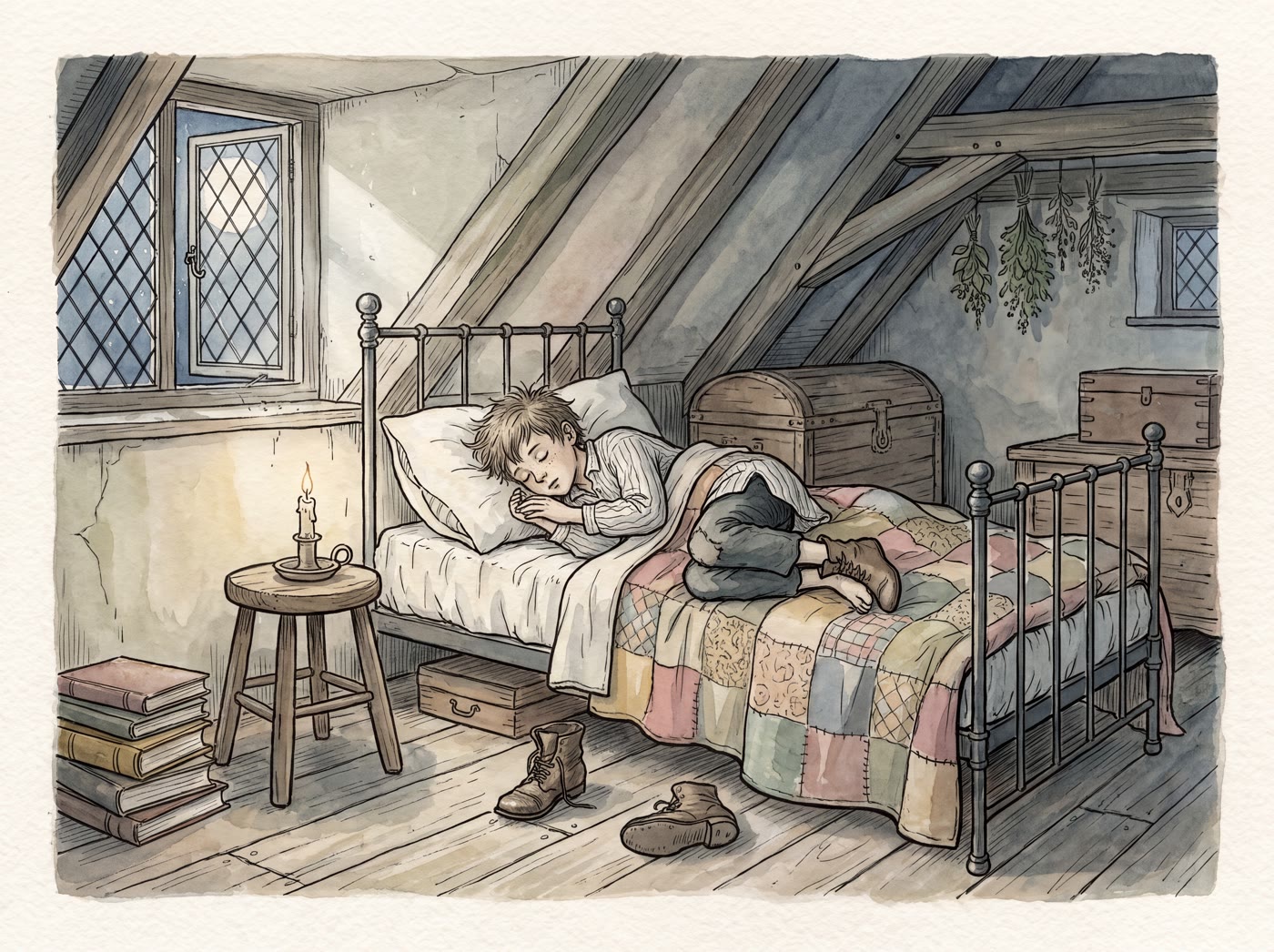
Diddle diddle dumpling, my son John,
Went to bed with his trousers on;
One shoe off, and the other shoe on,
Diddle diddle dumpling, my son John.
Where the rhyme comes from
Diddle Diddle Dumpling is first recorded in The Newest Christmas Box, a small collection printed in London around 1797, and it turns up again in the chapbook rhyme collections that followed. Iona and Peter Opie included it in The Oxford Dictionary of Nursery Rhymes (1951), where it carries the Roud Folk Song Index number 19709.
The opening line very likely began life outside the nursery altogether. “Diddle, diddle, diddle dumpling” was a London street cry — the sing-song call of pedlars selling hot dumplings — and the rhyme appears to have borrowed that ready-made, catchy phrase as its refrain. Regional versions swap the details about: Scottish singers recorded “Hey diddle dumplin’, my son John,” and other versions put John to bed in his britches or his stockings rather than his trousers.
What does it mean?
The honest answer is that it is a nonsense rhyme, and probably always was. Unlike rhymes with famous (if shaky) political back-stories, no one has ever produced a plausible historical figure or event behind Diddle Diddle Dumpling. It is best read as a small domestic joke: an affectionate grumble from a parent about a boy too tired — or too stubborn — to undress properly before falling into bed.
The dumpling-seller theory. The most widely accepted suggestion, and the one the Opies favoured, is simply that the refrain was lifted from the hot-dumpling sellers’ street cry. This is a theory rather than a documented fact, but it fits both the wording and the period.
Older senses of “diddle”. Some writers point out that “diddle” once meant to walk unsteadily, like a toddler, and later came to mean dawdling or wasting time — either of which would suit a wobbly, half-undressed boy. Again, this is speculation about word-play rather than evidence of a hidden meaning.
A music-hall song built on the chorus, telling of a “fast young fellow” who came home the worse for wear each night, gave the rhyme a knowing adult twist in the Victorian era. That song came long after the nursery rhyme, though, so it explains the rhyme’s popularity rather than its origin.
Sharing it with children
This is a perfect bedtime lap rhyme, because it is already about going to bed. Sit a child on your knees and bounce gently on each “diddle,” then slow right down for the last line. Toddlers love the shoe business: hold up one foot on “one shoe off” and the other on “the other shoe on,” and let them do the taking-off themselves — it turns the rhyme into gentle practice at dressing and undressing.
Older children enjoy swapping in their own name for John and inventing sillier things to wear to bed — a hat, a coat, one welly. It is also a lovely first rhyme for spotting a pattern, since the first and last lines are exactly the same.
Extra verses to sing
These verses aren’t traditional — they’re ours. Sing them if bedtime needs stretching out a little longer.
Diddle diddle dumpling, my son John,
Went to bed with his candle on;
One sock lost, and his nightcap gone,
Diddle diddle dumpling, my son John.
Diddle diddle dumpling, my son John,
Slept till the morning bells had gone;
Found his shoes with his hat still on,
Diddle diddle dumpling, my son John.