Hickety Pickety, My Black Hen
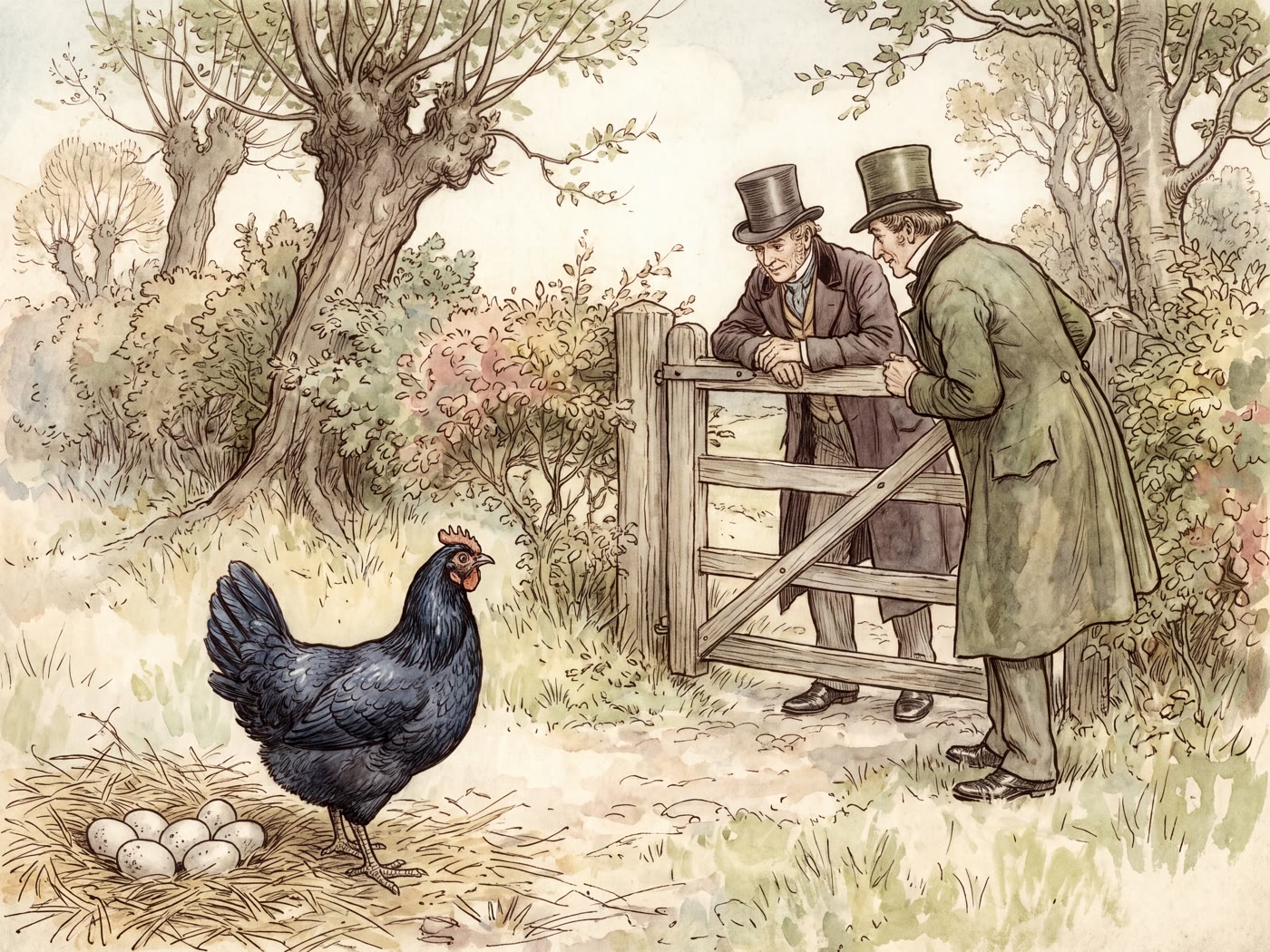
Hickety, pickety, my black hen,
She lays eggs for gentlemen;
Gentlemen come every day
To see what my black hen doth lay.
Sometimes nine and sometimes ten,
Hickety, pickety, my black hen.
Where the rhyme comes from
The honest answer is that nobody has pinned down where this one began. The words are anonymous, and the earliest printing is not established. Some websites give a confident year and the name of an early collection, but none of them shows its source, and we have not repeated them here.
What can be said is that the rhyme was in children’s books by the early twentieth century. Denslow’s Mother Goose (New York, 1901) and The Little Mother Goose (1912) both print a version, as reported by the Mama Lisa’s World rhyme archive; we have not seen the books ourselves.
They also show how loosely the words were held. Denslow’s book opens “Higglepy, Piggleby, my black hen” and goes straight to “Sometimes nine, and sometimes ten”, with no visiting gentlemen. The Little Mother Goose has “She lays good eggs for gentlemen”, keeps the gentlemen who come every day, and stops before the nine and ten. The six-line version above, which combines the two, is the one most often printed today. The opening line wobbles too: you will meet Hickety, Pickety, Higgledy, Piggledy and Higglety, Pigglety, all of them the same cheerful nonsense. If you only ever learned the first four lines, the “nine and ten” ending is not a mistake or a modern addition — it is a genuine part of the rhyme in some printed versions.
A different rhyme, Hickety Pickety Bumblebee, shares the opening sound but is not this one.
What does it mean?
The plain reading. A hen is so good a layer that gentlemen call every day to see how many eggs she has produced, and the answer is nine or ten. That is all the verse says, and no evidenced meaning beyond it has been found. The opening words are what puzzle people most, and they appear to be sound for its own sake: they set up the bouncing beat, rather than describing anything.
The unanswered questions. Why the visitors are gentlemen, and why the hen is black, nobody can say. The likeliest answer is simply that both suited the rhythm and the rhyme, but that is our reading, not a recorded explanation.
Sharing it with children
The rhythm is the thing to enjoy. Say it slowly at first and tap the beat on the table with one finger — HICK-et-y PICK-et-y MY black HEN — then speed up as the words become familiar.
It is also a handy rhyme for counting to ten. Set out an empty egg box, or a bowl of pom-poms or paper eggs, and let the child place nine or ten eggs in it as you reach the fifth line. Play “nine or ten?”: guess before counting, then count together. Once that is easy, take the eggs away one by one and count backwards from ten.
For a game with a part for everyone, let the child be the hen and the adult the visiting gentleman (or two gentlemen, if there are two adults), arriving on the third line to inspect the nest with great seriousness. Swap roles and go again. A hen who fusses over her eggs and a gentleman who bows low to look at them make the verse very funny to a small audience.
Extra verses to sing
These verses aren’t traditional — they’re ours. Sing them after the old words if the hen deserves a sequel.
Hickety, pickety, my brown hen,
She sits all day in her cosy pen;
Chicks come tumbling, one, two, three,
As fluffy as dandelions can be.
Hickety, pickety, my white hen,
She pecks the corn and she pecks again;
Children come with a basket each
To gather the eggs that are within reach.