Little Tommy Tucker
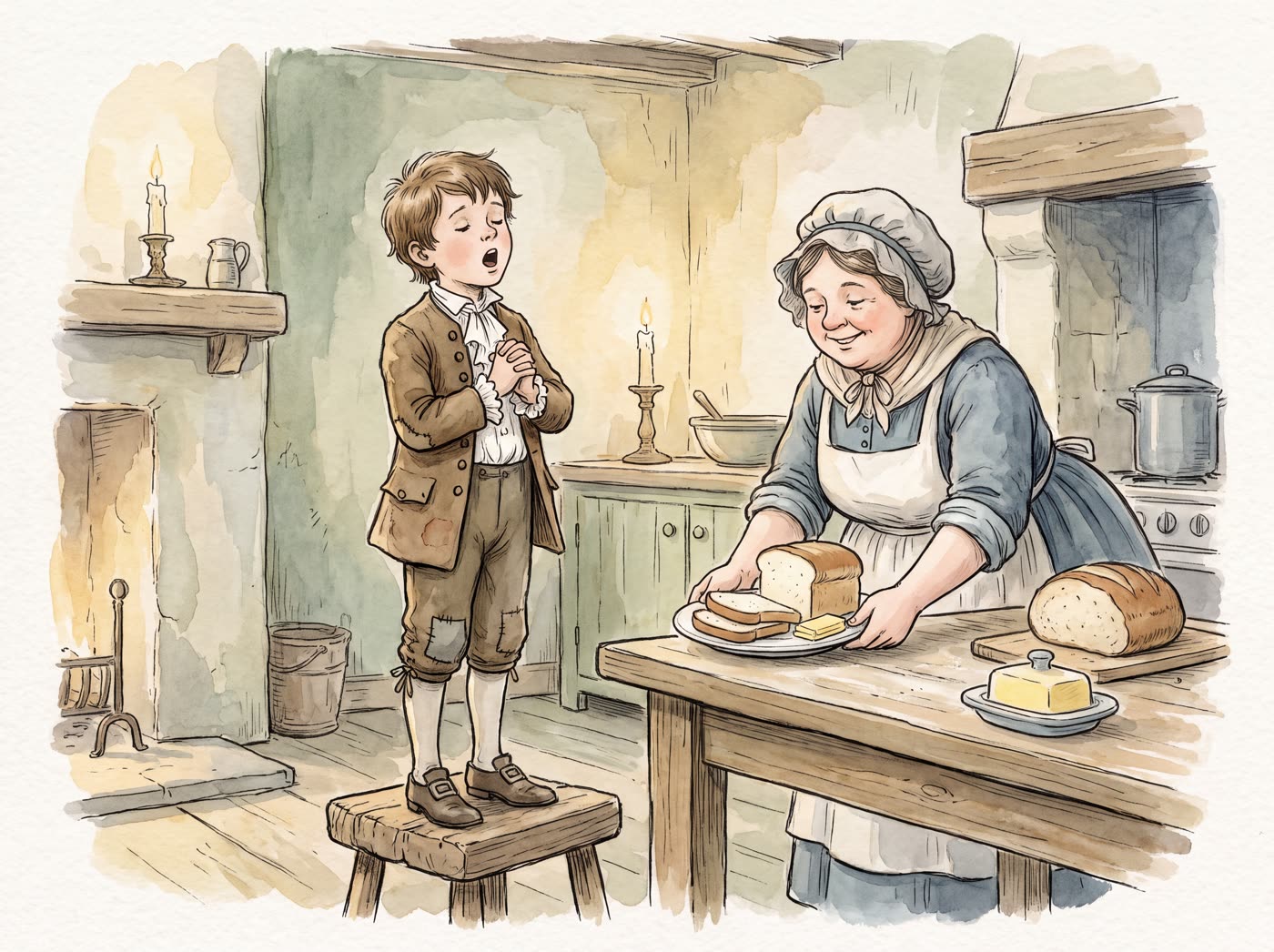
Little Tommy Tucker
Sings for his supper.
What shall we give him?
White bread and butter.
How shall he cut it
Without a knife?
How will he be married
Without a wife?
Where the rhyme comes from
Little Tommy Tucker was first printed in Tommy Thumb’s Pretty Song Book, published in London by Mary Cooper in 1744 — the earliest surviving anthology of English nursery rhymes, and a book of which only two copies are known to survive. There it is called “Little Tom Tucker”, and the words are close to ours but not quite the same. The food is the same — “White bread and Butter” — but the household question reads “What shall he Eat” rather than “What shall we give him”, and the knife and the wife are “without e’re a Knife” and “without e’re a Wife”. The rhyme was printed again in Mother Goose’s Melody, around 1765.
The phrase at the heart of the rhyme is older than the book. “To sing for one’s supper” was already a familiar saying in the early seventeenth century: dictionaries of idioms trace it to Beaumont and Fletcher’s play The Knight of the Burning Pestle, of about 1609, which has the line “Let him stay at home and sing for his supper”. They explain the phrase as meaning to work or perform in order to earn your reward, and one suggests that it alludes to travelling minstrels who were paid with a meal. Two other seventeenth-century fragments — a line in a ballad medley of about 1620, “Tom would eat meat but wants a knife”, and a 1648 epigram by Robert Herrick about a man called Tuck — have been suggested as echoes of the rhyme, though they are possible evidence rather than proof.
The rhyme has also had a long life in music: there is a round of 1885 for four voices, and Peter Warlock set it in Candlelight in 1924. Some versions give “brown bread and butter”, and both wordings are in use today.
What does it mean?
Plainly, it is a teasing little joke. Tommy has to sing to earn his supper, and the household offers him bread and butter. Then come two questions, each rhyming on its own answer: how will he cut the loaf without a knife, and how will he ever marry without a wife? The second question is the punchline — a boy who cannot yet manage his own bread and butter is hardly ready to set up house, and the gap between “knife” and “wife” does the rest. It is a rhyme about a hungry child, a meal and a bit of gentle mockery, with no story beyond that.
Who Tommy Tucker was, if he was anyone, is not known. Readings that make him an orphan or a beggar boy, or that find a hidden message in the white bread, circulate online, but we have found no evidence for any of them, and we would rather say so than repeat them as fact.
Sharing it with children
Sing for your supper. At a mealtime, let the child “earn” the next bite by singing the first four lines, with the grown-ups answering as the household when the rhyme asks what to give him. It turns a fussy tea into a small performance, and it gives the old saying a literal meaning children grasp at once.
Call and response. The two question lines are made for it. The adult asks, “How shall he cut it?” and the child shouts back “Without a knife!”; then “How will he be married?” and “Without a wife!”. Slow down before each answer and let the child fill the gap.
A bread-and-butter picnic. Lay out a rug, some slices of soft bread and a butter dish, and act out the rhyme in order: sing, serve, then puzzle over the missing knife. Spreading the butter with a blunt child’s knife (or a spoon) and a little help is a good way to solve the problem the rhyme leaves hanging.
Extra verses to sing
These verses aren’t traditional — they’re ours. Sing them when Tommy’s supper needs a second course.
Little Tommy Tucker
Sang a bit louder.
What shall we give him?
A cup of warm chowder.
How shall he sip it
Without a spoon?
He’ll hum for his supper
Beneath the moon.