Pease Porridge Hot
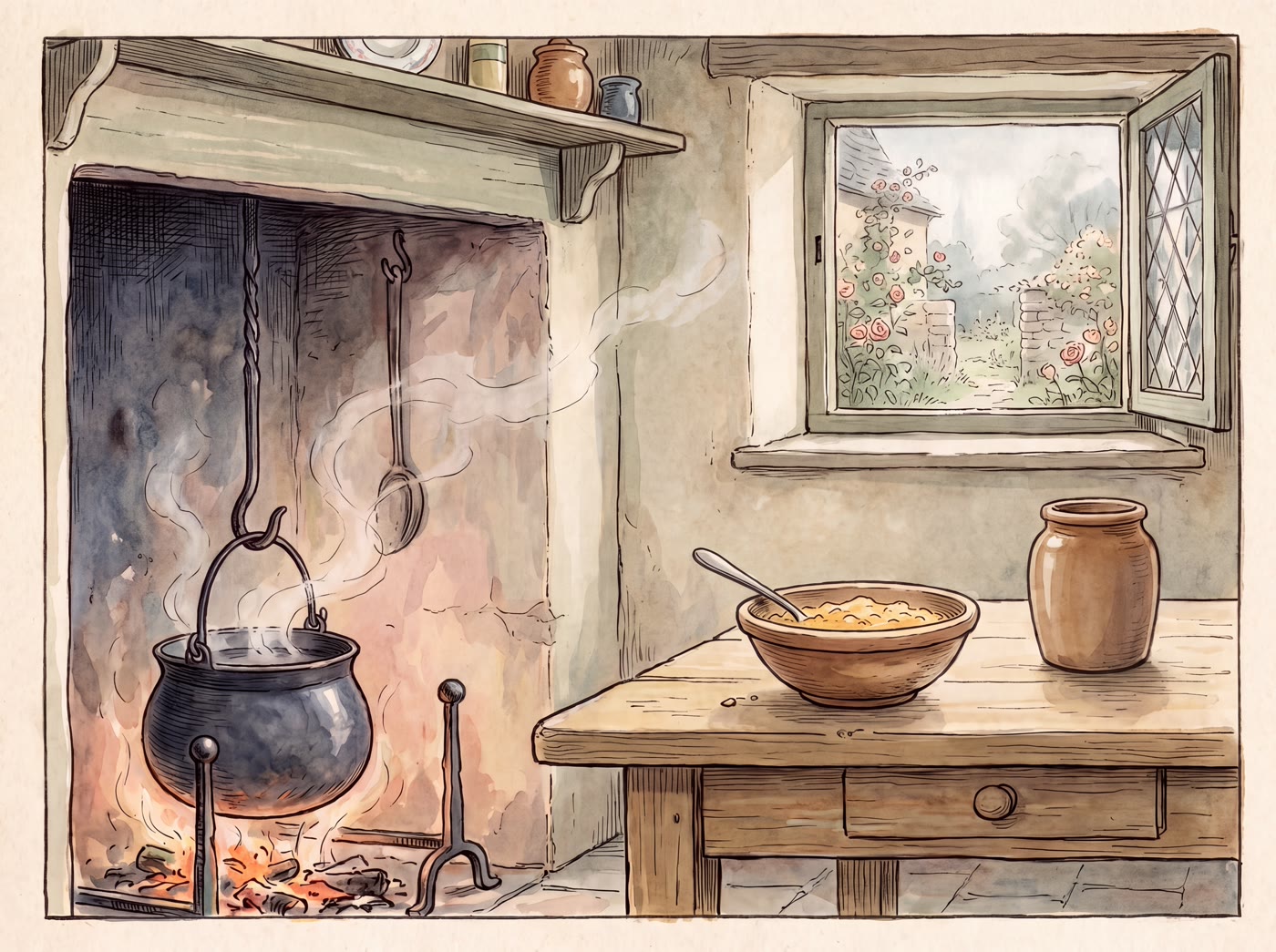
Pease porridge hot,
Pease porridge cold,
Pease porridge in the pot,
Nine days old.
Some like it hot,
Some like it cold,
Some like it in the pot,
Nine days old.
Where the rhyme comes from
First, the food. Pease porridge — also called pease pudding or pease pottage, and often searched for as “peas porridge” — is a savoury dish of boiled pulses, typically split yellow peas cooked with water, salt and spices, often alongside a bacon or ham joint. It is thick, pale yellow and mild in flavour, a little like hummus but somewhat more solid, and it is still eaten in the north-east of England. “Pease” is simply the older English word for peas, used like “flour” or “oatmeal”; our singular “pea” came later.
The rhyme was first recorded in the eighteenth century, and the earliest version we know is not a song at all but a riddle. In Mother Goose’s Melody it reads “Pease Porridge hot, / Pease Porridge cold, / Pease Porridge in the Pot / Nine Days old,” followed by a challenge: “Spell me that in four Letters? I will, THAT.” The answer, T-H-A-T, is the whole joke. The date of that book is itself disputed. It was traditionally placed around 1760 and credited to John Newbery, but more recent scholarship suggests a first edition around 1780 or 1781, and the earliest surviving copy is dated 1784 — so “eighteenth century” is as precise as we can honestly be.
The second stanza, “Some like it hot”, is the form given in the Opies’ Oxford Dictionary of Nursery Rhymes. James Orchard Halliwell printed the rhyme in The Nursery Rhymes of England (third edition, 1843), and it is catalogued in the Roud Folk Song Index as number 19631. Where the origins of the rhyme lie is not known.
What does it mean?
Probably nothing hidden. The rhyme describes a food, and in its earliest form it is a spelling riddle. We have found no evidence for a secret meaning — no sailors’ code, no political satire, no tale of hard times — and any such explanation you meet should be treated as unevidenced.
Leftovers. One food producer has suggested that “nine days old” simply reflects a pot of pease porridge being eaten, hot or cold, over many days. That is speculation, not evidence, and it is not advice: please do not keep porridge for nine days.
What the rhyme does have is a sound. The first two lines turn on the opposite of hot and cold, the third drops into the pot, and “nine days old” lands with a satisfying thud — ideal material for the clapping game below.
Sharing it with children
Pease Porridge Hot is a partner clapping rhyme. One pattern, recorded in an early twentieth-century game book (Wollaston’s The Song Play Book, 1922), has two players facing each other, clapping on the word rather than after it. It is not the only way to play it: variants exist, so adapt it freely.
The first line, “Pease porridge hot” — clap your own thighs on “pease”, your own hands together on “porridge”, then your partner’s hands on “hot”. “Pease porridge cold” follows exactly the same pattern.
The third line, “Pease porridge in the pot” — thighs on “pease”, own hands on “porridge”, then right hands only with your partner on “in the”, and your own hands together on “pot”.
The fourth line, “Nine days old” — left hands only with your partner on “nine”, own hands on “days”, then both of your partner’s hands on “old”. Repeat the same actions for the second stanza.
Go slowly at first, saying the words in a steady beat, then get faster each time round until the hands tangle and everyone laughs. Younger children can simply clap along with a grown-up, or tap their knees.
Other games: say “hot” in a big, puffing, steaming voice and “cold” in a shivering whisper. Or hold up a finger for each of the nine days and count them off on “nine days old”. If you can bring a bowl of real pease pudding to the table, so much the better: the rhyme will make more sense with a spoonful of its subject in front of you.
Extra verses to sing
These verses aren’t traditional — they’re ours. Clap them to the same pattern, or make up your own.
Pease porridge on the spoon,
Pease porridge in the bowl,
Eat it up by afternoon,
Warm and round and whole.
Some will blow on it hot,
Some will wait till it’s cool,
Some will scrape the empty pot,
Clapping hands by the stool.