Hot Cross Buns
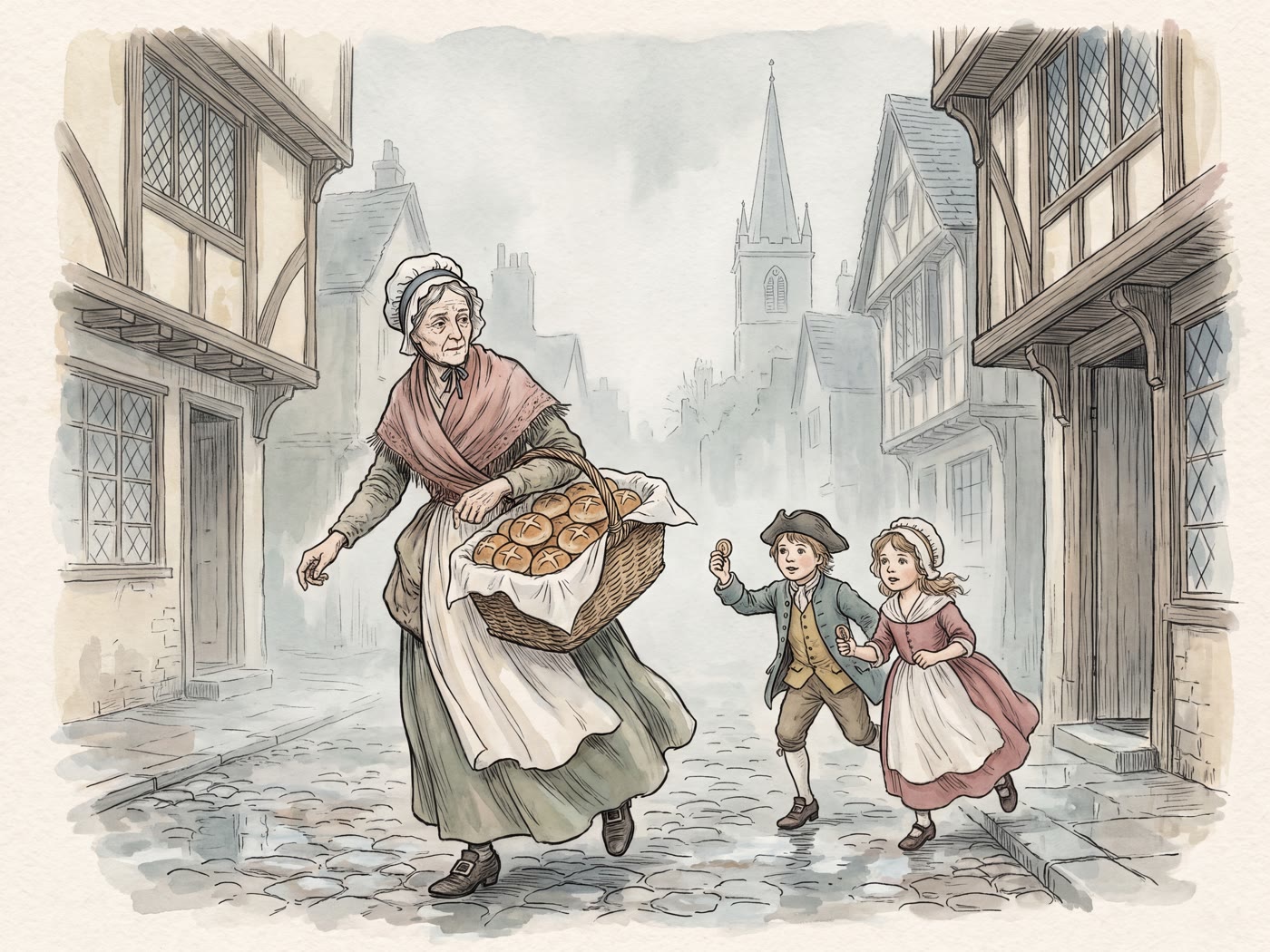
Hot cross buns!
Hot cross buns!
One a penny, two a penny,
Hot cross buns!
If you have no daughters,
Give them to your sons.
One a penny, two a penny,
Hot cross buns!
Where the rhyme comes from
Before it was a nursery song, Hot Cross Buns was an English street cry — the call of sellers of spiced buns on Good Friday. The earliest record the Oxford English Dictionary cites for hot cross buns at all is a couplet in Poor Robin’s Almanack, usually dated to 1733: “Good Friday comes this month, the old woman runs / With one or two a penny hot cross buns.” The cry is already there in miniature, and nothing earlier has been found. As the food historian Ivan Day told the BBC in 2010, look for records of the buns before the eighteenth century and “you hit nothing”.
A longer version was printed as a round in the London Chronicle in June 1767, according to Wikipedia’s account of the sources: “One a penny, two a penny, hot cross-buns; / If you’ve no daughters, give them to your sons; / And if you’ve no kind of pretty little elves, / Why then good faith, e’en eat them all yourselves.” So the daughters-and-sons lines, which can sound like a later nursery addition, are among the oldest parts of the words. Many rhyme sites repeat that the rhyme was first printed in The Christmas Box in 1798. We have not been able to check that claim, and if the 1767 round is right, 1798 cannot have been the first. The nursery version is best dated, loosely, to the late eighteenth century.
After that the words wander. James Orchard Halliwell’s The Nursery Rhymes of England (1846) ends with “You cannot do better than to eat them yourselves”, and his dialect dictionary records a Coventry Good Friday cry: “Butter them and sugar them and put them in your muns” — muns being mouths. The Opies printed a nineteenth-century children’s-booklet version, “’Tis Good Friday morning, the little boy runs, / Along with his sister, to buy hot cross buns”, and Iona Opie collected a nonsense variant, “One a penny poker, / Two a penny tongs, / Three a penny fire shovel, / Hot cross buns.” The Roud Folk Song Index lists the rhyme as number 13029. Today the Hot Cross Buns song most children learn usually stops after the first four lines; the daughters and sons are the half that gets forgotten.
What does it mean?
Mostly what it says. A hot cross bun is a spiced bun with currants or raisins and a cross on top, traditionally eaten on Good Friday in Britain and the Commonwealth. “One a penny, two a penny” is the seller’s price call: one bun for a penny, or two for a penny — the 1733 couplet’s “one or two a penny” says the same thing more plainly.
The Christian reading. The accepted Christian symbolism, as taught in schools and echoed by a Church of England spokesman, is that the cross stands for the crucifixion and the spices for those in which Jesus’s body was wrapped in the tomb. That explains what the bun signifies at Easter; it is not evidence of where the bun began, and the BBC’s own verdict is that the buns’ exact history is unclear.
The older legends. You will also meet stories that the buns descend from pagan spring offerings to the goddess Eostre, that a medieval monk at St Albans invented them, or that a Tudor law forbade their sale except on Good Friday and a few other days. All three are widely repeated, but thinly evidenced.
The song has had a second life in the classroom as a first tune for children learning an instrument, especially the recorder; the opening phrase in the common simplified version uses just three notes.
Sharing it with children
For the very young, make it a lap game. Sit a child facing you and pat their palms three times on each “hot cross buns”, once for each word, then draw a cross on their palm with a finger on the last line.
Older children make a fine bun stall. Lay out some “buns” — play dough, paper circles marked with a cross, or bean bags — and a handful of pennies or counters. One child is the seller and sings the cry; the customer pays one penny for one bun or one penny for two, and the seller counts them out. Swapping the price (“three a penny, four a penny”) keeps a first counting-and-money game going.
As a sing-along it works best as a call: one voice sings “Hot cross buns!” and everyone answers, the way a street seller and a crowd of customers might. Then try singing all eight lines, so the daughters and sons get their turn.
Extra verses to sing
These verses aren’t traditional — they’re ours. Sing them once the basket is empty.
Hot cross buns!
Hot cross buns!
Two for the daughters
And two for the sons.
When the basket’s empty,
Home the old woman runs.
One a penny, two a penny,
Hot cross buns!