The Muffin Man
Oh, do you know the muffin man,
The muffin man, the muffin man?
Oh, do you know the muffin man
Who lives in Drury Lane?
Oh yes, I know the muffin man,
The muffin man, the muffin man.
Oh yes, I know the muffin man
Who lives in Drury Lane.
Then two of us know the muffin man,
The muffin man, the muffin man.
Then two of us know the muffin man
Who lives in Drury Lane.
We all know the muffin man,
The muffin man, the muffin man.
We all know the muffin man
Who lives in Drury Lane.
Where the rhyme comes from
The earliest written record of the rhyme is a British manuscript of about 1820, now in the Bodleian Library at Oxford. Iona and Peter Opie give it in The Singing Game (1985), and its words are essentially the first verse still sung today — the question, the muffin man three times over, and the address in Drury Lane. Who first sang it is not known. The Roud Folk Song Index lists it as number 7922.
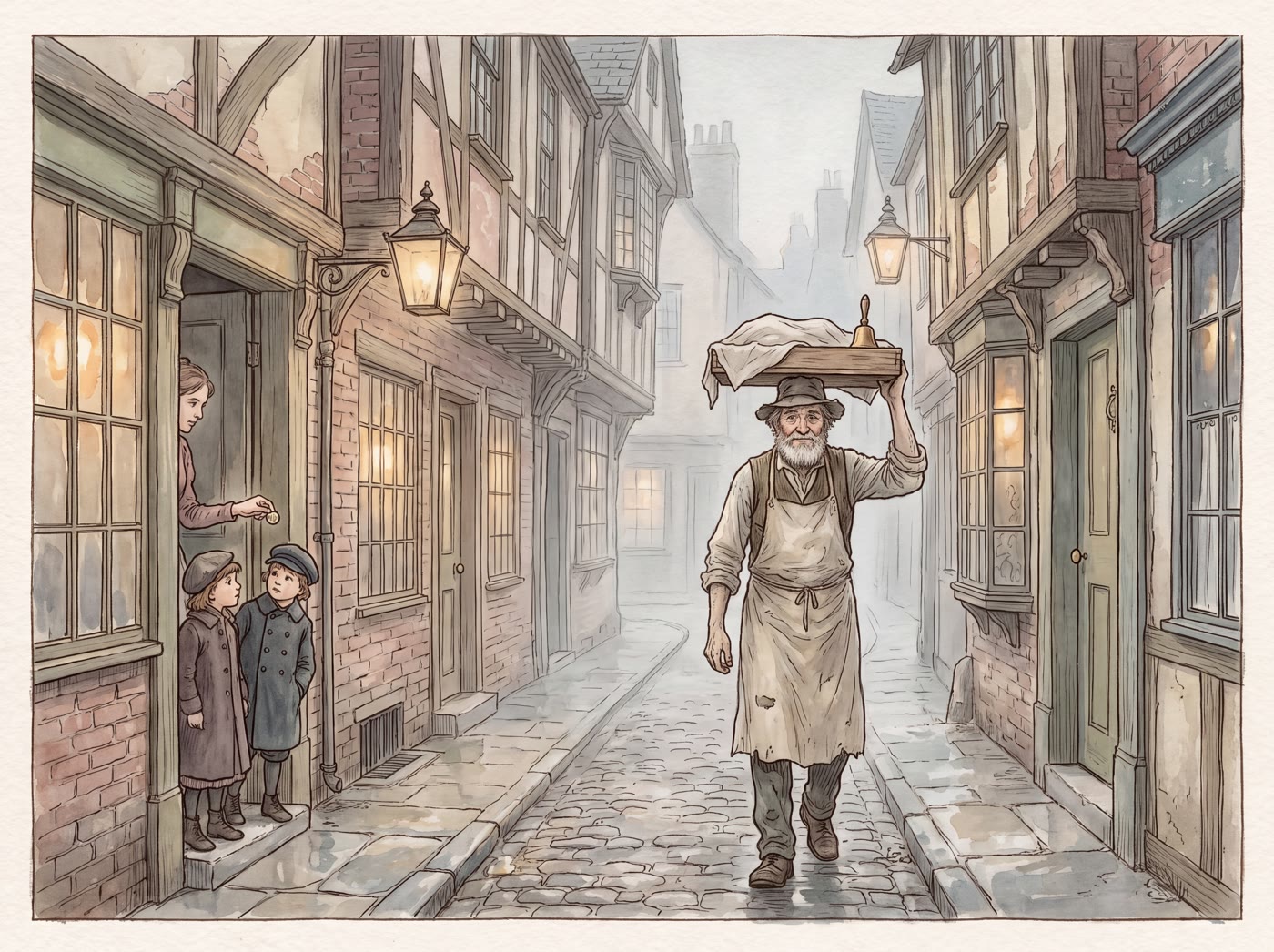
The muffin man himself was a real enough figure, though no source names any particular muffin man living in Drury Lane. Muffins — the yeasted griddle breads now called English muffins, not the sweet American cakes — were sold door to door through London’s streets, and by Victorian times much of a household’s fresh food arrived the same way. Henry Mayhew, in London Labour and the London Poor (1851), wrote that “the street-sellers of muffins and crumpets rank among the old street-tradesmen”, and counted several hundred of them, mostly boys and young men or old and infirm men. They are commonly said to have rung a handbell or cried their wares as they went. Drury Lane is a real street on the edge of Covent Garden, and in the rhyme it works simply as an ordinary London address.
One small, circumstantial clue that the trade was familiar in the rhyme’s own day: Pierce Egan’s Boxiana (1829) mentions a Mr Smith, a muffin-baker in Gray’s Inn Lane, caught up in a boxing-match bribery affair of 1825. It proves nothing about the rhyme, only that the muffin trade was a recognisable part of London life by then. The song has also travelled: a Dutch version, “Zeg ken jij de mosselman”, is set in Scheveningen, near The Hague, and swaps the muffins for mussels, and a Singaporean one has a satay seller in Tiong Bahru — both reported by blogs rather than folklorists.
What does it mean?
Probably nothing more than it says: do you know the man who brings the muffins? It is a question-and-answer game, and the Opies record that the play around it has changed shape over the years — a forfeit game, a guessing game and a dancing ring game.
The serial killer of Drury Lane. Search for the rhyme’s origin today and you will soon meet “Frederic Thomas Lynwood”, a man said to have preyed on children in Drury Lane around 1600. It is a modern internet invention, and a recent one. The fact-checkers at Snopes traced it to a TikTok video of January 2021, which appears to have lifted the tale from Uncyclopedia, an openly comic parody of Wikipedia; the name, the dates and every lurid detail were written there as a joke. No historical record of any Lynwood has been found, and the rhyme itself is first written down some two centuries after he is supposed to have lived. Many adults know the rhyme best from Lord Farquaad in Shrek, which is one reason so many go looking for its origins.
Sharing it with children
The Muffin Man is a game as much as a song, and a full account of it from 1888 still works. Matilda Anne Mackarness, in The Young Lady’s Book, describes it: one child asks the next, “Do you know the muffin man?”; that child answers “Yes, I know the muffin man”; then the two say together “Then two of us know the muffin man”, and the question passes on round the circle, the number rising, until everyone knows him. With small children, put one child in the middle as the muffin man; whoever answers joins them, and the middle grows until the circle is empty.
A small bell makes a good prop. Ring it before each question as if the muffin man were coming down the street, and let the child holding it be the one who asks. For a change, swap the food and the address — the jam-tart lady, the apple man who lives by the park — and let children invent the next seller. Toasting real English muffins afterwards makes a fine end to the game.
Extra verses to sing
These verses aren’t traditional — they’re ours. Sing them once the whole circle knows the muffin man.
Oh, have you heard the muffin bell,
The muffin bell, the muffin bell?
Oh, have you heard the muffin bell
Come ringing down the lane?
Now we’ve all had a muffin hot,
A muffin hot, a muffin hot.
Now we’ve all had a muffin hot,
So ring the bell again.