Polly Put the Kettle On
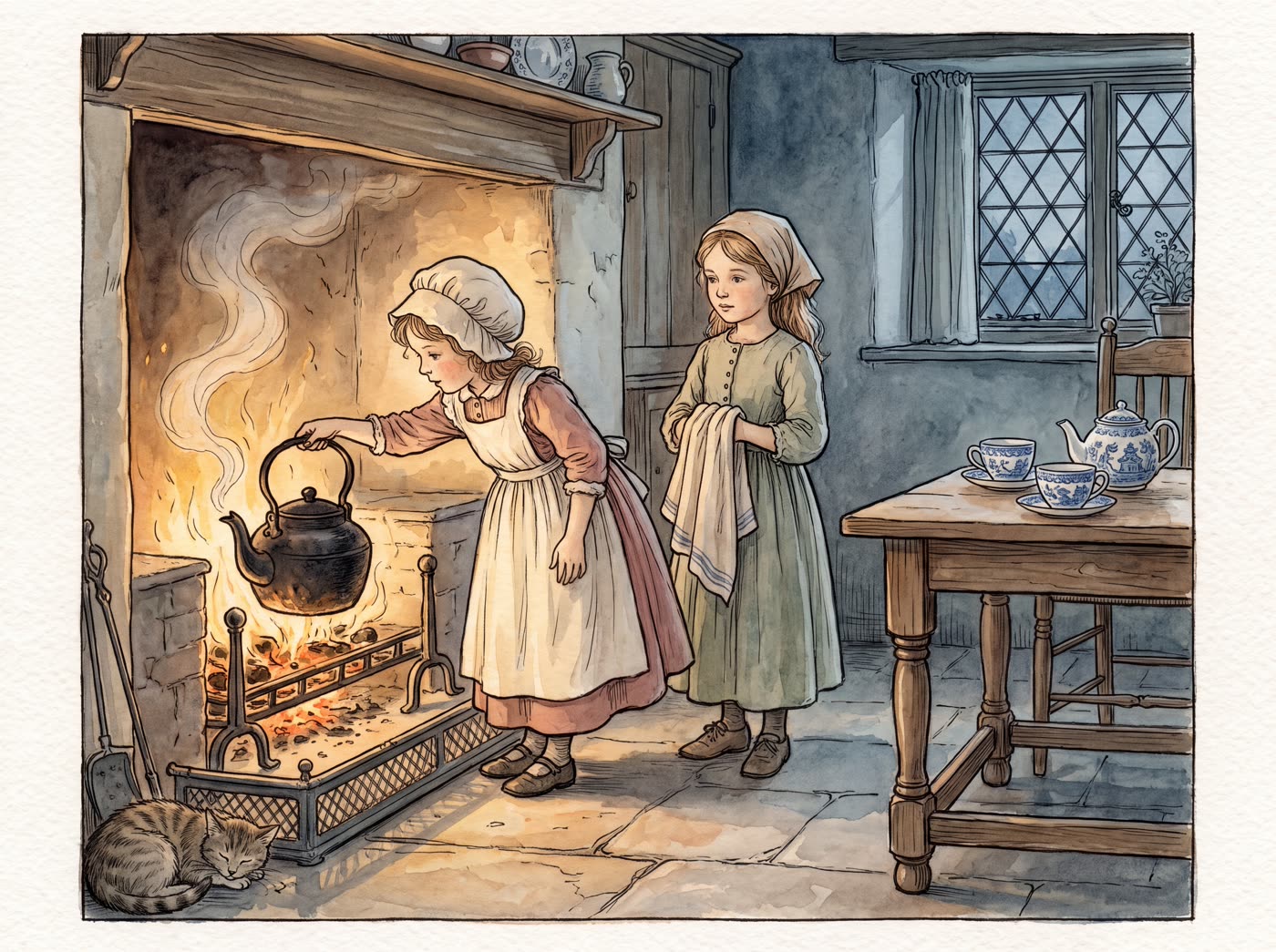
Polly put the kettle on,
Polly put the kettle on,
Polly put the kettle on,
We’ll all have tea.
Sukey take it off again,
Sukey take it off again,
Sukey take it off again,
They’ve all gone away.
Where the rhyme comes from
A song called “Molly Put the Kettle On, or Jenny’s Baubie” was published by Joseph Dale in London in 1803, and versions using Polly in place of Molly were printed in Dublin around 1790–1810 and in New York around 1803–07. The tune is older still: it borrows the Scottish air “Jenny’s Bawbee”, in circulation by the 1770s.
The words in the form we sing today are first recorded in Charles Dickens’s Barnaby Rudge (1841), and the rhyme was gathered into James Orchard Halliwell’s The Nursery Rhymes of England in the 1840s, which fixed it in the standard collections. It carries the Roud Folk Song Index number 7899.
Both names are period pet-forms: in middle-class households of the mid-eighteenth century “Polly” stood for Mary and “Sukey” for Susan. The kettle would have been heavy black iron, swung over an open fire on a hook rather than set on a stove.
What does it mean?
Unlike many old rhymes, this one has never attracted a serious political reading — and folklorists are content to take it at face value, as a small domestic scene about putting the kettle on for visitors and taking it off when they leave.
The squabbling siblings. A frequently repeated story holds that the rhyme was made up by a father of five — three girls and two boys — whose daughters would sing “Polly put the kettle on” to start a pretend tea party and drive their brothers off, whereupon the boys would answer with “Sukey take it off again”. It is a charming theory, but no evidence supports it; treat it as folklore rather than history.
A tea call. More plausibly, the tune served as a “tea call” — a familiar melody whistled or sung to summon a household to the table at a time when taking tea was a fixed and rather serious ritual. That would explain its simple, repetitive, carrying shape.
Sharing it with children
This is a lovely lap rhyme with built-in actions. Sit a child facing you and mime swinging a kettle over the fire on each “put the kettle on”, then lift it away with a puff of breath for “take it off again”. Because each line repeats three times, very young children join in quickly — it is often one of the first rhymes a toddler will sing unprompted.
Sing it for real at teatime while the kettle boils, and swap in the names of the children in the room (“Amir put the kettle on…”). A toy tea set turns it into a whole game: pour, sip, and then “they’ve all gone away” becomes the tidy-up cue, which is a gentle and cheerful way to end play.
Extra verses to sing
These verses aren’t traditional — they’re ours. Sing them if the tea party wants to carry on a little longer.
Polly fetch the little cups,
Polly fetch the little cups,
Polly fetch the little cups,
And set them in a row.
Sukey blow the fire up bright,
Sukey blow the fire up bright,
Sukey blow the fire up bright,
For someone’s at the door.