Old Mother Hubbard
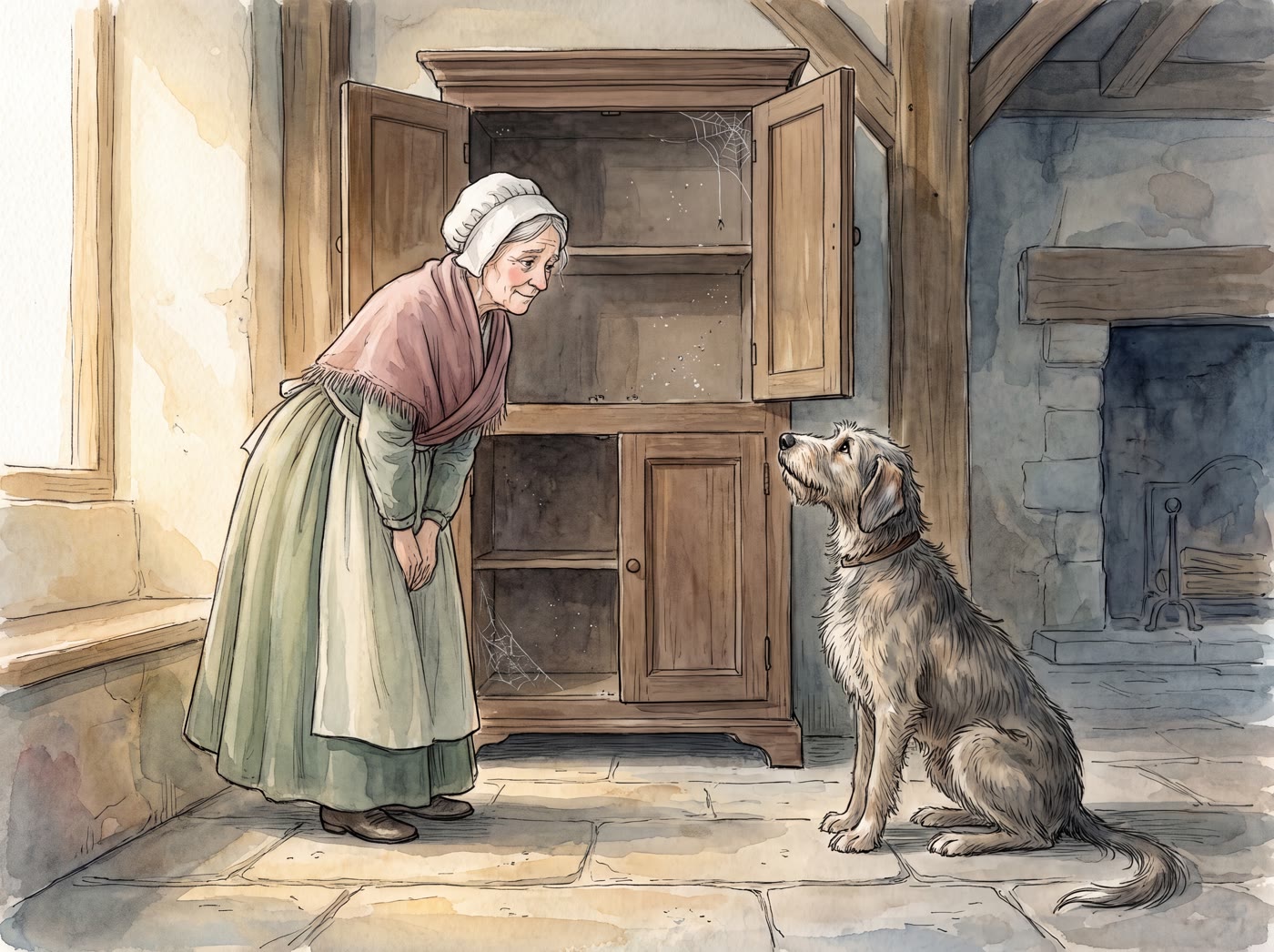
Old Mother Hubbard,
Went to the cupboard,
To get her poor dog a bone.
But when she got there,
The cupboard was bare,
And so the poor dog had none.
Where the rhyme comes from
Old Mother Hubbard was first given a full printing on 1 June 1805, when the London publisher John Harris issued The Comic Adventures of Old Mother Hubbard and Her Dog. It ran to fourteen verses, and it was a sensation — tens of thousands of copies sold within months, followed by a Continuation in 1806, a flood of pirated editions, parodies and sequels, and even a style of loose-fitting dress that took the old lady’s name.
The book is attributed to Sarah Catherine Martin (1768–1826), who is said to have written it in 1804 while staying with her sister’s family at Kitley House in Yealmpton, Devon. The story goes that her brother-in-law, exasperated by her chatter, told her to run away and write one of her stupid little rhymes. Martin herself claimed she had only drawn the pictures, and scholars think she was probably right to hedge: the famous opening stanza is in a different metre from the rest of the poem, and fragments of it turn up in chapbooks in the 1790s. The likeliest account is that Martin took an existing scrap of nursery verse and spun thirteen comic verses out of it.
The name itself is older still. A “Mother Hubberd” appears in Edmund Spenser’s satirical Mother Hubberds Tale of 1591, though that poem — a beast fable about an ape and a fox — has nothing to do with the rhyme beyond the borrowed name.
What does it mean?
Cardinal Wolsey. The story most often repeated is that the rhyme is a coded attack on Cardinal Thomas Wolsey, who failed to obtain Henry VIII’s divorce from Catherine of Aragon so that he could marry Anne Boleyn. In this reading Wolsey is Mother Hubbard, the dog is the King, the bone is the annulment and the bare cupboard is the Catholic Church. It is a neat allegory — but it is only a theory, and a late one. No Tudor source connects the words to Wolsey, and the rhyme is not recorded anywhere until the 1790s, more than two centuries after his fall. Historians treat it as folklore attached to the rhyme long afterwards, not as its origin.
Plain nursery nonsense. The simpler explanation is that there is no hidden meaning at all. Martin’s fourteen verses are pure comic absurdity: the dog smokes a pipe, reads the news, rides a goat, dances a jig and plays the flute. The bare cupboard is a joke about an empty larder — a familiar enough sight in the England of 1805 — and the humour lies in a devoted old woman who can find her dog everything in the world except his dinner.
Sharing it with children
This one begs to be acted out. Sit a child on your lap and walk your fingers up their arm for the journey to the cupboard, then throw both hands wide on “the cupboard was bare” for a lovely little surprise. Toddlers enjoy being the dog — sitting up, begging, and giving a mournful howl on the last line.
It is also a gentle first rhyme for talking about kindness and disappointment: what could Mother Hubbard do next? Older children like inventing their own verses about what she fetched the dog instead, which is exactly what Sarah Martin did for thirteen verses. A real kitchen cupboard, opened and found bare, makes the whole thing land beautifully.
Extra verses to sing
These verses aren’t traditional — they’re ours. Sing them if the poor dog deserves a happier ending.
Old Mother Hubbard,
Went back to the cupboard,
And searched every shelf to the top.
She found but a crumb,
So she counted her sum,
And walked to the butcher’s shop.
Old Mother Hubbard,
Came home to the cupboard,
With a bone that was bigger than three.
The dog gave a bark,
And they danced till the dark,
As happy as ever could be.