There Was an Old Woman
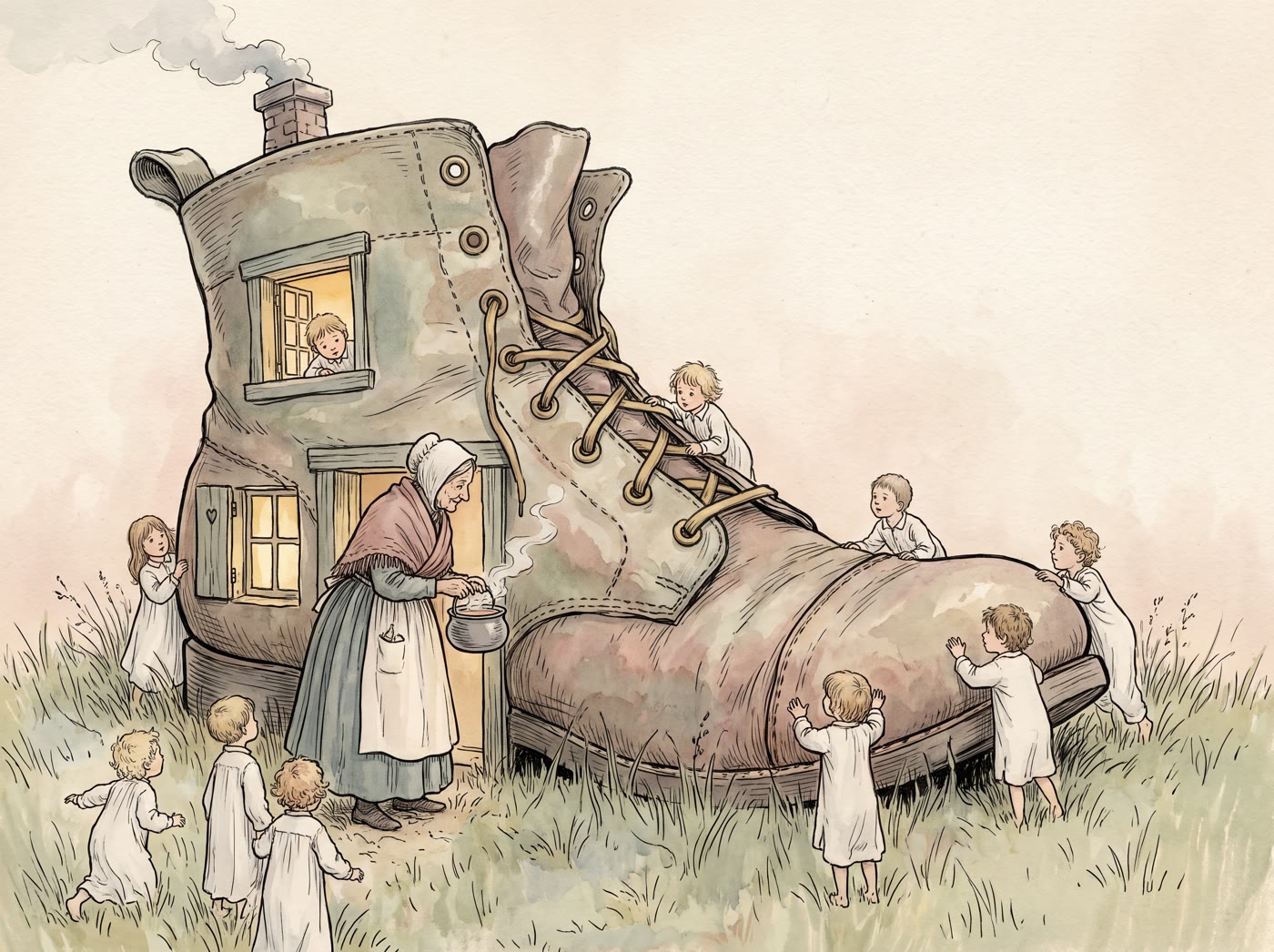
There was an old woman who lived in a shoe,
She had so many children, she didn’t know what to do,
She gave them some broth without any bread,
Then whipped them all soundly and put them to bed.
Where the rhyme comes from
The earliest printed version appears in Joseph Ritson’s Gammer Gurton’s Garland, or, The Nursery Parnassus — a collection dated 1784 and widely circulated in its 1794 printing. Ritson’s text is blunter than the one we sing today: instead of whipping them soundly, the old woman “whipp’d all their bums, and sent them to bed.”
A second early version, printed in London in Baptist Noel Turner’s Infant Institutes in 1797, ends quite differently — the old woman goes out to order a coffin for her children and returns to find them all “a-loffeing” (laughing). Iona and Peter Opie noted that “a-loffeing” has a Shakespearean ring to it, which suggests the rhyme was already old when it was first written down. Many further variants were printed through the 18th and 19th centuries, and W. W. Denslow’s 1901 Mother Goose illustration fixed the image of the boot-shaped cottage in most people’s minds.
What does it mean?
Nobody knows. As Peter Opie drily observed, most explanations amount to matching the old woman with some historical figure “for little reason other than the size of their families.” The popular theories are worth knowing, but none of them is proven:
George II and his parliament. The story attached to this page for years — and argued at length by the writer Albert Jack — is that the “old woman” is King George II, nicknamed thus because his wife Queen Caroline was thought to be the real power behind the throne. In this reading the unruly children are Members of Parliament, the whipping is the party whip, the bed is the House of Commons, and the broth without bread is the king’s penny-pinching after the South Sea Bubble of 1721. It is neat, and it may even be true — but it is a modern interpretation with no contemporary evidence behind it, so treat it as theory rather than history.
A real mother with a very large family. Candidates offered over the years include Queen Caroline herself, who had eight children, and Elizabeth Vergoose of Boston, who had six of her own and ten stepchildren. There is no documentary link between any of them and the rhyme.
Shoes and fertility. The Opies suggested a folklore reading instead: shoes have long been linked with fertility and marriage — casting a shoe after a bride, or tying shoes to the newlyweds’ car — and the archaeologist Ralph Merrifield recorded a Lancashire custom in which a woman hoping to conceive would try on the shoes of a woman who had just given birth. A house bursting with children inside a shoe may simply be that old idea taken to its cheerful extreme.
Sharing it with children
This is a lovely counting-and-cuddling rhyme. Sit a child on your lap and tap out the beat on their knees; on “so many children”, wiggle all ten fingers and count them together, then hide them all under a blanket “bed” on the last line. Modern parents usually soften the ending — “then kissed them all soundly and put them to bed” works perfectly and scans just the same, and it makes a good moment to talk about how differently grown-ups used to treat children. An old wellington boot, a shoebox and some paper windows make an easy afternoon craft: build the shoe house and count how many toy people can live in it.
Extra verses to sing
These verses aren’t traditional — they’re ours. Sing them if the old woman deserves a kinder evening.
There was an old woman who lived in a boot,
She hung out the washing on laces and soot,
She counted her children by twos and by threes,
And found she had two more than last night’s count of these.
So she baked them the bread that the broth never had,
And the smallest one buttered it, terribly glad;
She kissed every forehead and blew out the light,
And the great leather shoe went to sleep for the night.