There Was a Crooked Man
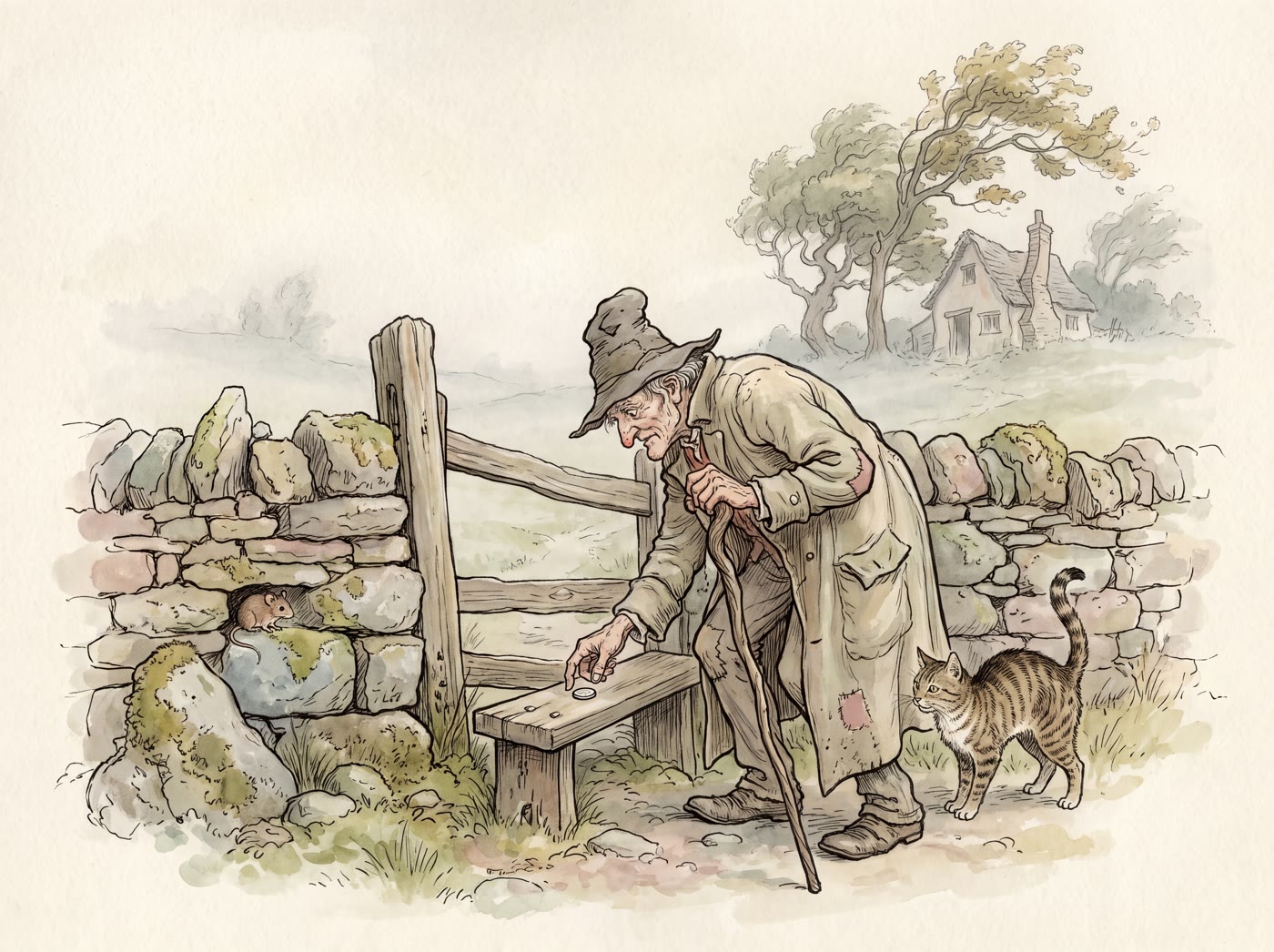
There was a crooked man,
And he walked a crooked mile.
He found a crooked sixpence
Upon a crooked stile.
He bought a crooked cat,
Which caught a crooked mouse,
And they all lived together
In a little crooked house.
Where the rhyme comes from
There Was a Crooked Man was first recorded in print by the antiquarian James Orchard Halliwell in The Nursery Rhymes of England (London, 1842), a collection he described as gathered “principally from oral tradition”. His wording differs very slightly from the version most people sing today: the man “went a crooked mile” and found his sixpence “against a crooked stile”.
Because Halliwell was writing down verses that were already being spoken aloud, the rhyme is certainly older than 1842 — but how much older, nobody knows. There is no earlier printed trace of it. It appeared in Victorian children’s books through the second half of the century, including The Crooked Man and Other Rhymes (1851), and became widely popular in the early twentieth century, when illustrators seized on the chance to draw tilted houses, leaning stiles and lopsided cats.
What does it mean?
Several explanations are repeated confidently online. None of them can be traced back to the rhyme’s own era, so all are best treated as theories rather than history:
The Scottish theory. A widespread story holds that the crooked man is the Covenanter general Sir Alexander Leslie, who fought for Scottish religious and political freedom during the reign of Charles I; the “crooked stile” is then the English–Scottish border, and the “little crooked house” the awkward union of two kingdoms sharing one monarch. It is a tidy reading — but it is a modern interpretation, unsupported by any seventeenth-century evidence, and Halliwell recorded the rhyme with no political note at all.
The Lavenham theory. Others point to the Suffolk wool town of Lavenham, whose medieval timber-framed houses have settled over the centuries into famous leans and tilts. One building there is even known as The Crooked House. It is an appealing origin, though again offered without documentary support.
The simplest reading. The likeliest explanation is the least dramatic: the rhyme is comic nonsense, and the joke is the word itself. “Crooked” spreads outward from the man to his mile, his coin, his stile, his cat, his mouse and finally his house, until the whole world has caught the same delightful tilt. That escalating absurdity is the point — and it is why children love it.
Sharing it with children
This is a lovely rhyme for the lap and for the hands. Crook a finger on every “crooked” — a bent finger for the man, two bent fingers for the cat’s ears, a whole bent arm for the house — and let the child join in until the crooks arrive faster than the words. Older toddlers enjoy walking a “crooked mile” across the room, zigzag and wobbling, then hunting for a hidden coin.
It also makes a gentle first drawing game: fold a sheet of paper and draw a house, a cat and a tree in which no single line is allowed to be straight. Hiding a real sixpence — or any coin — for the child to find on a step turns the middle of the rhyme into a small treasure hunt.
Extra verses to sing
These verses aren’t traditional — they’re ours. Sing them if the crooked house needs a little more company.
He planted a crooked seed,
And it grew a crooked tree.
It carried a crooked apple
That he shared for supper tea.
He whistled a crooked tune,
Which the cat began to sing,
And the mouse in the crooked corner
Danced a crooked highland fling.
One night in the crooked house,
When the crooked candle died,
The moon came in through the window
All bent and bright and wide.
“How straight the world would look,”
Said the crooked man with a smile,
“But I’d rather my crooked corner
Than a straight and tidy mile.”