Jack Sprat
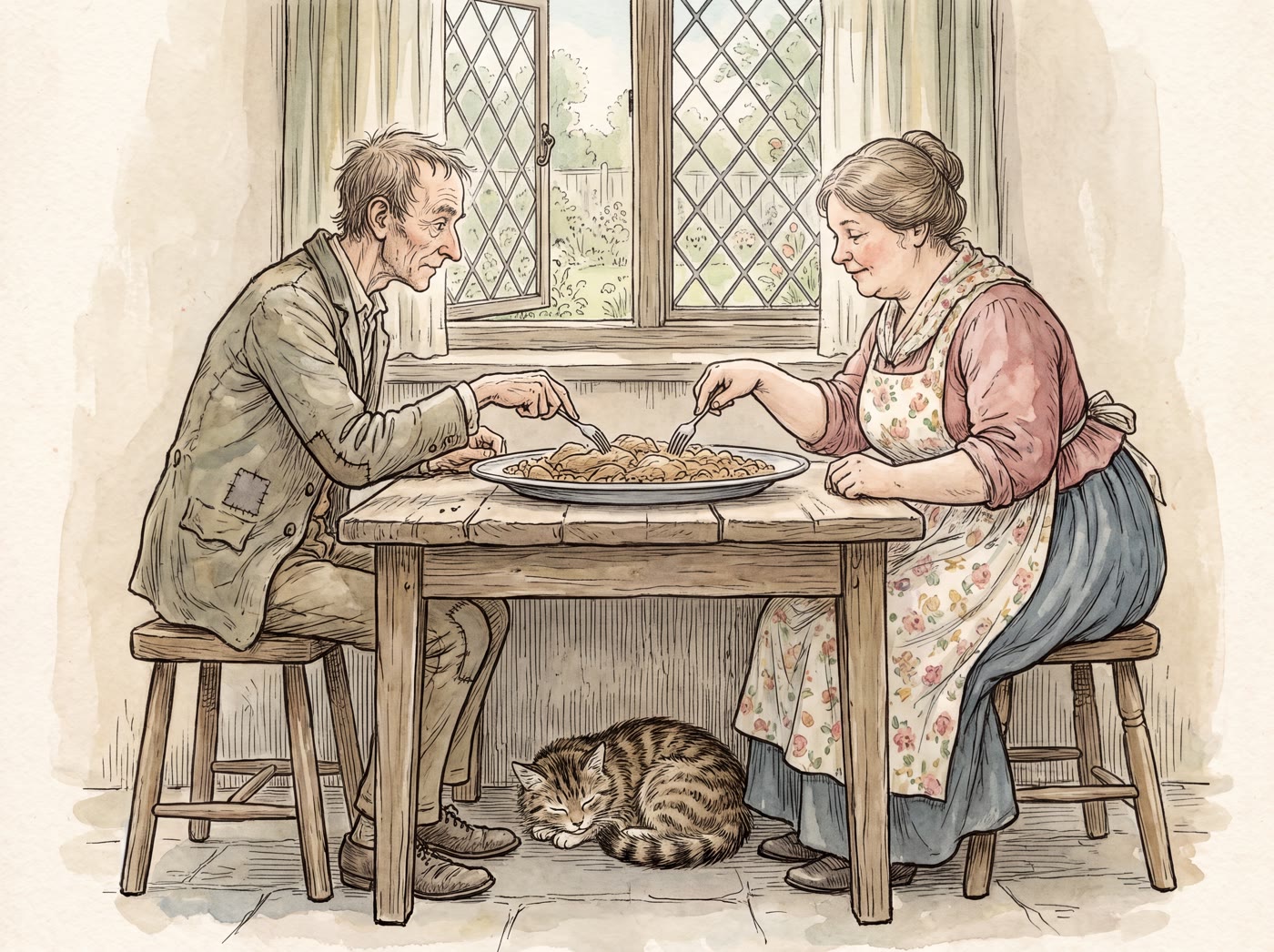
Jack Sprat could eat no fat,
His wife could eat no lean,
And so between them both you’ll see,
They licked the platter clean.
Where the rhyme comes from
Jack Sprat began life as a proverb rather than a children’s song, a saying about a mismatched couple who nonetheless manage well. It appears in John Clarke’s Paroemiologia Anglo-Latina, a collection of English proverbs printed in London in 1639. As transcribed from Clarke, the saying runs: “Jack will eat no fat, and Jill doth love no leane. Yet betwixt them both they lick the dishes cleane.” (Some modern books print the first line slightly differently; we have not seen Clarke’s own page, so treat the spelling as approximate.) The couple are an ordinary Jack and Jill, not a king and queen.
The name is older than the proverb. “Jack Sprat” was used in the 16th century for a person of small stature, and it turns up in print around 1569 in an anonymous morality play, The Marriage of Wit and Science, though what exactly it means there is not certain. By 1699 a dictionary of slang defined a “Jack-sprat” as “a dwarf, or very little fellow”. The sprat, a small fish, may be why. A variant recorded about twenty years after Clarke, in James Howell’s proverbs, gives the couple different names: “Archdeacon Pratt would eat no fatt, / His wife would eat no lean”, and between the archdeacon and Joan his wife “the meat was eat up clean”.
The rhyme reached the nursery through Mother Goose’s Melody, a little book published by the Newbery firm. It is usually dated to about 1765, but that date is an editor’s inference from the style of the book, not a printed one. The earliest copy that survives is the edition of 1791, where the rhyme reads “Jack Sprat / Could eat no fat, / His wife could eat no lean; / And so betwixt them both, / They lick’d the platter clean” and is followed by a maxim: “Better to go to bed supperless, than rise in debt.” So the rhyme, in very nearly its familiar form, was in print by the late eighteenth century. The Opies note in The Oxford Dictionary of Nursery Rhymes that it may have been used with children much earlier than any surviving printing.
In 1849 James Orchard Halliwell printed a much longer version, which he thought to be of some antiquity. In it Jack courts and marries Joan Cole, and later verses follow the couple through their household animals. Today only the first four lines survive in common use.
What does it mean?
At its plainest the rhyme is a small domestic joke and a thrifty moral: two people who want opposite things waste nothing between them. As a proverb that was very likely the whole point — a neat picture of a well-matched pair, and of not letting good food go to waste. The maxim attached to it in 1791, about going to bed supperless rather than rising in debt, points the same thrifty way.
Two grander readings are often repeated. Both are modern interpretations, and neither has contemporary evidence behind it:
Charles I and Henrietta Maria. A popular theory, put forward by the history writer Linda Alchin in a 2004 book, casts Jack as King Charles I — a notably short man — left “lean” when Parliament refused him taxes, who with his queen Henrietta Maria “licked the platter clean” once he had dissolved Parliament and raised money himself. It is an appealing fit, but it is a later reading of the rhyme rather than a documented origin.
King John and his queen. An alternative folklore tradition, borrowed from the Robin Hood legends, applies the rhyme to the unpopular King John and his queen, emptying the country’s platter between them. Some tellings add that the coffers were left bare after the ransom paid for Richard I. Again, this is a story told about the rhyme, not a record of how it came to be written.
There is also a chronological difficulty, and this is our own inference from the early records rather than a scholar’s finding. The proverb is already in print in 1639, during Charles I’s reign, yet nothing in that version ties it to him. Nothing in the oldest forms points to a king and queen: they name a Jack and a Jill, or an archdeacon and his wife Joan.
Sharing it with children
Jack Sprat is a lovely lap rhyme because the whole thing can be done with two hands. Hold up a thin finger for Jack and a round fist for his wife, and let them nod to each other on their lines. On “licked the platter clean”, sweep a flat palm in a big circle and finish with a satisfied smack — toddlers will join in on that last line long before they can say the rest.
It also makes a gentle first conversation about differences: one person likes this, one likes that, and together they manage rather well. At the table, ask a child what they would leave on the plate and who in the family would happily eat it — a small, cheerful lesson in sharing and in not wasting food.
Extra verses to sing
These verses aren’t traditional — they’re ours. Sing them on if the supper isn’t finished.
Jack Sprat would eat no crust,
His wife would eat no crumb,
And so between them both, you see,
The birds were glad they’d come.
Jack Sprat could drink no cream,
His wife could drink no tea,
And so between them both, you see,
The cat had both for free.