The House That Jack Built
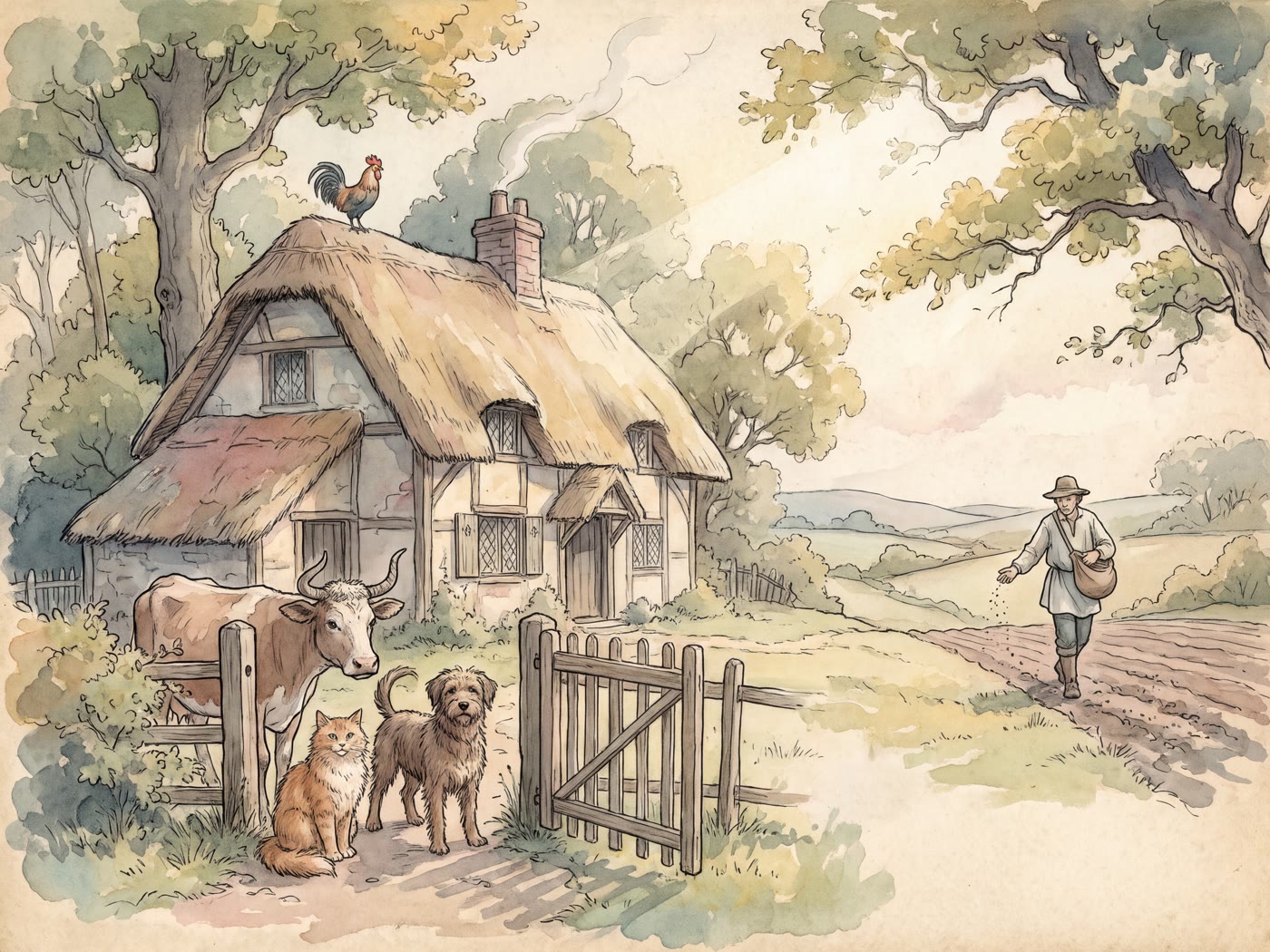
This is the house that Jack built.
This is the malt
That lay in the house that Jack built.
This is the rat,
That ate the malt
That lay in the house that Jack built.
This is the cat,
That killed the rat,
That ate the malt
That lay in the house that Jack built.
This is the dog,
That worried the cat,
That killed the rat,
That ate the malt
That lay in the house that Jack built.
This is the cow with the crumpled horn,
That tossed the dog,
That worried the cat,
That killed the rat,
That ate the malt
That lay in the house that Jack built.
This is the maiden all forlorn,
That milked the cow with the crumpled horn,
That tossed the dog,
That worried the cat,
That killed the rat,
That ate the malt
That lay in the house that Jack built.
This is the man all tattered and torn,
That kissed the maiden all forlorn,
That milked the cow with the crumpled horn,
That tossed the dog,
That worried the cat,
That killed the rat,
That ate the malt
That lay in the house that Jack built.
This is the priest all shaven and shorn,
That married the man all tattered and torn,
That kissed the maiden all forlorn,
That milked the cow with the crumpled horn,
That tossed the dog,
That worried the cat,
That killed the rat,
That ate the malt
That lay in the house that Jack built.
This is the cock that crowed in the morn,
That woke the priest all shaven and shorn,
That married the man all tattered and torn,
That kissed the maiden all forlorn,
That milked the cow with the crumpled horn,
That tossed the dog,
That worried the cat,
That killed the rat,
That ate the malt
That lay in the house that Jack built.
This is the farmer sowing his corn,
That kept the cock that crowed in the morn,
That woke the priest all shaven and shorn,
That married the man all tattered and torn,
That kissed the maiden all forlorn,
That milked the cow with the crumpled horn,
That tossed the dog,
That worried the cat,
That killed the rat,
That ate the malt
That lay in the house that Jack built.
Where the rhyme comes from
The earliest known printing, as recorded by William Baring-Gould’s The Annotated Mother Goose and the Opies’ Oxford Dictionary of Nursery Rhymes, is in Nurse Truelove’s New-Year’s-Gift, or the Book of Books for Children, published in London in 1755. We have not seen a scan of that book ourselves, so treat the date as theirs rather than ours. The rhyme was then printed in many collections in the late eighteenth and early nineteenth centuries. A possible earlier trace, a line “This is the man all forlorn” in a Boston newspaper of 1739, has been noted, but it is only a possible one.
Folklorists class the rhyme as a cumulative tale, type 2035 in the Aarne–Thompson–Uther index. Some have argued that it descends from Chad Gadya (“One Young Goat”), an Aramaic song in the Passover Haggadah first printed in 1590. The two do share a cumulative shape, but the Opies found little else in common, so it is best taken as a parallel in form, not a proven ancestor. The nineteenth-century collector James Orchard Halliwell thought “priest all shaven and shorn” hinted that the rhyme might be as old as the mid-sixteenth century; that was an inference, not evidence.
The pattern proved easy to borrow: William Hone’s The Political House That Jack Built (1819), illustrated by George Cruikshank, is a famous parody.
What does it mean?
Very little, and that is its charm. The rhyme never tells the story of Jack or his house; it shows how one thing leads to another, and the only tale in it is that of the tattered man and the forlorn maiden. Who Jack was, if anyone, is not known. Claims that the rhyme is a coded political, religious or historical allegory are folklore: we found no evidence for any of them, and the scholars we have relied on treat the origin as unknown.
What the rhyme does do is teach grammar by stealth. Each stanza adds one more clause to the chain and repeats everything before it, so a child who can say the last verse has, without noticing, practised nested relative clauses and a long sequence in order.
Sharing it with children
Memory chain. Say the first stanza together, then add one link at a time. Stop at whichever verse your listener can manage; the rat is a fine place to end for a two-year-old.
Picture cards. Draw or cut out the characters — house, malt, rat, cat, dog, cow, maiden, man, priest, cock, farmer — and lay them in a row. Children can put them in order, or you can shuffle them and recite the rhyme while they pick the right card.
A line each. In a group, give each child one character. When the verse reaches theirs, they say it, or make its noise. The cock and the cow tend to be popular.
Speed-up. Once the chain is secure, say it again faster, then faster again. The repeated ending, “that lay in the house that Jack built”, is a pleasing thing to trip over.
Extra verses to sing
These verses aren’t traditional — they’re ours. They add two more links beyond the farmer, so sing them after the farmer’s verse and then run the whole chain back to the house that Jack built.
This is the wife who baked the bread,
That fed the farmer sowing his corn,
That kept the cock that crowed in the morn…
This is the child who slept in the bed,
That woke to the smell of the wife’s fresh bread,
That fed the farmer sowing his corn…