Who Killed Cock Robin
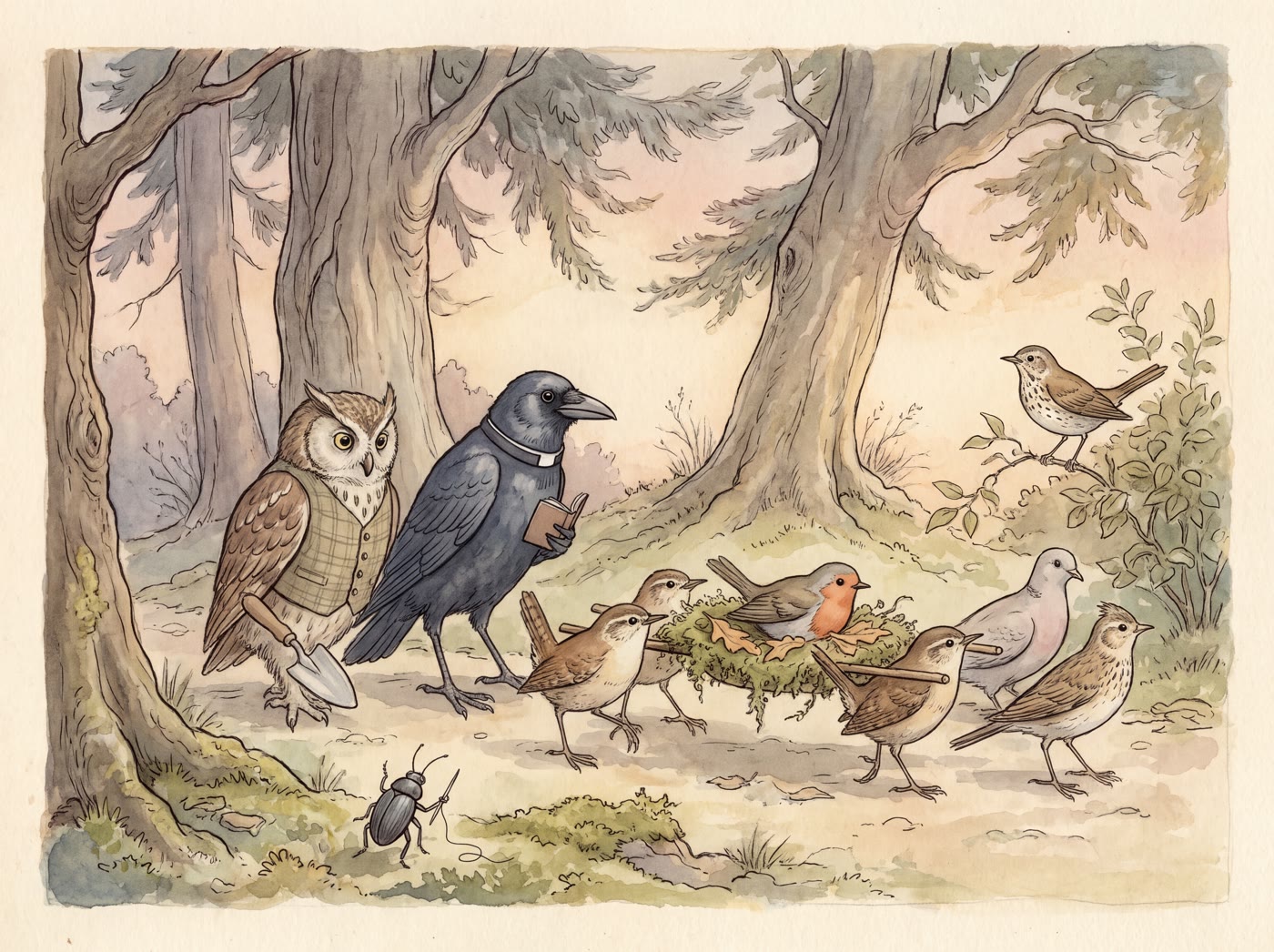
Who killed Cock Robin?
I, said the Sparrow,
With my bow and arrow,
I killed Cock Robin.
Who saw him die?
I, said the Fly,
With my little teeny eye,
I saw him die.
Who caught his blood?
I, said the Fish,
With my little dish,
I caught his blood.
Who’ll make the shroud?
I, said the Beetle,
With my thread and needle,
I’ll make the shroud.
Who’ll dig his grave?
I, said the Owl,
With my pick and trowel,
I’ll dig his grave.
Who’ll be the parson?
I, said the Rook,
With my little book,
I’ll be the parson.
Who’ll be the clerk?
I, said the Lark,
If it’s not in the dark,
I’ll be the clerk.
Who’ll carry the link?
I, said the Linnet,
I’ll fetch it in a minute,
I’ll carry the link.
Who’ll be chief mourner?
I, said the Dove,
I mourn for my love,
I’ll be chief mourner.
Who’ll carry the coffin?
I, said the Kite,
If it’s not through the night,
I’ll carry the coffin.
Who’ll bear the pall?
We, said the Wren,
Both the cock and the hen,
We’ll bear the pall.
Who’ll sing a psalm?
I, said the Thrush,
As she sat on a bush,
I’ll sing a psalm.
Who’ll toll the bell?
I, said the Bull,
Because I can pull,
I’ll toll the bell.
All the birds of the air
Fell a-sighing and a-sobbing,
When they heard the bell toll
For poor Cock Robin.
Where the rhyme comes from
According to Iona and Peter Opie’s Oxford Dictionary of Nursery Rhymes, the earliest known record of the rhyme is in Tommy Thumb’s Pretty Song Book in 1744. That printing has only the first four verses — the killer, the witness, the blood and the shroud, answered by the Sparrow, the Fly, the Fish and the Beetle. The longer funeral, with its parson, pallbearers and tolling bell, was not printed until about 1770, again on the Opies’ dating.
Words vary from book to book; the version above is the one most often given today. The rhyme was clearly loved: it went on to fill small illustrated books of its own, among them a nineteenth-century Death and Burial of Poor Cock Robin, and a sequel in which the Sparrow is put on trial. Some versions end with the Sparrow hanged.
Older bird laments exist, and are sometimes set beside it as echoes rather than ancestors. John Skelton wrote Phyllyp Sparowe, a lament for a pet bird, around 1508, and a fifteenth-century schoolmaster’s notebook contains a scrap of verse about a sparrow shooting an arrow. Nobody has shown that either is a forerunner of this rhyme.
What does it mean?
The honest answer is that nobody knows. Several explanations are offered, and all of them rest on resemblances of name or incident rather than on evidence. Peter Opie pointed out that an existing rhyme could have been adapted to fit the political events of the eighteenth century.
The fall of Sir Robert Walpole. Robin is a diminutive of Robert, and Walpole’s government fell in 1742, not long before the rhyme’s first printing. The idea is attractive but unsubstantiated.
The death of William Rufus. William II, “the Red”, was killed by an arrow in the New Forest in 1100, and the Sparrow’s bow and arrow have been read as a parody of the event. Again, there is nothing in writing to link the two.
An old sacrifice. Some folklorists have read the rhyme as the faint memory of a ritual killing, or of the death of the god Balder in Norse myth. This is the sort of “pagan survival” reading that is easy to make and very hard to prove.
One small puzzle is more modest. Not everyone in the procession is a bird, and several early illustrated books show the Bull as a stocky bullfinch. It may well have been the original intention, though that is a guess from the pictures.
Do not confuse the rhyme with the 1935 Disney cartoon or an episode of Midsomer Murders, both of which borrow its title.
Sharing it with children
The rhyme is a funeral procession, told gently and in a steady rhythm, and the death is that of a bird rather than anyone a child knows. Some adults may find it a soft way to open a conversation about loss; it is only a suggestion, and you will know best whether your child is ready.
It is made for call and response. Read each question, and let a child — or a different child for each creature — answer. Thirteen voices answer, though the Wren says “we”, so a pair of children can share that part. Give the Bull a bell, or a spoon on a saucepan, to toll.
For a memory game, build a chain: name the Sparrow, then the Sparrow and the Fly, then the Sparrow, Fly and Fish, and so on, until the whole procession is recited in order. Finger puppets or paper beaks on sticks give younger children a role to hold, and the rhythm of the closing stanza — the long, quiet “a-sighing and a-sobbing” — is best said slowly and softly.
Extra verses to sing
These verses aren’t traditional — they’re ours. Sing them as a gentle coda if you would like the procession to end on a quieter note.
Who’ll bring a leaf?
I, said the Moth,
With my wings of cloth,
I’ll bring a leaf.
Who’ll keep him in mind?
We, said the birds,
Without any words,
We’ll keep him in mind.