Ladybird, Ladybird
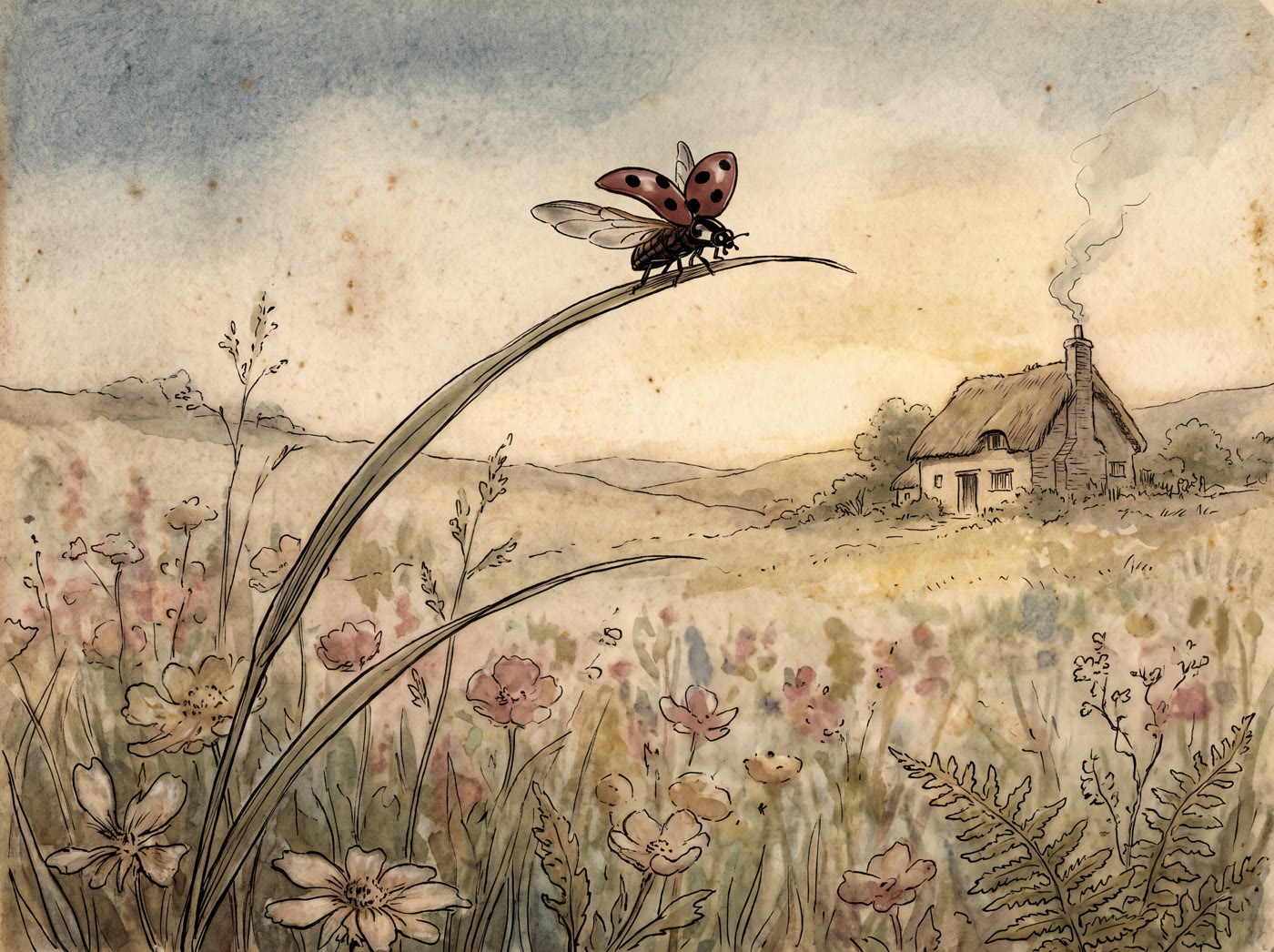
Ladybird, ladybird, fly away home,
Your house is on fire and your children are gone,
All except one, and her name is Ann,
And she hid under the baking pan.
Where the rhyme comes from
Ladybird, Ladybird — also sung as Ladybug, Ladybug, its usual name in America — has been dated to at least 1744. That year Mary Cooper published Tommy Thumb’s Pretty Song Book in London, the oldest printed collection of English nursery rhymes known to survive, and it includes the rhyme as “Lady Bird”. The 1744 text is shorter than the one above: “Lady Bird, Lady Bird, / Fly away home, / Your house is on fire, / Your Children will burn.”
There is no surviving child, no Ann and no pan. The happier ending in the popular version is a later addition; we have not found a date for it. The wording has wandered a great deal since. The child who escapes may be Nan, Anne or Little Anne, and she may hide under a warming pan, a porridge pan, a frying pan or a pudding pan. A version recorded around Peterborough and published in 1911 has “Your horse is on foot, your children are gone; / All but one, and that’s little John, / And he lies under the grindle stone”. James Orchard Halliwell printed a Yorkshire version in 1842 that begins “Ladycow, Ladycow, ply thy way home”, and a Scots one noted in 1849 opens “Dowdy-cow, dowdy-cow, ride away heame”.
German children have a close cousin — “Marienkäferchen, fliege weg! Dein Häuschen brennt” — quoted from an 1848 collection, though which language borrowed from which is not known. In America the word “ladybug” is recorded as early as 1699, but the rhyme is not mentioned there until the nineteenth century, when it turns up in Mark Twain’s The Adventures of Tom Sawyer (1876). It is number 16215 in the Roud Folk Song Index.
What does it mean?
The honest answer is that nobody knows for certain. It is best read as a send-off: the child speaks to the insect, the insect flies, and that is the end of the matter. Two explanations are often given, and neither is documented.
Burning the fields. The usual explanation is that farmers once burned stubble or hop vines after harvest, and the rhyme warned the helpful ladybirds to escape. It is a tradition rather than a documented fact. We have found no record of farmers reciting the rhyme, and nothing showing that it began in that practice. It is plausible, and unproven.
The Catholic reading. The insect’s name is generally taken to refer to Our Lady, the Virgin Mary — hence the German Marienkäfer and the Swedish “Virgin Mary’s keyholder”. From there, a popular story makes the rhyme a coded warning from the days of laws against Catholics. It is widely repeated, but there is no contemporary evidence: the 1744 text has nothing religious in it, and the same name for the insect is found across Europe. A second tale, that the beetles first appeared in answer to prayers to save medieval crops from pests, is likewise a legend rather than a record.
If the fire in the words worries you, it need not. The rhyme is nearly always spoken in a gentle sing-song as the insect leaves a hand, and in the popular version Ann, at least, is safe under her pan.
Sharing it with children
Among children it is common to place a ladybird on the hand, or to blow it gently from a sleeve, and recite the rhyme, often with a wish. Let it walk up a finger of its own accord and say the words slowly, so that “fly away home” comes as it leaves. Do not shake the insect off, and wash hands afterwards.
Count the spots on its back together before it goes. Spot-counting has its own folklore — in Sussex, one belief is said to promise as many happy months as there are spots — but it is a game, not a forecast.
Without a ladybird to hand, make a finger-play: a closed fist for the shell, then two flapping hands as the wings lift on “fly away”, and a hidden thumb tucked under the other palm for Ann beneath her pan. The surviving child makes a good guessing game for toddlers: where is Ann hiding?
Extra verses to sing
These verses aren’t traditional — they’re ours. Sing them if you would like the rhyme to end somewhere cosier.
Ladybird, ladybird, fly away home,
Your house is quite safe and your children have grown,
They’re all in the garden, and Ann is there too,
Waiting with supper and leaves wet with dew.
Ladybird, ladybird, over the hill,
The kettle is warm and the cottage is still,
Ann lit a candle and left it to shine,
So fly away home, and be back by nine.