Star Light, Star Bright
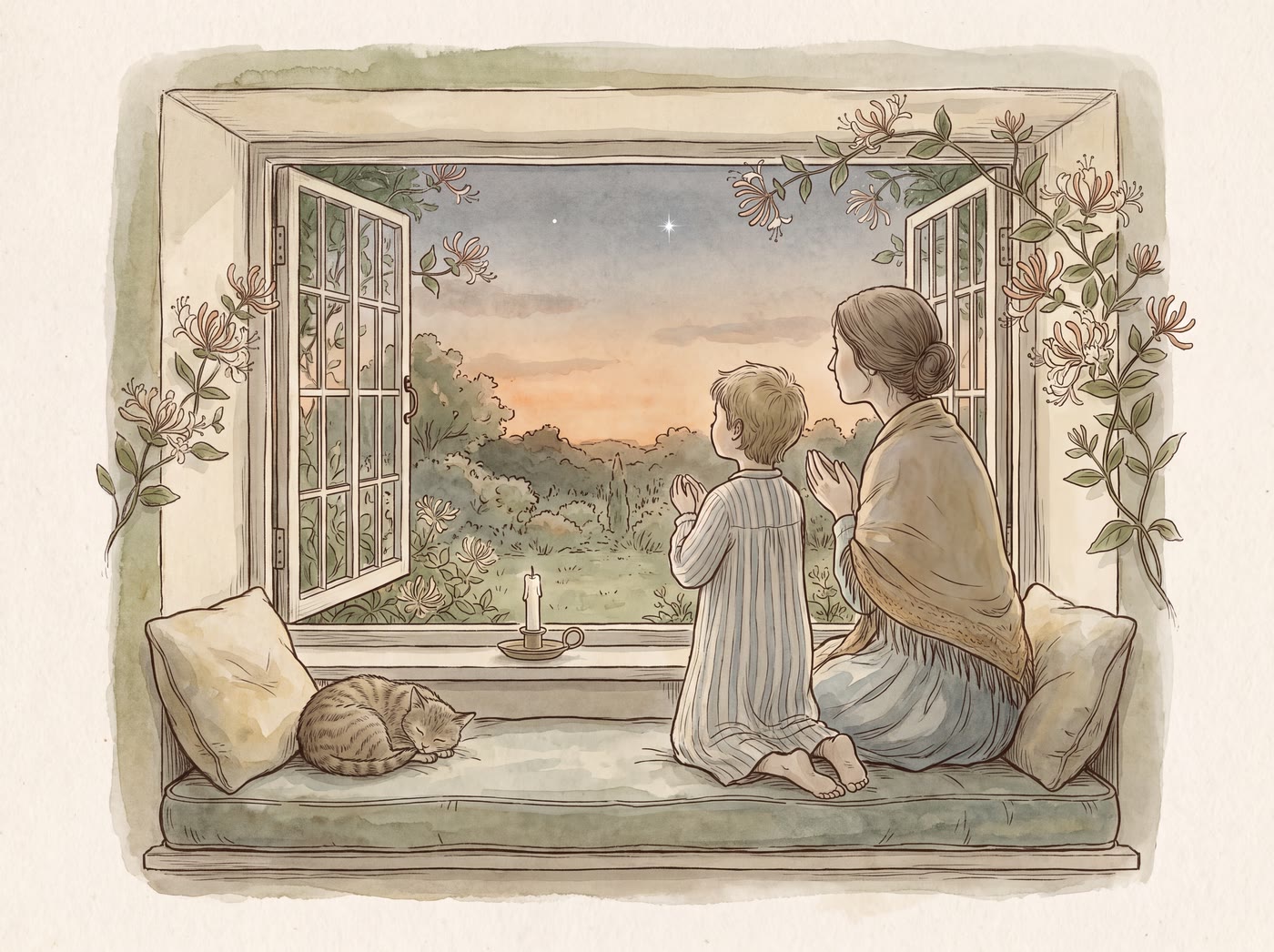
Star light, star bright,
The first star I see tonight;
I wish I may, I wish I might,
Have the wish I wish tonight.
Where the rhyme comes from
Those four lines are the whole rhyme. There is no longer “full poem” hiding behind them, and no original singer: Star Light, Star Bright is an anonymous traditional chant, not an authored song, and nobody knows who first said it. It is a wishing charm, spoken aloud on seeing the first star of the evening. Pop songs and films have borrowed the phrase over the years, but they are separate works.
It is also an American rhyme. It was first recorded in America in the second half of the nineteenth century, and according to Opie and Tatem’s A Dictionary of Superstitions (1989) the rhyme and its custom seem to have reached Britain by the early twentieth century, and have since spread worldwide. Particular printings from the 1860s and 1870s are sometimes cited as the earliest, but we have not been able to read them, so the half-century is as far as we will go. The rhyme is number 16339 in the Roud Folk Song Index.
Like anything passed on by mouth, the words wander a little. Some versions drop the “The” from the second line — “First star I see tonight” — and some end “Have this wish I wish tonight”. None of them is wrong.
What does it mean?
A wish, said properly. The meaning is the plain one. You find the first star, say the words to it, and make your wish. “I wish I may, I wish I might” is the speaker hoping to be both allowed and able to have what they are about to ask for — a careful, almost legal bit of phrasing for a child’s spell. The custom of wishing on a star is probably older than the rhyme, but where it began is not known. Claims that it reaches back to antiquity are widely repeated, though the evidence is thin.
The first star is often a planet. The bright “star” that appears in the western sky soon after sunset is often not a star at all but Venus, the brightest object in the night sky after the Moon. Venus never strays far from the Sun, so it is only ever seen around dusk or dawn, and it is an evening “star” for only part of the year. Many a wish, in other words, has been made on a planet — and nobody seems to mind.
Sharing it with children
This is a rhyme for the window at the end of the day. Make it a small evening ritual: as the sky darkens, stand at the glass — or in the garden on a summer evening — and see who can spot the first star. Streetlights, cloud and aeroplanes all make it harder than it sounds, which only makes the find more of a triumph. Whoever sees it first says the rhyme. Older children may enjoy knowing that the brightest early “star” may be a planet, and checking it night after night.
Then the wish. Many families say a wish made on the first star must be kept secret or it won’t come true, so make it a whispered game: the wish goes into cupped hands, or isn’t said aloud at all. A quiet hand action suits the mood. Hold up an open hand, fingers spread, for the star on “Star light, star bright”; on “I wish I may, I wish I might”, close it gently and bring it to the chest, keeping the secret wish safe inside.
Nothing in the record makes it a bedtime rhyme, but it makes a lovely one, and it pairs naturally with Twinkle, Twinkle, Little Star: one rhyme wonders what the star is, the other asks it for something. Say them one after the other, curtains open, and then draw the curtains.
Extra verses to sing
These verses aren’t traditional — they’re ours. One for after the wish is made, and one for the nights when the clouds win.
Star light, star bright,
Watch me sleeping through the night;
Keep my secret wish held tight
Till the morning brings the light.
Cloudy night, no star in sight,
Not a single twinkling light;
I’ll fold my wish up small and tight
And wish it on tomorrow night.