One for Sorrow
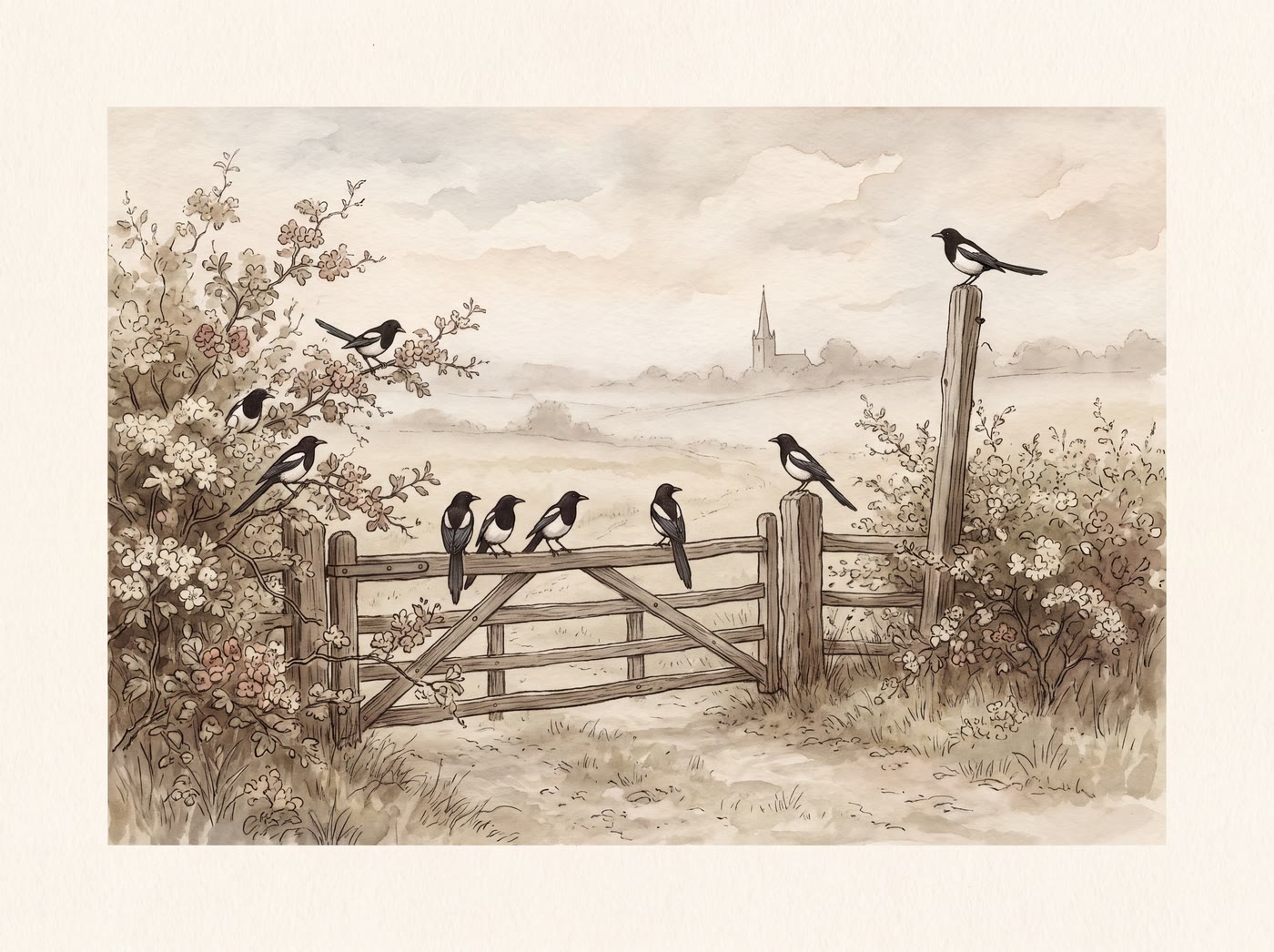
One for sorrow,
Two for joy,
Three for a girl,
Four for a boy,
Five for silver,
Six for gold,
Seven for a secret never to be told.
Where the rhyme comes from
Nobody knows who made this rhyme. It is first recorded in 1780, in Samuel Johnson and George Steevens’s supplement to their edition of Shakespeare’s plays, in a note explaining that in the West the magpie was called “to this hour” a magatipie. The lines they give are short and blunt: “One for sorrow, / Two for mirth, / Three for a wedding, / Four for death.” Rhyme sites often credit Brand’s Observations on Popular Antiquities instead; Brand does discuss the magpie as an omen, but the lines themselves come from the Shakespeare note.
The silver, the gold and the secret first appear in print in 1846, in Michael Aislabie Denham’s Proverbs and Popular Sayings of the Seasons, printed for the Percy Society: “Five for silver, / Six for gold; / Seven for a secret never to be told”. Denham’s version runs on to ten, and grows darker as it goes — so dark that the printed text will not give it in full. “Eight for heaven” is printed plainly; hell and the devil, in the last two lines, are reduced to dashes.
The version most of us know, with its girl and boy, is neither of these. It is a later blend of the old lines, given as the common modern form in P. Tate’s Flights of Fancy (2010); we have found no record of when the girl and boy first appeared. Regional versions vary enormously. A longer one recorded in Lancashire continues: “Eight for a wish, / Nine for a kiss, / Ten a surprise you should be careful not to miss, / Eleven for health, / Twelve for wealth, / Thirteen beware it’s the devil himself.” That is as far as any traditional version we know of goes. Lines running on to twenty, which circulate widely online, are modern invention rather than recovered folklore.
A version served as the theme tune of ITV’s children’s programme Magpie (1968–1980), performed by the Spencer Davis Group, and its popularity is thought to have pushed out many local variants. Steps’ 1998 song “One for Sorrow” is a different work altogether.
What does it mean?
It is a counting superstition. You count the magpies you see, and the number tells your fortune. The rhyme sits inside a much older belief: Iona Opie and Moira Tatem’s Dictionary of Superstitions (1989) traces the idea of the magpie as a bird of ill omen in Britain back to at least the early sixteenth century. Where that belief began is not documented, and every story offered to explain it should be treated as folklore rather than fact.
Saluting the lone magpie. Because a single bird means sorrow, English tradition says a lone magpie should be greeted politely — “Good morning, Mr Magpie, how are Mrs Magpie and all the other little magpies?” In Shropshire, Georgina Jackson’s Shropshire Folk-Lore (1885) recorded a fiercer remedy: defying the devil aloud and spitting three times.
Why silver, why gold? There is no documented reason behind any of the numbers. Sorrow and joy, wedding and death, silver and gold are simply what tradition attached to each count, and the meanings shift from one version to the next — mirth becomes joy, a wedding becomes a girl. The honest answer is that the individual meanings are arbitrary.
Magpies or crows? Both, depending on where you live. Where magpies are rare, particularly in America, the rhyme is used for crows, jackdaws and other members of the crow family; in eastern India the common myna takes the magpie’s place.
Sharing it with children
The rhyme belongs outdoors, so take it for a walk. Magpies are easy for small children to spot — black and white, long-tailed, loud — and a magpie-spotting walk turns every sighting into a counting task: how many on the lawn, how many on the roof, which line does that land on? If you see just one, teach the greeting.
Indoors, make it a fist-counting game. Start with closed fists and raise one finger for each line, five on the first hand and two on the second, so the child feels where “seven for a secret” falls.
For a quieter session, draw a magpie for each number and write the line beneath it — a small illustrated counting book of the child’s own. Finally, play “make up your own line for eleven”: the rhyme has always been rewritten, so any child who invents “eleven for a puddle” is doing exactly what generations before them did.
Extra verses to sing
These verses aren’t traditional — they’re ours. No old version we know of counts past thirteen, so if your walk turns up a whole flock, here is the rest of the way to twenty.
Fourteen for a feather,
Fifteen for fine weather,
Sixteen for a song in the hawthorn tree,
Seventeen for a story to share with me.
Eighteen for a nest,
Nineteen for a rest,
Twenty for the magpies all flying home to bed,
With the sun going down in gold and red.