Tinker, Tailor, Soldier, Sailor
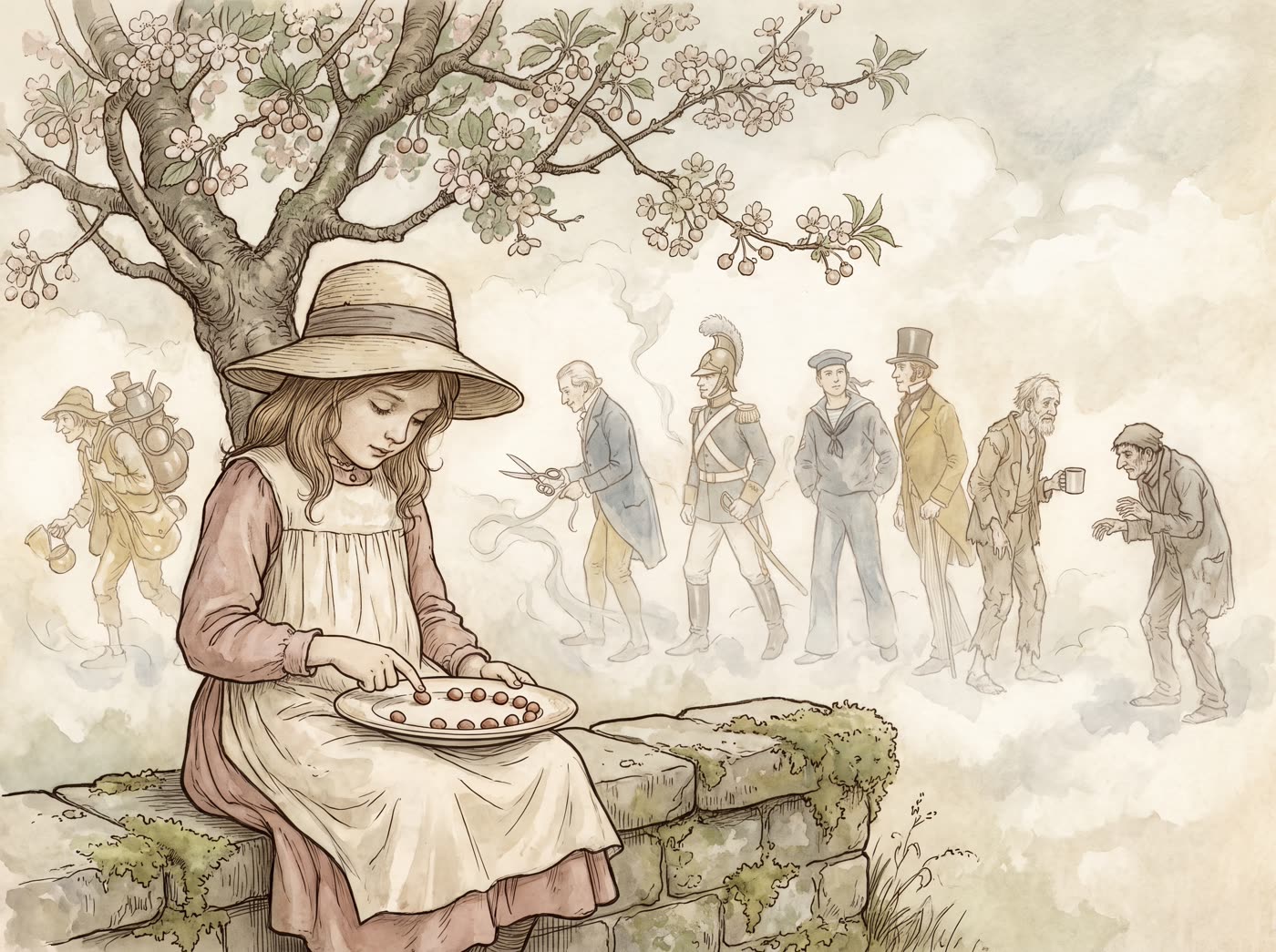
Tinker, tailor,
Soldier, sailor,
Rich man, poor man,
Beggar man, thief.
Where the rhyme comes from
This is one of the oldest counting-out rhymes still in daily use, and it carries the Roud Folk Song Index number 802. The earliest record of the opening four trades appearing together is in William Congreve’s comedy Love for Love (1695), where the sailor Ben sings of “a soldier and a sailor, a tinker and a tailor” who “had once a doubtful strife, sir, to make a maid a wife, sir” — already a song about who a girl might marry.
Lists of trades of this kind are older still. William Caxton’s The Game and Playe of the Chesse (c. 1475) names the pawns “Labourer, Smith, Clerk, Merchant, Physician, Taverner, Guard and Ribald” — the same idea of society set out as a countable row of figures, though it is a forerunner rather than a version of our rhyme.
The words we know settled into a children’s rhyme during the 19th century, when collectors began writing down what children actually chanted. James Orchard Halliwell recorded a button-counting rhyme in the 1840s that begins quite differently — “My belief, a captain, a colonel, a cow-boy, a thief” — a useful reminder that the list was never fixed. Iona and Peter Opie gathered the rhyme’s history in the Oxford Dictionary of Nursery Rhymes (1951). In America the sequence is usually continued or replaced with “rich man, poor man, beggar man, thief, doctor, lawyer, merchant, chief”.
What does it mean?
Unusually for a nursery rhyme, we do not have to guess what it is for: children have always told us. It is a counting-out rhyme and a fortune-telling game at once. You count objects — cherry stones left on the plate, buttons down a coat, petals off a daisy, bounces of a ball, jumps of a skipping rope — giving one word to each, and the word that falls on the last object is your answer. In the older game the answer was the trade of the husband a girl would marry; in the playground it simply decides who is “it”.
The list itself is a small ladder of Georgian and Victorian society, running from the travelling mender of pots down through respectable trades and the services to money, poverty and crime. Whether that descent was meant as social comment is a matter of interpretation rather than record — the honest reading is that the words were chosen because they scan, alliterate and cover the whole range of fortunes a life might take, which is exactly what a fortune-telling game needs.
Longer versions. Children have always extended it, and the same game runs through other lists — “Lady, baby, gypsy, queen”, “Coach, carriage, wheelbarrow, cart”, “Big house, little house, pig-sty, barn” — used to divine what you will wear, ride or live in. These are traditional companions to the rhyme rather than parts of it.
A note on the name. The rhyme is best known today through John le Carré’s Tinker Tailor Soldier Spy (1974), which borrows the rhyme to codename its suspects. That is a modern echo of the rhyme, not a clue to its origin.
Sharing it with children
This rhyme is counting practice with a prize at the end, so give children something real to count. Cherry or plum stones on the side of a plate are the traditional choice; buttons, pebbles, raisins, conkers or beads all work. Touch each one as you say a word, one word to one object, and let the child say where it lands. That one-to-one touching is genuine early maths — it teaches that counting is about matching, not just reciting.
Once they have the idea, play with the numbers. Ask before you start: “How many stones do we need for it to land on sailor?” Count out eight objects and discover that the rhyme always ends on “thief”; add one more and it starts again at “tinker”. Older children can work out the pattern for themselves, which is a first taste of remainders and repeating cycles.
It is also a good talking rhyme. Ask what a tinker actually did, why a sailor was a fine thing to marry, and what jobs the list would hold if it were written today — then make your own version with a doctor, a driver, a baker and an astronaut. Chant it while skipping, pull it out to decide who goes first, and count the buttons on a coat on the way out of the door.
Extra verses to sing
These verses aren’t traditional — they’re ours. Add them when eight trades aren’t enough to go round.
Baker, builder,
Farmer, miller,
Fine lady, fisherman,
Piper, chief.
Doctor, driver,
Diver, diver,
Cherry stone, button stone,
Count them again.