One Potato, Two Potato
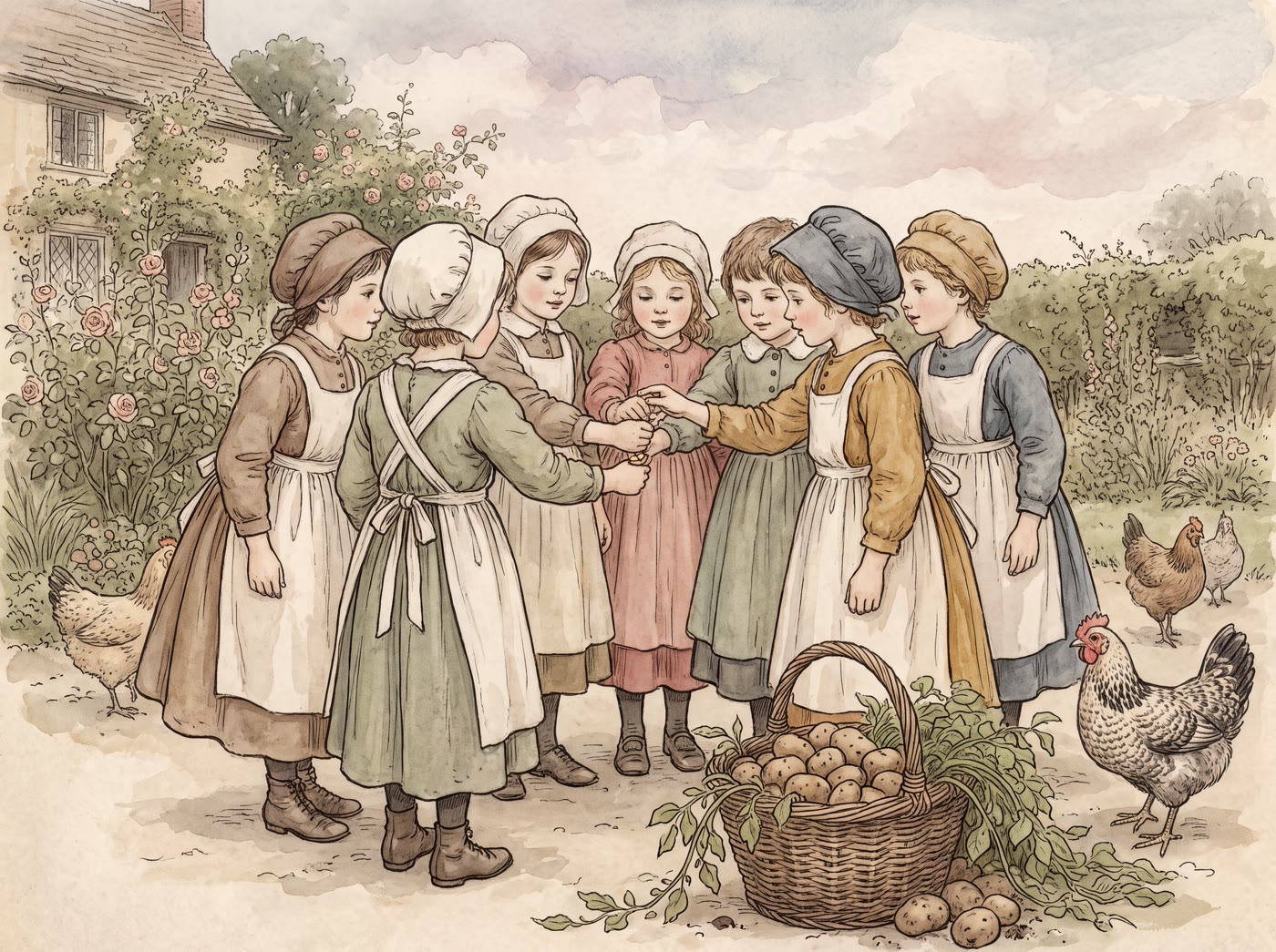
One potato, two potato,
Three potato, four,
Five potato, six potato,
Seven potato, more.
Where the rhyme comes from
One Potato, Two Potato belongs to the great family of playground counting-out rhymes — the chants children use to decide who is “it”. The earliest record anyone has traced comes from Nova Scotia, in Canada, where it was noted in 1885: Roger Abrahams and Lois Rankin give that date in Counting-Out Rhymes: A Dictionary (1980), and Jacqueline Simpson and Steve Roud repeat it in A Dictionary of English Folklore (2000). That tells us only when grown-ups began writing the chant down, not when children began saying it.
Unlike a printed nursery rhyme, it has no single author, and where it began nobody knows. It travelled by mouth, from one playground to the next, and travelled well: Iona and Peter Opie, surveying Children’s Games in Street and Playground (1969), found it “in constant use” in both Britain and the United States. The Roud Folk Song Index lists it as number 19230.
A rhyme that lives by mouth is never quite fixed. One collected version ends “seven potato, raw”; another carries on to “eight potato, nine potato, ten potato, all”; and one ends, bluntly, “One bad spud!” The version printed here, ending on “more”, is simply the one we give. How old it really is, nobody can honestly say.
What can be said is why it works. “Potato” has three neat syllables, so each number and its potato make one even beat, and the bare single words “four” and “more” land like a full stop. Short lines, a strong rhyme and almost no story make it easy to learn at a single hearing — exactly what a chant needs if it is to be passed on without a book.
What does it mean?
Chiefly, it means “you are it”. The rhyme is a fair-choosing device: the players hold out their fists, one child taps each fist in turn on every beat, and whoever’s fist falls on “more” is out (or, if the players agree beforehand, chosen). The fist goes behind the back and the count begins again until one player is left.
The famine theory. Because of the potato, the rhyme is sometimes said to carry a memory of the Irish potato famine, or of children counting a meagre harvest. This is folklore rather than documented history — no early source connects the two, and nothing in the words themselves speaks of hunger: the potatoes are simply things to count.
The counting-out inheritance. The plainer view is simply that it is one of a great many nonsense counting-out chants, close cousins of “Eeny, meeny, miny, moe” and “Ip dip sky blue”, in which the rhythm matters far more than the words. Its job is to sound impartial, so that no child can argue with the result. It keeps the same company on this site: Tinker, Tailor, Soldier, Sailor is still used to settle who is “it”, and Hickory Dickory Dock was once used for counting-out too.
Sharing it with children
The rules, plainly. Everyone stands in a circle and holds out both fists, and one player is the counter — who counts their own fists along with everyone else’s. Going round the circle, the counter taps one fist for each number: “one potato” on the first fist, “two potato” on the next, then “three potato”, “four”, and on to “seven potato” and “more”, eight taps in all. The fist touched on “more” goes behind its owner’s back, and the next round starts from the fist after it. A player who loses both fists is out; the last fist left decides who is “it”.
Play it properly with fists. With everyone’s hands out, each tap lands on a beat — one, two, three, four — so the counting is felt in the hands as well as heard. It is a lovely first lesson in one-to-one correspondence: one tap, one number, every time.
For younger children, line up real potatoes (or wooden blocks) and move one forward for each number, then count them back down from seven to one. Older children can predict who will be “out” before the count begins — changing the starting player and watching the answer change is a first taste of arithmetic patterns. It also works as a skipping chant, one jump per potato.
For a game that needs no counter at all, sit in a circle and pass a single real potato from hand to hand, one pass for each number, while everyone chants together. Whoever is holding it on “more” chooses the next game, or the next rhyme, and starts the potato on its way again. Slow the chant right down for the smallest players, so the passing stays gentle and every hand gets its turn.
Extra verses to sing
These verses aren’t traditional — they’re ours. Add them when the counting needs to go on a little longer.
One potato, two potato,
Dug from the ground,
Three potato, four potato,
Rolling round and round.
Five potato, six potato,
Into the pot,
Seven potato, more potato —
Count them while they’re hot!