One Man Went to Mow
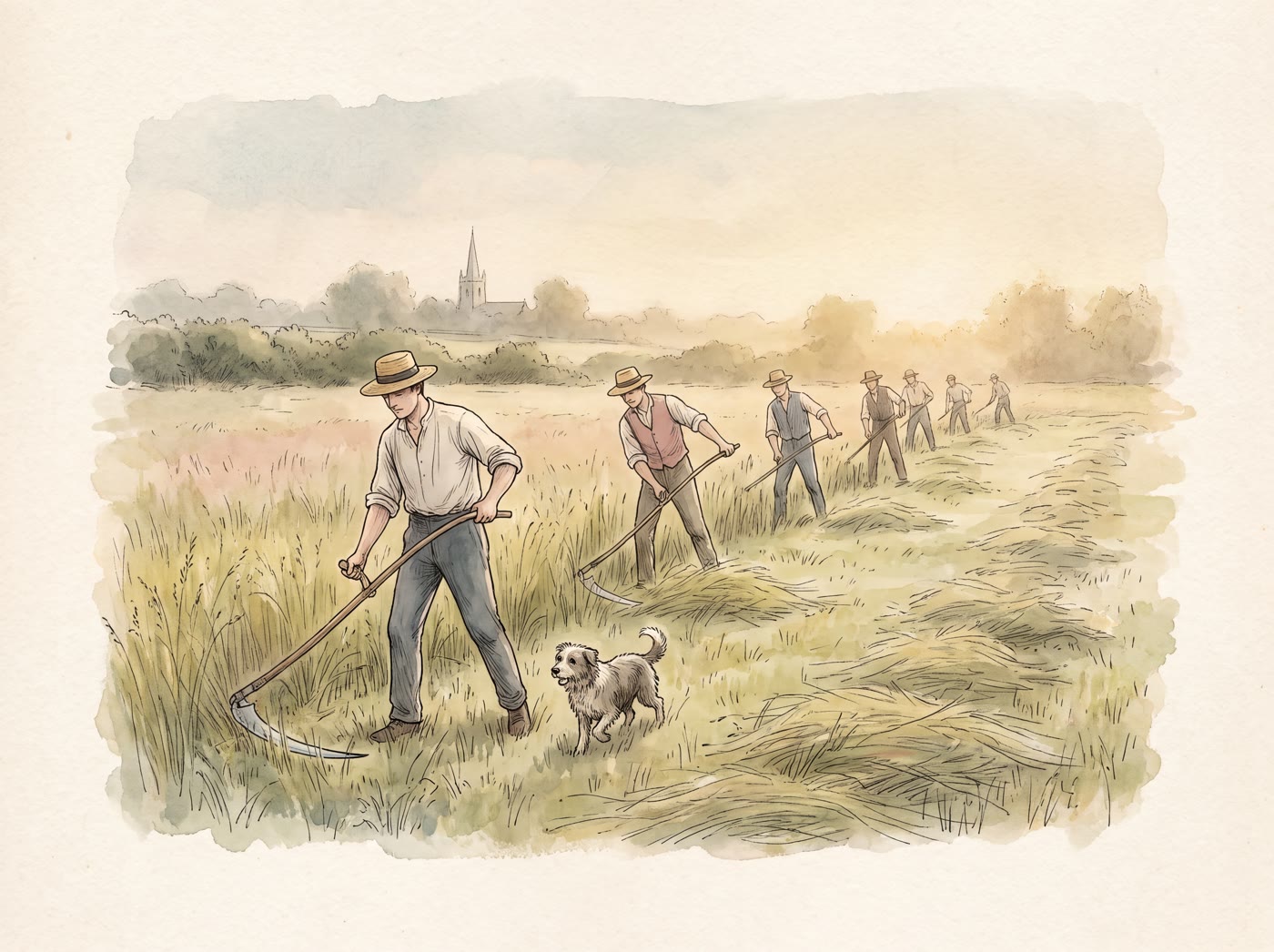
One man went to mow,
Went to mow a meadow,
One man and his dog, Spot,
Went to mow a meadow.
Two men went to mow,
Went to mow a meadow,
Two men, one man and his dog, Spot,
Went to mow a meadow.
Three men went to mow,
Went to mow a meadow,
Three men, two men, one man and his dog, Spot,
Went to mow a meadow.
Four men went to mow,
Went to mow a meadow,
Four men, three men, two men, one man and his dog, Spot,
Went to mow a meadow…
Where the rhyme comes from
One Man Went to Mow is an English folk song of unknown authorship. Unlike many older nursery rhymes it has no tidy first printing to point to: it belongs to the oral tradition of the hayfield and the schoolyard, and collectors picked it up long after it was already being sung. It appears in mid-20th-century collections for children — among them the BBC’s Singing Together songbooks of the 1960s — which is the earliest widely-cited printed source rather than the song’s beginning.
Its setting, however, is genuinely old. Before mechanical mowers, a hay meadow was cut by a team of men working in staggered line with long scythes, each following the swathe of the man ahead. A song that adds one mower at a time describes exactly how that work looked, and the steady swing of the tune matches the steady swing of a scythe.
The song gained a second life in the 1980s, when a recording by Wally Whyton travelled with Chelsea football supporters to a pre-season tour of Sweden and came home as a terrace chant. That story is fondly told by the club’s fans and is a matter of recent memory rather than documented history, but it explains why a counting song for toddlers is also roared by thousands of adults on a Saturday afternoon.
What does it mean?
At face value the song means what it says: a haymaking crew grows man by man, and the dog comes along too. It is a cumulative song, in the same family as The Twelve Days of Christmas — each new verse adds one item and then recites the whole list backwards, so the fun lies in remembering rather than in the story.
A working song. The most likely explanation is the simplest: rhythmic songs made long, repetitive field work pass more easily, and children helping at harvest picked them up. That is a reasonable reading of the words rather than a documented origin.
The bawdy theory. It is sometimes claimed online that “mowing a meadow” was once a bawdy euphemism and the song began as an adult drinking song. This is folklore rather than evidence — no early text supports it, and it is best treated as one of the many after-the-fact explanations that attach themselves to old songs.
Why Spot? The dog is often unnamed in older versions; “his dog, Spot” and the barked “Woof!” are later, much-loved additions from the nursery and from radio versions for children.
Sharing it with children
This is a counting song that earns its keep. Hold up fingers as each new man joins the meadow — one, then two, then three — and let the child count down again with you through the long list. It teaches counting forwards, counting backwards from a number, and the idea that the same set can be recited in either direction.
For a livelier version, give each child a number and have them stand up in turn as their number is sung, then sit down again on the way back down; with a group of ten you can sing the whole song and everybody gets a turn. Add a swinging arm for the scythe on “went to mow” and a hearty “Woof!” for Spot, and the song becomes a game. It also makes a fine first lesson in why haymaking needed many hands.
Extra verses to sing
These verses aren’t traditional — they’re ours. Sing them when you reach the end of the meadow.
Ten men went to mow,
Went to mow a meadow,
Ten men, nine men, down and down to one man and his dog, Spot,
Went to mow a meadow.
Ten men sat to rest,
Sat beside the meadow,
Ten hats off, ten cups filled, and a bone for good old Spot,
Sat beside the meadow.