Ten Green Bottles
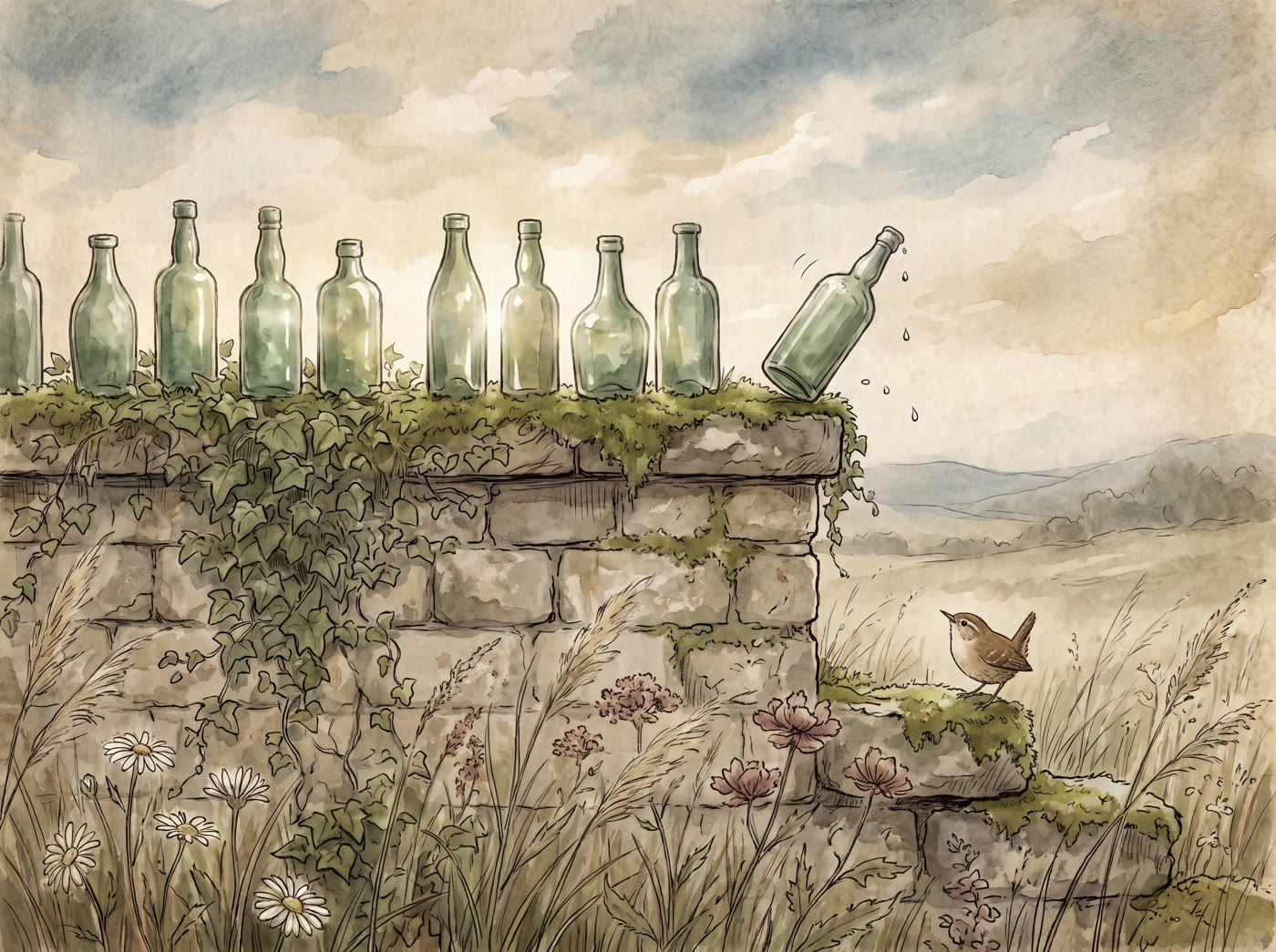
Ten green bottles hanging on the wall,
Ten green bottles hanging on the wall,
And if one green bottle should accidentally fall,
There’ll be nine green bottles hanging on the wall.
Nine green bottles hanging on the wall,
Nine green bottles hanging on the wall,
And if one green bottle should accidentally fall,
There’ll be eight green bottles hanging on the wall.
… and on down through eight, seven, six, five, four, three and two, until:
One green bottle hanging on the wall,
One green bottle hanging on the wall,
And if that green bottle should accidentally fall,
There’ll be no green bottles hanging on the wall.
Where the rhyme comes from
Ten Green Bottles is a countdown song rather than a printed nursery rhyme, and like most playground songs it circulated by ear long before anyone wrote it down. Its first solid appearance in print is in The Oxford Song Book, Volume II (1928), where it is simply described as a “traditional North country song”. A radio broadcast of traditional Yorkshire songs in the early 1930s helped fix the idea that it began in the north of England, though that is an association rather than a documented origin.
The song shares its tune and its shape with the American “Ninety-Nine Bottles of Beer on the Wall”. Earlier printed versions of that family of songs count down from ninety-nine or forty-nine, and describe the bottles as blue or green and always “hanging” on the wall. The children’s version trims the count to a manageable ten and quietly drops the beer — which is exactly what makes it useful in a nursery.
A word of warning: a widely copied story claims a 14th-century English manuscript contains an early version of the song (“Syxthene boetell gryne Yhangen…”). That was an April Fool’s hoax published in 1999. It is not evidence, and no printed record of the song is known before the late 1920s.
What does it mean?
Unusually for a traditional rhyme, there is no hidden meaning to hunt for — and no serious one has ever been proposed. The song is a piece of arithmetic set to a tune. Its whole purpose is the countdown, and its charm is in the deadpan telling: nobody throws the bottles, nobody is blamed. They fall, one at a time, “accidentally”, with cheerful inevitability, until the wall is bare.
Where people do speculate, it is usually about the company the song keeps. Because the melody is shared with a drinking song, it is sometimes suggested that Ten Green Bottles is a sanitised pub or bowling ditty adopted by children. That is a plausible theory given the wider family of “bottles hanging on the wall” songs, but the direction of borrowing has never been firmly established, and it remains a theory rather than a documented history.
Sharing it with children
This is one of the best songs there is for counting backwards, which children find far harder than counting up. Line up ten real objects — plastic bottles, wooden blocks, toy animals — along the back of the sofa or a low shelf, and take one away at the end of each verse. Seeing the row shrink while hearing the number change is what makes the idea stick.
Try pausing before the last line of each verse and letting the child supply the new number. Once that is easy, make it a group game: give each child a number, and they crouch or “fall” when their verse arrives. For older children, start at twenty, or count down in twos — and for a long car journey, starting at fifty is a fine way to lose half an hour.
Extra verses to sing
These verses aren’t traditional — they’re ours. Sing them once the wall is empty.
No green bottles hanging on the wall,
No green bottles hanging on the wall,
But we gathered up the pieces from the grasses where they’d sprawled,
And we mended every bottle that had fallen off the wall.
Ten green bottles back upon the wall,
Ten green bottles back upon the wall,
And the wren came down to sing to them, the sun began to fall,
And not one single bottle tumbled off the garden wall.