Ten in a Bed
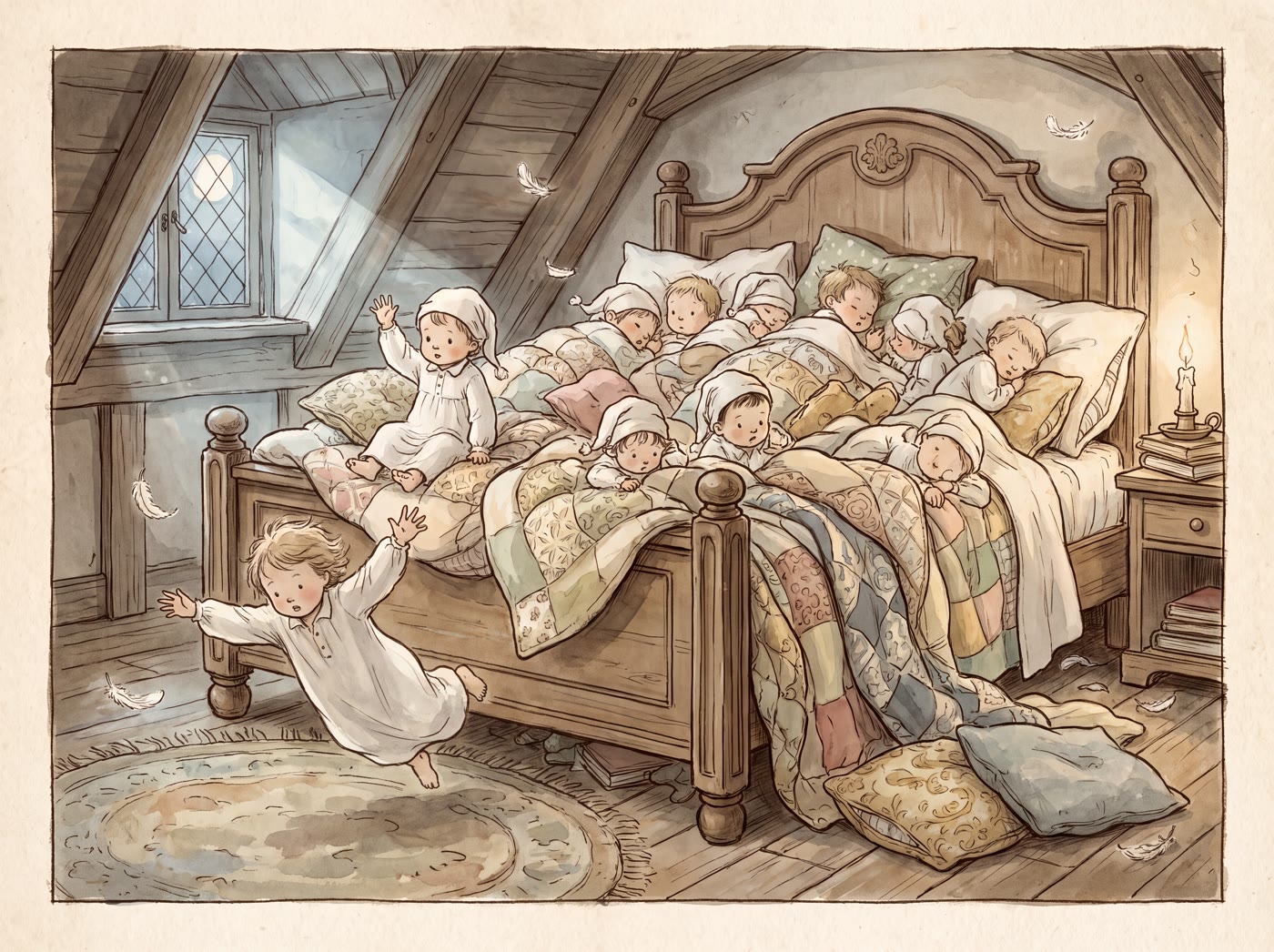
There were ten in a bed,
And the little one said,
“Roll over, roll over.”
So they all rolled over,
And one fell out.
There were nine in a bed,
And the little one said,
“Roll over, roll over.”
So they all rolled over,
And one fell out.
… and on down through eight, seven, six, five, four, three and two, until:
There was one in a bed,
And the little one said,
“Good night!”
Where the rhyme comes from
Ten in a Bed is a countdown song rather than a printed nursery rhyme, and like most songs that travel by ear it has no known author and no tidy first edition. Folklorists place its roots in English-language oral tradition, but the printed trail only becomes clear in the twentieth century — which is late, by nursery rhyme standards.
What the early printed versions show is that the song began as adult comedy rather than a nursery piece. Versions circulating in American songbooks and British scouting and camp repertoires in the 1930s and 1940s made the joke about overcrowding — a boarding house with far too many lodgers in one bed — and the fall at the end of each verse was often a good deal less gentle than it is today. A 1941 party-games book, for example, prints a “Men in a Boarding House Bed” version built on exactly the same rolling refrain.
The children’s form, counting down neatly from ten and ending with a sleepy “good night”, settled in the middle of the twentieth century; a version titled “Roll Over” was recorded for Folkways Records in 1959. Penny Dale’s much-loved picture book Ten in the Bed (Walker Books, 1988) then fixed the song in a generation of nurseries, swapping the ten children for one child and nine soft toys.
What does it mean?
There is no hidden history here to decode, and nobody has seriously claimed one. Ten in a Bed is arithmetic set to a tune: its subject is subtraction, and its joke is the patient inevitability of it. The little one — the smallest, the one with the least authority — is the one giving the orders, and everybody obeys, verse after verse, until the bed is finally his own. Children find that reversal very funny indeed.
The one genuine speculation worth mentioning concerns the song’s adult ancestry. Because the earliest printed versions are boarding-house and camp songs about too many bodies in too small a bed, it is often suggested that the nursery version is a cleaned-up descendant of a bawdier original. Given the dates that is a reasonable reading, but the oral record is thin and the direction of borrowing has never been documented — so it remains a theory rather than established fact.
A common playground extension adds a mock-serious warning after each tumble: “Please remember to tie a knot in your pyjamas — single beds are only made for one.” It is widely sung in Britain and Ireland, but it is a later accretion, not part of the older core.
Sharing it with children
This is one of the finest songs there is for counting backwards, which is much harder for young children than counting up. The great advantage of Ten in a Bed over other countdowns is that it is played with bodies: line up ten teddies and soft toys along the sofa, or ten children along a rug, and remove one at the end of every verse. Seeing the row shrink as the number changes is what makes the idea stick.
Do the actions as you sing. Hold up ten fingers for the count, bring your hands close together for “the little one”, roll your fists around each other for “roll over”, and let one hand tumble away on “one fell out”. With a group, have each child roll sideways along the floor and the one at the end roll gently off the mat.
Try pausing before the first line of each new verse and letting the child supply the number. Once ten to one is easy, count down in twos, or start at twenty. And because the last verse ends with “good night”, the song doubles as a bedtime wind-down — sing it slower and softer with each verse and it becomes a lullaby.
Extra verses to sing
These verses aren’t traditional — they’re ours. Sing them when the bed is empty and nobody wants to stop.
There was one in a bed,
And the little one said,
“It’s lonely, it’s lonely.”
So they all climbed back in,
And nobody fell out.
There were ten in a bed,
And the little one said,
“Budge over, budge over.”
So they all budged up close,
And they slept till the morning.