One, Two, Buckle My Shoe
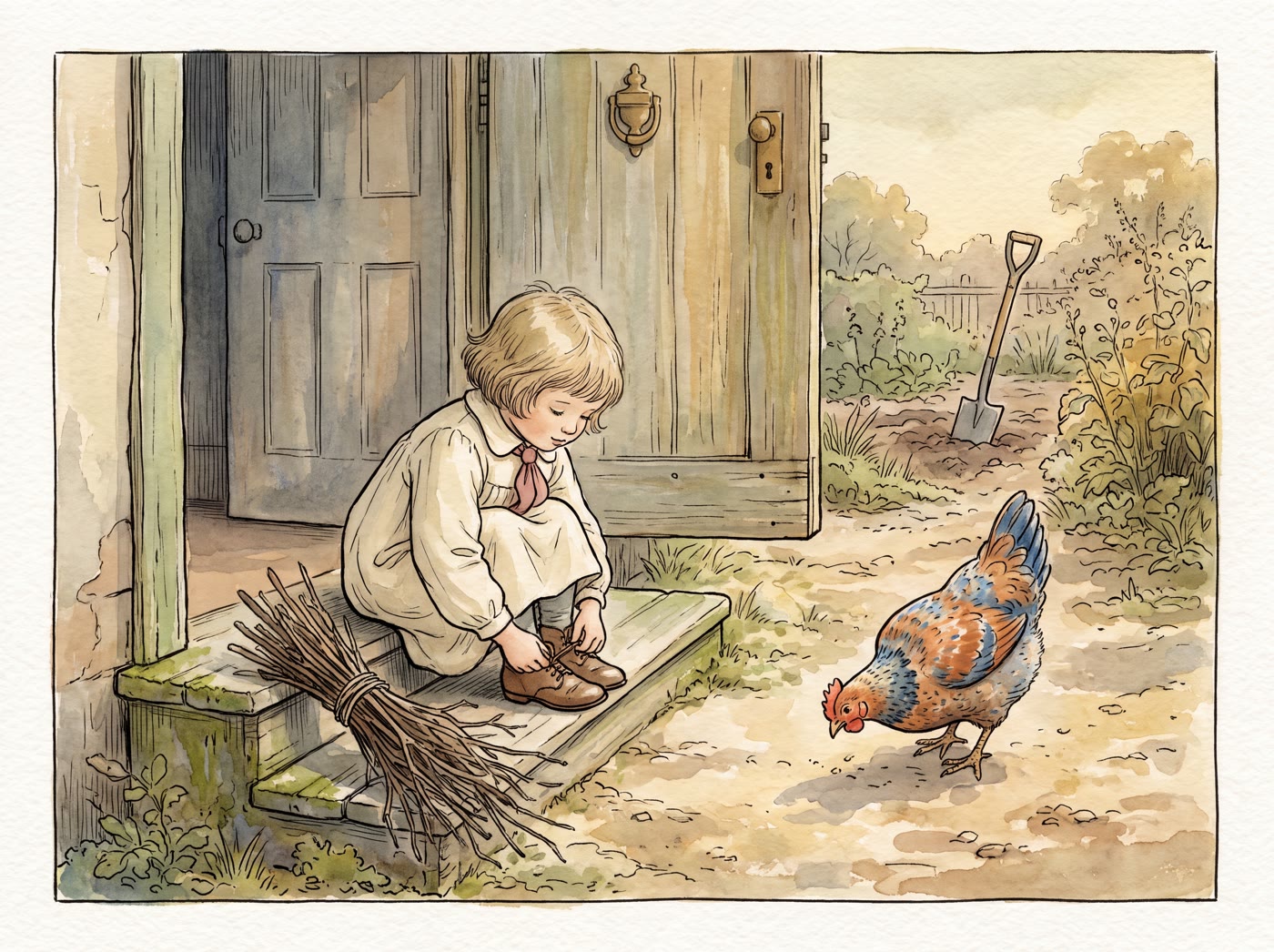
One, two, buckle my shoe,
Three, four, knock on the door,
Five, six, pick up sticks,
Seven, eight, lay them straight,
Nine, ten, a big fat hen,
Eleven, twelve, dig and delve,
Thirteen, fourteen, maids a-courting,
Fifteen, sixteen, maids in the kitchen,
Seventeen, eighteen, maids a-waiting,
Nineteen, twenty, my plate’s empty.
Where the rhyme comes from
One, Two, Buckle My Shoe was first recorded in Songs for the Nursery, published in London in 1805 — the earliest printing we can point to, though the rhyme was almost certainly older and already passing from mouth to mouth. It carries the Roud Folk Song Index number 11284, and the familiar twenty-line text above is the version given in the Opies’ Oxford Dictionary of Nursery Rhymes.
It reached America early. The folklore collector Henry Carrington Bolton, writing in The Counting-Out Rhymes of Children (1888), quoted an elderly woman who remembered a longer version being used at Wrentham, Massachusetts as early as 1780 — a recollection made a century after the fact, but a useful sign that the rhyme was in circulation well before it was printed.
Like most rhymes of the oral tradition, its words never settled. Gammer Gurton’s Garland (1810) gives “Three, four, lay down lower”, “Eleven, twelve, who will delve” and “Fifteen, sixteen, maids a-kissing”; modern nurseries often sing “shut the door” or “knock at the door”. The rhyme was a favourite with illustrators too: Walter Crane made a picture-book of it in 1869 and returned to it in The Buckle My Shoe Picture Book of 1910. Agatha Christie borrowed the title for a Poirot novel in 1940.
What does it mean?
The plainest answer is the best supported: it is a counting-out rhyme, built so that each pair of numbers is anchored by a rhyming image. “Shoe” fixes two, “sticks” fixes six, “hen” fixes ten. The pictures are chosen because they rhyme, not because they tell a story, and the flat little ending — “my plate’s empty” — suggests a rhyme that makes no great claims for itself.
The lace-maker’s day. A widely repeated theory reads the rhyme as a description of a lace-maker’s working day: buckling the shoes to set out, knocking at the workshop door, picking up and straightening the lace-making sticks or bobbins, with the “big fat hen” taken to be the round pillow the lace is worked on, and the maids and the empty plate marking the household round. It is an attractive reading, and it is repeated almost everywhere — but it is an interpretation applied to the words long afterwards, not something the early printings say. Treat it as folklore rather than established history.
A lesson in good habits. Others read the rhyme as gentle moral instruction: dress yourself, go to work, gather your tools, put them in order, earn your dinner. Again this is a modern gloss on a simple text, and the rhyme works perfectly well without it.
What is certain is its function. Counting-out rhymes existed to choose who was “it” in a game, and this one doubles as a ladder from one to twenty. That is job enough for any set of words.
Sharing it with children
This rhyme is a counting lesson disguised as a game, so let the numbers do the work. Hold up fingers in pairs as you chant — two fingers for “one, two”, four for “three, four” — and children quickly learn to count on in twos as well as in ones. Pausing before each rhyme word (“Five, six, pick up…?”) turns it into a guessing game and sharpens their ear for rhyme.
It acts out beautifully. Buckle a real shoe, knock on a real door, gather a handful of sticks from the garden and lay them in a straight line, then count them back. Sorting and lining up twenty small objects — sticks, buttons, pebbles — is genuine early maths: one-to-one counting, ordering, and the idea that twenty stays twenty however you arrange it.
Older children can take it faster, or clap and skip to it — it has long been a skipping-rope and hand-clapping rhyme. And because the ending is a plate, it is a very good rhyme to chant on the way to the table.
Extra verses to sing
These verses aren’t traditional — they’re ours. Add them when twenty isn’t far enough.
Twenty-one, two, the soup is on too,
Twenty-three, four, come back for more,
Twenty-five, six, the candlewicks,
Twenty-seven, eight, the hour is late,
Twenty-nine, thirty, my hands are dirty.
Thirty-one, two, unbuckle my shoe,
Thirty-three, four, close up the door,
Thirty-five, six, the fire we’ll fix,
Thirty-seven, eight, the hen’s at the gate,
Thirty-nine, forty, goodnight to the party.