Hush, Little Baby
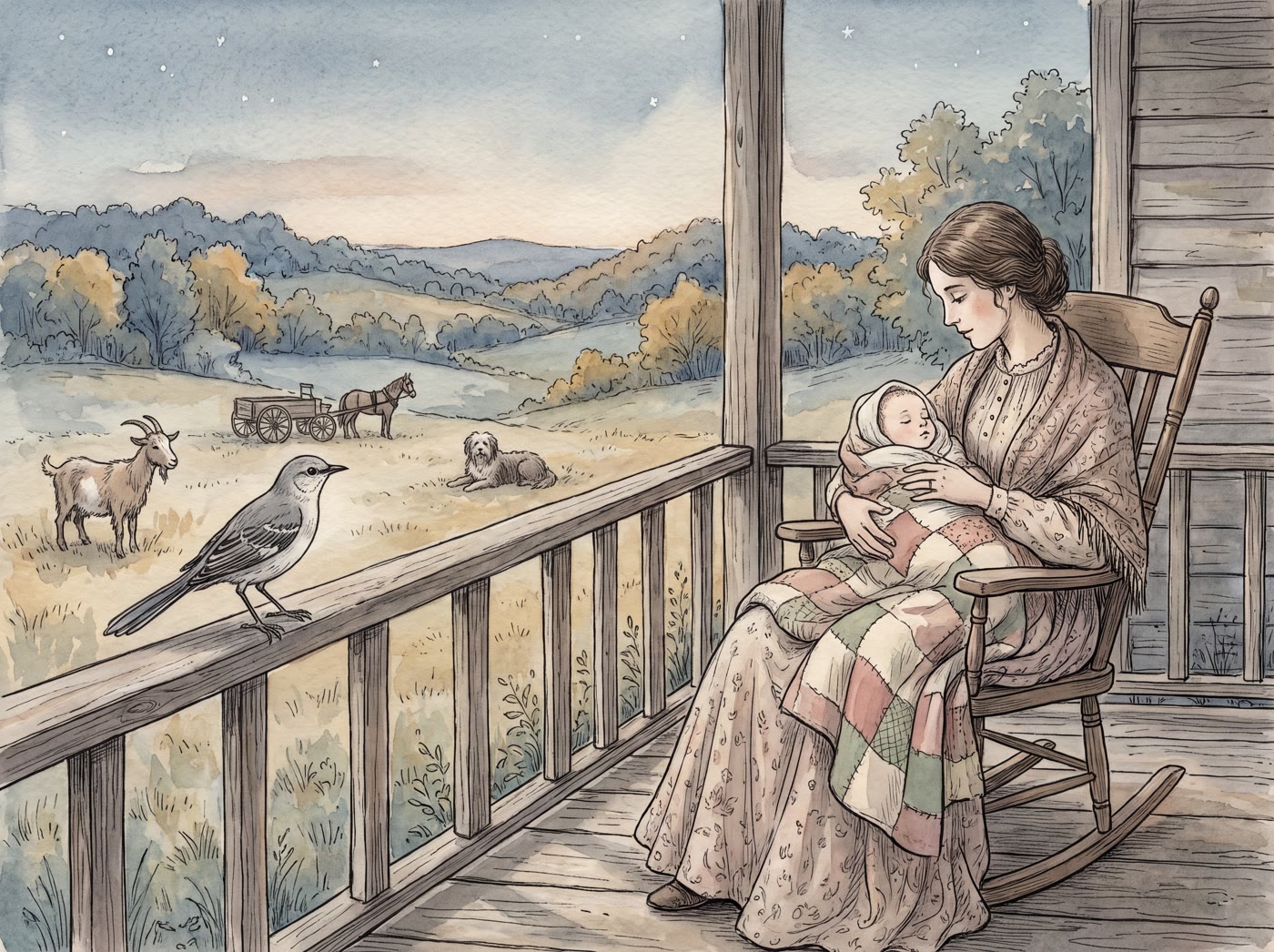
Hush, little baby, don’t say a word,
Mama’s gonna buy you a mockingbird.
And if that mockingbird won’t sing,
Mama’s gonna buy you a diamond ring.
And if that diamond ring turns brass,
Mama’s gonna buy you a looking glass.
And if that looking glass gets broke,
Mama’s gonna buy you a billy goat.
And if that billy goat won’t pull,
Mama’s gonna buy you a cart and bull.
And if that cart and bull turn over,
Mama’s gonna buy you a dog named Rover.
And if that dog named Rover won’t bark,
Mama’s gonna buy you a horse and cart.
And if that horse and cart fall down,
You’ll still be the sweetest little baby in town.
Where the rhyme comes from
Hush, Little Baby is a traditional American lullaby, thought to have begun in the Southern United States. Its author is unknown, and so is the date it was first sung; the Roud Folk Song Index lists it as number 470.
The earliest written records yet found come from an English collector. In 1918 Cecil Sharp, on his song-hunting journeys through the Appalachians, took down a version called “The Mocking Bird” from a singer in Endicott, Franklin County, Virginia; on the same collecting trips he noted a textually complete version sung by Julie Boone of Micaville, North Carolina. Both belong to the Cecil Sharp manuscript collection at Clare College, Cambridge, catalogued by the Vaughan Williams Memorial Library. No earlier printed source has been confirmed.
The folklorist James Madison Carpenter caught a version on a phonograph cylinder in Durham, North Carolina, some time around 1929–35. On 21 May 1939 John and Ruby Lomax recorded Bernice Haynes singing it in Varner, Arkansas — her first line was “Hush little baby, don’t you cry” — and the recording is now held in the Library of Congress’s Archive of American Folk Culture. Alan Lomax recorded more versions across the South, Texas Gladden’s among them, and in 1949 he recorded Jean Ritchie singing the version handed down in her family in the Cumberland Mountains of Kentucky. She released it in 1952 on Singing the Traditional Songs of Her Kentucky Mountain Family. It is often said that the words most people sing today descend from the Ritchie family text; that is plausible, but no source has yet shown it.
Singers have always made the song their own. In the version most often printed today, Mama is doing the promising; in others it is Papa or Daddy, and the folk-song archives file several wordings under the same Roud number. The gifts shift order and lines change from family to family — some singers have a diamond ring that “don’t shine” rather than one that turns brass. None of this is corruption of an original. It is simply how a song lives when it is passed on by voice.
What does it mean?
The song is a bribe, and a loving one. Every gift the singer promises goes wrong: the bird won’t sing, the ring turns brass, the glass breaks, the goat won’t pull. Each failure only prompts a new promise, and the chain can run for as long as the baby stays awake. Then the last line drops the bargaining altogether — whatever breaks, you’ll still be the sweetest little baby in town. The gifts were never the point.
Why a mockingbird. The northern mockingbird, Mimus polyglottos, is a common songbird of the Southern and Eastern United States, famous for copying the songs of many other birds. For a baby who will not settle, a bird that can sing anything is a fine thing to promise, and it is at home among the goats, carts and horses of a rural Southern yard.
The “dark meaning”. Search for this lullaby and you will soon meet claims that it hides something sinister. They come from recent blog posts, videos and listicles, which mostly read the run of broken gifts as proof that every promise fails. No folk-song collection, field recording or early source records any such reading. Legends attached to some older rhymes have at least a long history of being told; this one has none. The plain reading stands: a parent running out of promises, and a baby loved regardless.
Sharing it with children
This is a lullaby first and last, so let the beat do the work. Hold the baby against your shoulder or in your arms and rock on the two strong beats of each line — HUSH, little BAby. Keep your voice low and slow, and let each verse be a little quieter than the last. Swapping the child’s own name in for “baby” is an old trick: “Hush, little Rosie, don’t say a word”.
Older children enjoy taking over the chain. Stop after “And if that horse and cart fall down” and let them invent the next gift and the rhyme that goes with it — nonsense is welcome, and the song has always grown this way. For toddlers, try a gentle call and response: you sing “And if that mockingbird won’t sing”, and they answer with the next gift, or simply whisper the last word of each line back to you.
Extra verses to sing
These verses aren’t traditional — they’re ours. The song has always invited new gifts, so add your own too.
Hush, little baby, close your eyes,
Mama’s gonna buy you some fireflies.
And if those fireflies won’t glow,
Mama’s gonna light you a lamp turned low.
And if that lamp burns out tonight,
Mama’s gonna borrow the moon’s own light.
And if that moon slips out of sight,
You’ll still have Mama, so sleep tight.