Itsy Bitsy Spider
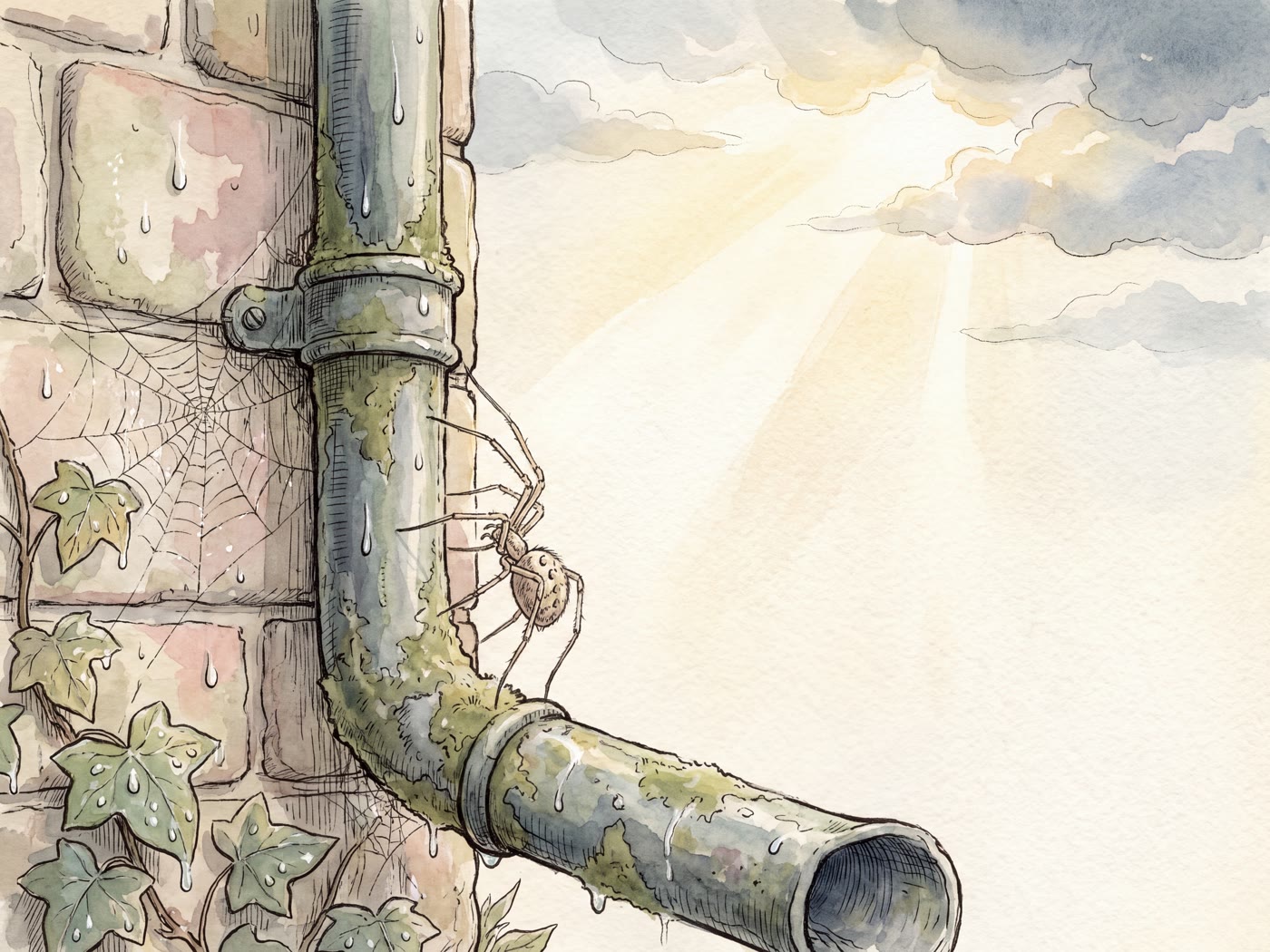
The itsy bitsy spider climbed up the waterspout,
Down came the rain and washed the spider out.
Out came the sun and dried up all the rain,
And the itsy bitsy spider climbed up the spout again.
Where the rhyme comes from
One spider, three names. In America it is the Itsy Bitsy Spider; in Britain and Australia it is Incy Wincy (or Incey Wincey), the name under which it is taught in British schools, BBC School Radio included; older American collections call it Eensy Weensy or Eency Weency. They are all the same song. The Oxford English Dictionary treats “incy-wincy” as a variant of “eensy-weensy” — extremely small. The Roud Folk Song Index lists it as number 11586.
The author is unknown, and so is the exact origin. The earliest printing yet found is a surprising one: an adult travel book, Arthur Walbridge North’s Camp and Camino in Lower California (New York, 1910), which gives four lines about “the blooming, bloody spider” that went up the water spout, was washed out by the rain, and came up the spout again once the sun had dried up all the rain. North calls it “that classic, the ‘Spider Song’” — which suggests it was already well worn in the singing, though no printing earlier than 1910 has been found. Two years later a version reported from an Indiana college commencement, printed in the 1912 proceedings of the Indiana Sanitary and Water Supply Association, comes closer to the modern shape while keeping its saltier language. A 1913 item in Collier’s mentions a cousin, a Cockney lyric about a sparrow in a spout, which shows the waterspout pattern travelling in more than one form.
How the grown-up song became a nursery fingerplay is not documented step by step; the change happened gradually, and by the mid-twentieth century the children’s wording was settled. In 1948 Ruth Crawford Seeger printed “The Eensy Weensy Spider”, with music, in American Folk Songs for Children, and the same year Marian Hansen recorded a version in the journal Western Folklore, in an article on children’s rhymes accompanied by gestures — so the hand motions are at least as old as the printed children’s text. Later recordings, Carly Simon’s and Little Richard’s among them, have carried it further still.
What does it mean?
A small story about not giving up. The spider climbs, is washed down, waits for the sun and climbs again. There is no evidence that the rhyme means anything more than that, and the plain reading is the honest one.
The “dark meaning” stories. Online lists of sinister nursery rhymes sometimes attach the song to the Boer War or to some hidden social message. These are modern internet speculation: no early source connects the rhyme to any historical event, military, political or otherwise, and none of the early printings carries any such gloss.
Sharing it with children
This is a fingerplay, and the motions are half the fun. For the climb, touch the thumb of one hand to the index finger of the other, then swivel upward so the free thumb and finger meet above — and keep going, hand over hand, up the spout. For the rain, raise both hands and wiggle the fingers down through the air. For the sun, sweep both arms up and round into a big circle overhead. Then back to the thumb-and-finger climb for the last line.
Once the motions are familiar, play with the voice. Sing it as a big fat spider, slow and booming with heavy fists for the climb; then as a teeny tiny spider, in a whisper, with the smallest fingertips. Then let the child choose the next spider. A slow-to-fast challenge suits older ones: sing it very slowly, then a little faster each time, until the climbing hands tie themselves in knots. And with paper and crayons, draw a tall waterspout and let a child move a thumbprint spider up it, wash it down with blue scribbles, and bring out a yellow sun.
Extra verses to sing
These verses aren’t traditional — they’re ours. Sing them when a child wants to know what the spider did next.
The itsy bitsy spider spun a web across the spout,
Along came the wind and blew the web about.
Out came the moon and the stars began to shine,
And the itsy bitsy spider spun another, twice as fine.
The itsy bitsy spider climbed right up to the top,
She looked across the garden and decided she would stop.
She sat upon the gutter in the sunshine, warm and dry,
And the itsy bitsy spider waved the rain clouds all goodbye.