Little Miss Muffet
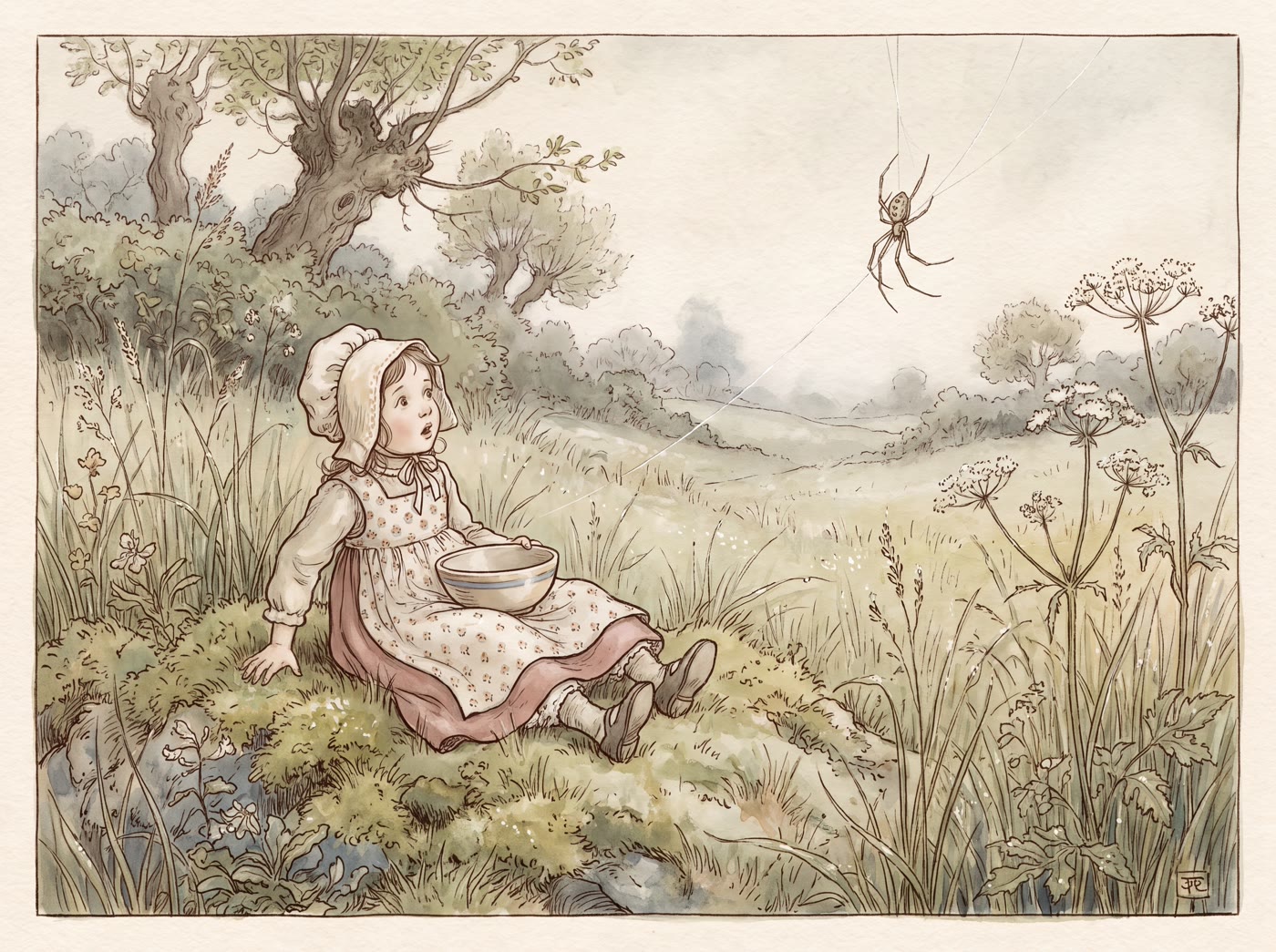
Little Miss Muffet,
Sat on a tuffet,
Eating her curds and whey,
Along came a spider,
Who sat down beside her,
And frightened Miss Muffet away.
Where the rhyme comes from
Little Miss Muffet first appeared in print in Songs for the Nursery, published in London by Tabart and Co. in 1805. The earliest text runs a little differently from the version we sing today — “There came a big spider, and sat down beside her” — and the familiar “Along came a spider” settled into place only in later printings.
Nothing has been found before 1805, but Iona and Peter Opie, whose Oxford Dictionary of Nursery Rhymes remains the standard authority, thought the verse was probably older than its first printing. It belongs to a whole family of “Little Somebody” rhymes — Little Jack Horner, Little Polly Flinders, Little Poll Parrot — in which a small person sits down to do something pleasant and is interrupted. Nineteenth-century versions swapped the names about freely: “Little Mary Ester, sat upon a tester” (1812) and “Little Miss Mopsey, sat in the shopsey” (1842).
Much of the rhyme’s charm rests on two old words. Curds and whey are simply the two parts of milk once it has separated — the soft curds are roughly what we now call cottage cheese, and it was an ordinary children’s supper. A tuffet, according to the Oxford English Dictionary, is a grassy hillock or small mound. The idea that a tuffet is a little three-legged stool seems to have come from the rhyme rather than before it, helped along by Victorian and Edwardian illustrators who liked to sit her on a stool or a toadstool.
What does it mean?
Most likely it means exactly what it says: a child is enjoying her food, a spider arrives, and she runs. It is a perfect small drama for very young listeners. Two more colourful explanations are often repeated, and both should be treated as folklore rather than history.
The entomologist’s daughter. The best-known theory holds that Miss Muffet was Patience, daughter (or stepdaughter) of Dr Thomas Muffet, the Elizabethan physician and insect scholar who died in 1604 — a man who kept spiders about the house and believed in their medicinal virtues. It is a tidy story, but there is no evidence for it beyond the shared surname, and the Opies were sceptical: two hundred years separate Dr Muffet’s death from the rhyme’s first appearance.
Mary, Queen of Scots. Others have claimed the rhyme mocks Mary, Queen of Scots, frightened away by the Calvinist reformer John Knox, who preached fiercely against her. Most scholars doubt it. Stories that tie nursery rhymes to famous political events are very often invented long afterwards, and this one is no exception.
Sharing it with children
This is a lovely lap rhyme with a built-in surprise. Sit a child on your knee and rock gently through the first three lines, miming spoonfuls from an imaginary bowl. Then walk two fingers up their arm as the spider — slowly, so the anticipation builds — and finish with a gentle tickle and a wobble for “frightened Miss Muffet away.” Children will ask for it again and again, because they know exactly what is coming.
It is also a rhyme full of good questions. What is a tuffet? Let them sit on a cushion, a footstool and a grassy bank and decide which one Miss Muffet had. Curds and whey are easy to show at the kitchen table with a spoonful of lemon juice in warm milk, and a bowl of cottage cheese makes the rhyme suddenly real. Finally, it is a kind way into talking about spiders: acting out a braver ending, in which Miss Muffet says hello instead of running, does more for a nervous child than any amount of reassurance.
Extra verses to sing
These verses aren’t traditional — they’re ours. Sing them if Miss Muffet deserves her breakfast back.
Little Miss Muffet,
Came back to her tuffet,
And peeped through the grass to see;
The spider was spinning,
And politely beginning
To ask if she’d stay for tea.
So brave Miss Muffet,
Sat down on her tuffet,
And shared out her curds and whey;
The spider sat by her,
And nobody’s shyer,
And nobody ran away.