Little Jack Horner
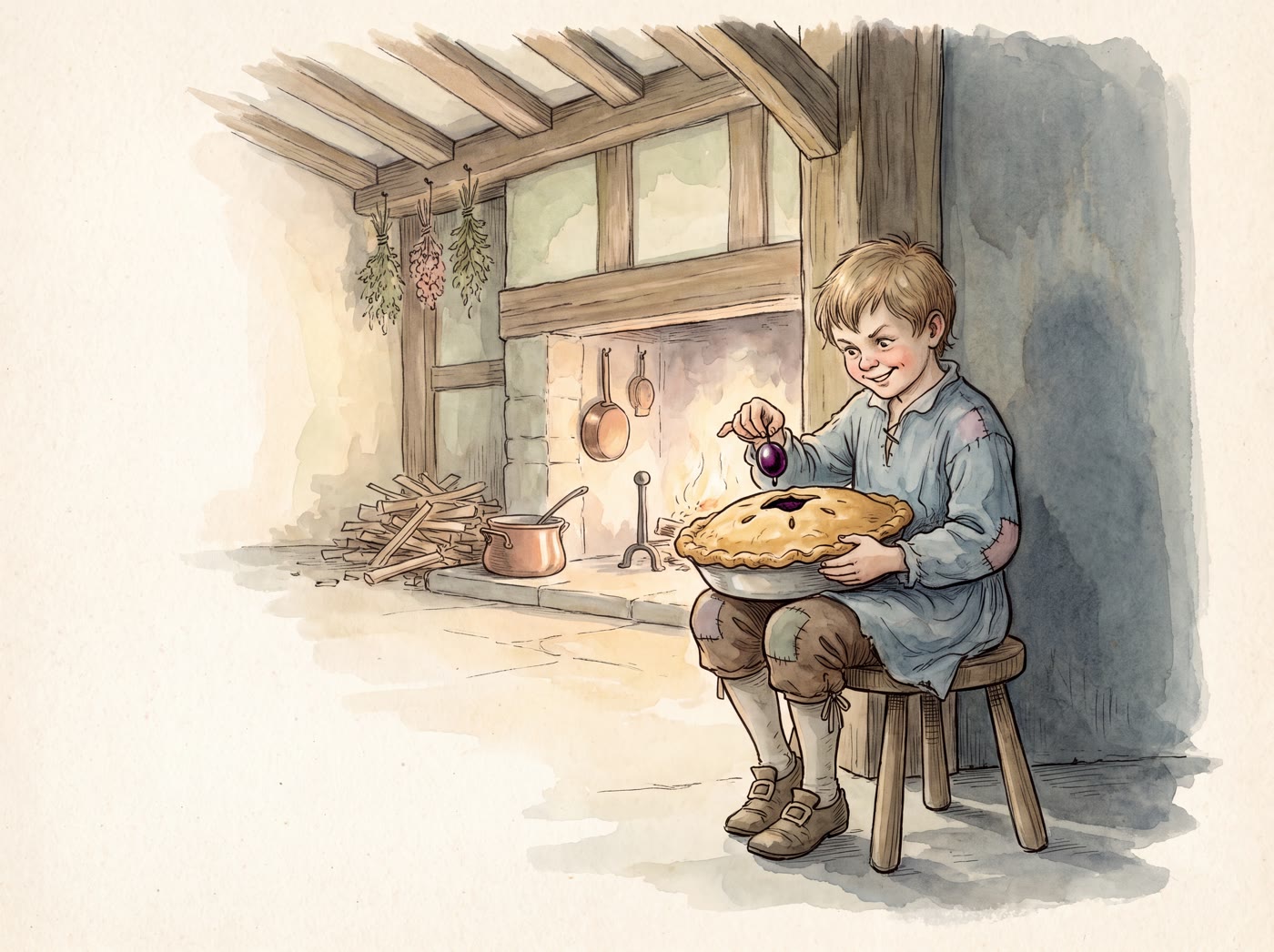
Little Jack Horner,
Sat in a corner,
Eating his Christmas pie.
He put in his thumb,
And pulled out a plum,
And said, “What a good boy am I!”
Where the rhyme comes from
The earliest surviving record of the verse is in Namby Pamby, a satirical ballad by Henry Carey published in 1725. Carey was mocking a rival poet, Ambrose Philips, for writing babyish verses for his patrons’ children, and he quoted the Jack Horner rhyme as an example of the nursery stuff Philips was imitating. That he could quote it in passing suggests the rhyme was already familiar — a character called Jack Horner, complete with his corner (a “chimney corner”), turns up in a printed pamphlet as early as 1665.
The rhyme was printed for children in Mother Goose’s Melody in the later 18th century, and a chapbook of 1764, The History of Jack Horner, spun it out into a long comic tale — though that story was largely borrowed from a much older poem, The Fryer and the Boy, with Jack’s name simply attached to it. The tune most people sing today was written down by the composer and collector James William Elliott in his National Nursery Rhymes and Nursery Songs of 1870.
What does it mean?
On the surface it is a small joke about a smug child: Jack does something greedy and congratulates himself for it. Ever since Carey used it in 1725, the rhyme has been a byword for self-satisfied opportunism — helping yourself, then praising yourself for it.
The Glastonbury pie. The famous theory, which only appears in the 19th century, links Jack to Thomas Horner, steward to Richard Whiting, the last Abbot of Glastonbury. As Henry VIII dissolved the monasteries between 1536 and 1541, the story goes, the abbot sent Horner to London with an enormous Christmas pie concealing the title deeds to a dozen manors, hoping to buy the king’s goodwill. On the road Horner supposedly put in his thumb and drew out the deeds to the Manor of Mells in Somerset for himself. Some tellings add that, since the estate included lead mines in the Mendips, the “plum” is a pun on the Latin plumbum, lead.
It is a marvellous story, but it should be treated as folklore rather than history. The Horner family did acquire Mells at about this time — that much is documented — but the records indicate the manor was bought and paid for, and both Horner’s descendants and later owners of Mells have long insisted the legend is untrue. No source connects the rhyme to Thomas Horner until roughly three centuries after the events it supposedly describes.
Sharing it with children
This is a lovely lap rhyme because the whole thing is one small action. Sit a child on your knee, cup your hand as the pie, and let them press a thumb in on “he put in his thumb” — then lift it high on “pulled out a plum” and finish with a proud, chest-puffing “what a good boy am I!” Toddlers will do the thumb long before they can say the words.
It also makes a happy kitchen rhyme. Press thumbprints into pastry or dough and drop a fruit into each hollow, and you have thumbprint tarts and a rhyme to chant while they bake. With older children, the rhyme opens a gentle conversation: was Jack really a good boy for taking the best bit for himself? Few nursery rhymes hand you a moral question that neatly.
Extra verses to sing
These verses aren’t traditional — they’re ours. Sing them if Jack ought to learn to share.
Little Jack Horner
Peeped round his corner,
And saw all his friends passing by.
He carried it out,
And shared it about,
And said, “What a fine feast have I!”
Little Jack Horner
Now needs no corner,
He sits by the fire, warm and dry.
The plums are all gone,
But the singing goes on,
And there’s always a slice for a passer-by.