Rain, Rain, Go Away
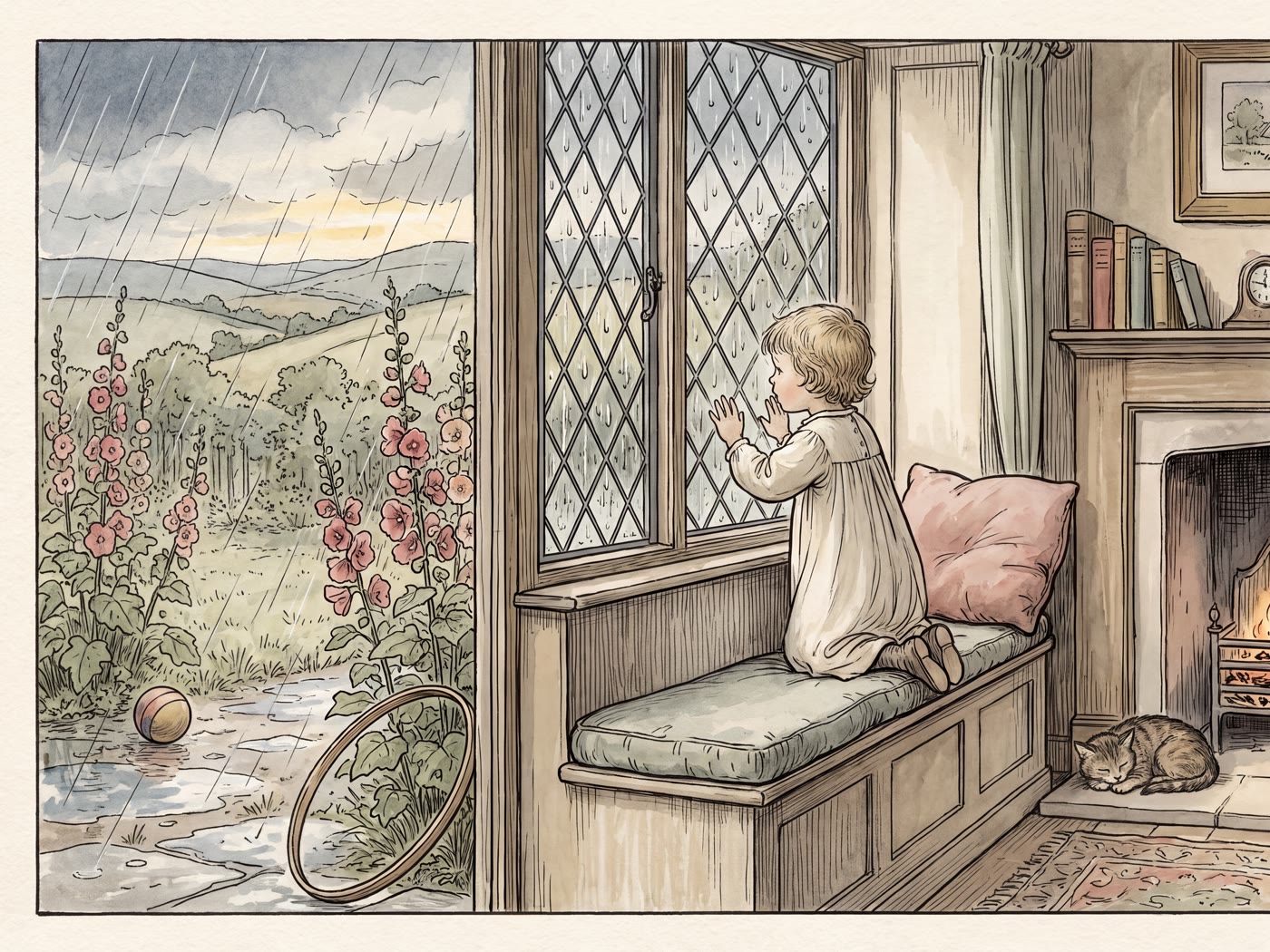
Rain, rain, go away,
Come again another day,
Little Johnny wants to play.
Rain, rain, go away,
Come again another day,
Daddy wants to play.
Rain, rain, go away,
Come again another day,
Mummy wants to play.
Rain, rain, go away,
Come again another day,
Brother wants to play.
Rain, rain, go away,
Come again another day,
Sister wants to play.
Rain, rain, go away,
Come again another day,
Baby wants to play.
Where the rhyme comes from
The first verse is the one most people know; the run through the family — Daddy, Mummy, Brother, Sister, Baby — is the form widely sung in nurseries and classrooms today. Behind both lies a very old charm. No author is known, and none is likely to be: this is something children have said to the weather for well over three centuries.
The earliest English record is a proverb. James Howell’s collection of proverbs of 1659 gives “Raine, raine, goe to Spain: faire weather come againe” — the date and wording the Opies record in The Oxford Dictionary of Nursery Rhymes. A generation later, around 1687, the antiquarian John Aubrey noted that little children had a custom of chanting a charm to send the rain away, ending “come again a Saturday”. Neither of these early versions has a child in it at all.
The child arrives later. By the 1844 edition of James Orchard Halliwell’s The Nursery Rhymes of England, the familiar shape is in print: “Rain, rain, go away, / Come again another day; / Little Arthur wants to play.” Slotting a real child’s name into the last line is therefore documented from at least the 1840s. “Little Johnny” is simply the placeholder that stuck, especially in American tradition — a twentieth-century folklore collection from North Carolina has Johnny wanting to play “in the meadow on the hay” — but no dated first printing of the Johnny line has been found. The rhyme is number 19096 in the Roud Folk Song Index.
What does it mean?
A charm against the weather. The plain meaning is the right one: it is a spell children chant at the rain, exactly as Aubrey described. Similar rain-chasing rhymes are found in many societies, Karen Dolby notes in Oranges and Lemons: Rhymes from Past Times, as far back as ancient Greece and Rome. Britain alone has a whole family of them. A Scottish version runs “Rain, rain, gang to Spain, / And never come back again”; a Norfolk one chants “Go to France and go to Spain”; in Northumberland and Cornwall the rain is offered a bribe to leave, cake in one place, figgy cake and brandy in another. There is no single fixed “original” — only many local forms of the same wish.
The Spanish Armada. It is widely repeated online that “go to Spain” recalls the Spanish Armada of 1588 and the reign of Elizabeth I. It makes a stirring story, but the evidence is thin to the point of absence: no historian or folklorist ties the rhyme to that event, and the Opies’ scholarly account makes no such claim. Spain is better explained as just one of the many faraway places children have told the rain to go.
It is sometimes confused with “It’s Raining, It’s Pouring”, which is a separate rhyme and a far younger one, from the twentieth century.
Sharing it with children
This is a window rhyme. Stand at the glass with a child on a wet morning and chant it at the clouds, putting their own name in the last line, as children were doing in Halliwell’s day — it is remarkable how personal a three-line spell becomes once it is about them.
Add actions for the three lines: fingers pattering down like rain for “Rain, rain”, both hands pushing the weather firmly away for “go away”, and arms swept up and round into a big sun for the last line. On a wet playtime, turn it into a naming game: go round the room, each child choosing who wants to play next — a friend, a teacher, the class tortoise. And when the charm finally works, go out in boots and count the puddles on the way down the path.
Extra verses to sing
These verses aren’t traditional — they’re ours. Sing them when the clouds begin to lift.
Rain, rain, go away,
Take the clouds and all the grey,
Leave the puddles where we play.
Sun, sun, come and stay,
Dry the grass and warm the day,
All the children want to play.