Whether the Weather
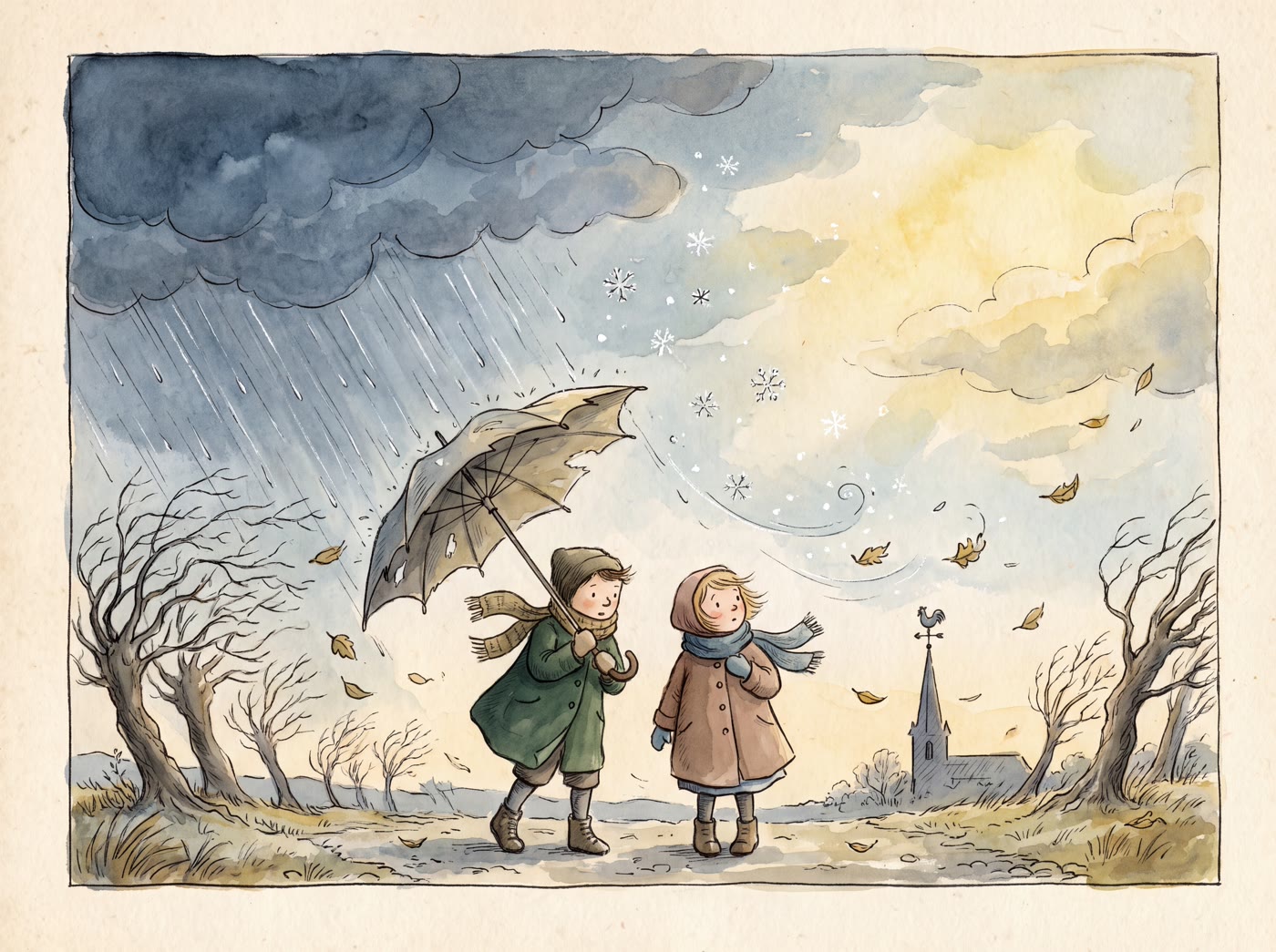
Whether the weather be cold,
Or whether the weather be hot,
We’ll weather the weather,
Whatever the weather,
Whether we like it or not.
Where the rhyme comes from
Unlike Peter Piper, which can be traced to a dated London book of 1813, Whether the Weather has no known first printing. It circulates as an anonymous piece — usually credited simply to “Anon” or labelled a traditional British rhyme — and it belongs to the large body of playground and elocution verse that passed from mouth to mouth for years before anyone thought to write it down. Claims that it dates from the 16th or 17th century turn up regularly online, but no source is ever given for them, and they should be treated as guesswork rather than history.
Most versions carry an opening couplet that this page’s traditional text leaves out, and you will very often hear the fuller seven-line form: Whether the weather be fine, / Or whether the weather be not, / Whether the weather be cold, / Or whether the weather be hot, / We’ll weather the weather / Whatever the weather, / Whether we like it or not. Both are “correct”; a rhyme with no printed original has no official wording, only the versions people actually say. Other variants end “whether we’re young or we’re old” or swap in damp, mild, rainy and fair — and choral and classroom settings have added verses of their own.
What can be dated is the pun the rhyme is built on. Weather as a verb, meaning to come safely through a storm, is old seafaring English: a ship weathered a gale, or weathered a headland by sailing to windward of it. From there it drifted into everyday speech for surviving any hard passage. So “we’ll weather the weather” is a real idiom used twice over, not nonsense — which is exactly what makes the line satisfying to say.
What does it mean?
On the surface, very little — and that is deliberate. The verse is a homophone drill. Whether, weather and whatever sound nearly identical, so saying them in quick succession forces the mouth to keep resetting between the wh- and w- shapes and the -ther ending. In accents that still distinguish whether (with a breathy hw-) from weather, the rhyme is also a neat pronunciation exercise; in most modern British and American speech the two words have fallen together, which is precisely why they tangle.
A spelling lesson in disguise. The old page on this site put it well: the twister highlights the difference in meaning between whether and weather. Teachers have long used it for that, since the joke only lands once you know that identical sounds can be different words. That is a use of the rhyme rather than a documented origin, but it is an honest one.
A little bit of stoicism. Read as a sentiment rather than an exercise, the last three lines are a cheerful shrug: the weather is going to do as it pleases, and we will get through it regardless. Some writers present this as the rhyme’s “real meaning” or tie it to a particular national temperament. It is a fair reading of the words, but there is no evidence anyone composed it as a philosophy — it is a wordplay piece that happens to end in good sense.
Sharing it with children
This one rewards patience over speed. Begin slowly enough to feel the difference between each word, and put an exaggerated puff of breath on whether to separate it from weather — the exaggeration is half the fun and it genuinely helps. Say a line, let the child echo it, then add the next, building the verse backwards from the last line if the middle keeps collapsing.
Once it is steady, make it a challenge: three clean runs in a row beats one lucky fast one. Time it with a stopwatch and try to beat yesterday, or take turns round the table with one line each, so a stumble passes the rhyme on. Whisper it, then boom it. Clap the beat as you go. It also makes a fine game for looking out of the window — say the verse each morning and change cold and hot to whatever the sky is actually doing: whether the weather be foggy, or whether the weather be bright. Tangles are the point, so laugh at every one.
Extra verses to sing
These verses aren’t traditional — they’re ours. Add them once the first one is easy.
Whether the weather be wet,
Or whether the weather be dry,
We’ll weather the weather,
Whatever the weather,
Whether it snows or we fry.
Whether the weather blows wild,
Or whether the weather blows still,
We’ll weather the weather,
Whatever the weather,
Whether we’re well or we’re ill.