She Sells Sea Shells
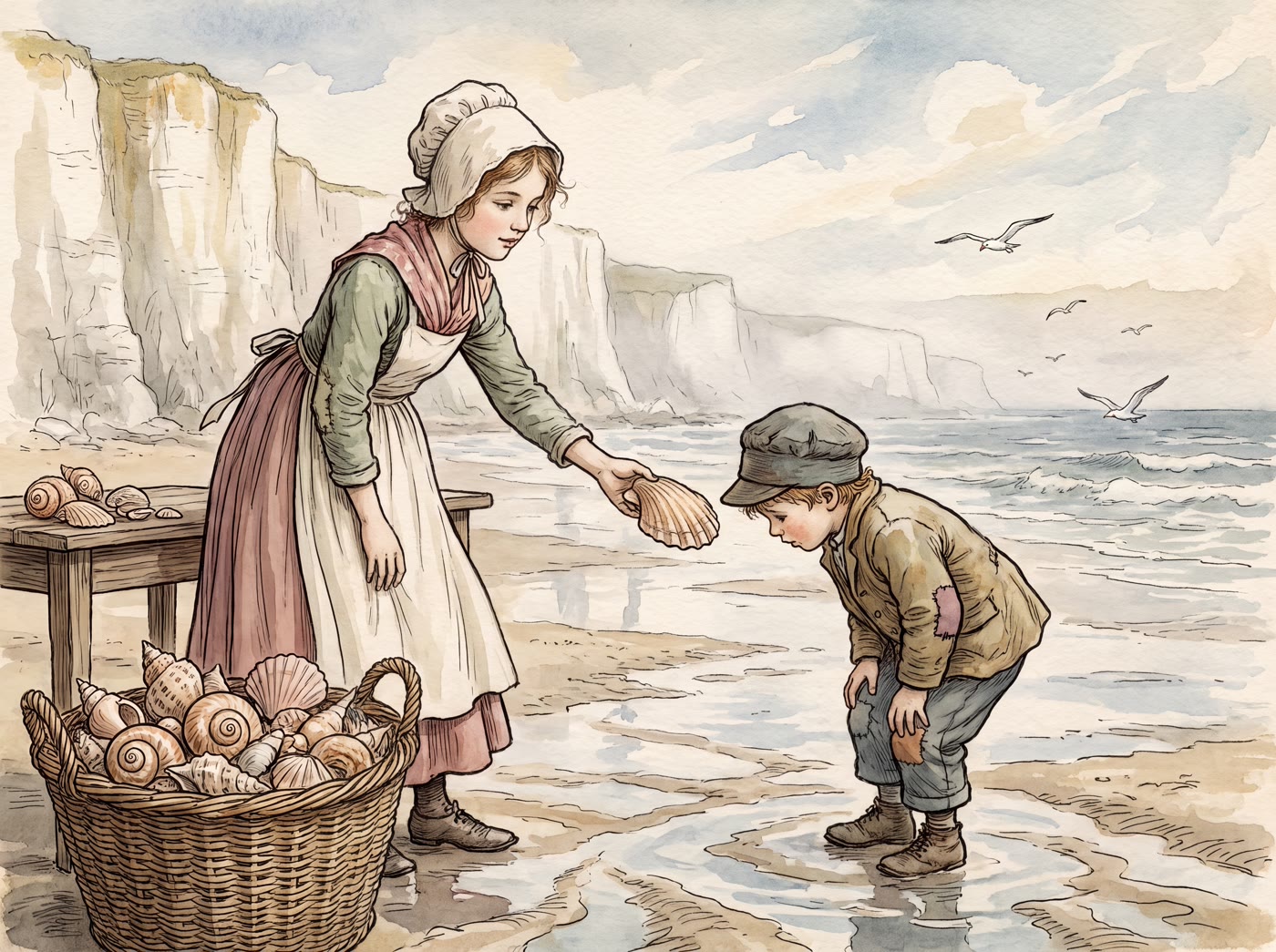
She sells sea-shells on the sea-shore,
The shells she sells are sea-shells, I’m sure,
For if she sells sea-shells on the sea-shore,
Then I’m sure she sells sea-shore shells.
Where the rhyme comes from
This is one of the best-documented tongue twisters in English, and its paper trail is much longer than most people expect. The earliest known printing of the phrase “she sells sea shells” comes from 1855, in Letters and Sounds: An Introduction to English Reading by Alexander Melville Bell — the Edinburgh speech teacher who was the father of Alexander Graham Bell. It appeared there not as a joke but as a serious elocution exercise.
By 1871 it had escaped the classroom: the Christmas number of The Family Herald printed it among “Alliterative Puzzles,” purely for amusement. Through the 1870s and 1880s it multiplied into dozens of variants in elocution manuals and newspapers — “She sells sea shells. Shall he sell sea shells?” (1878), “She sells sea shells saucily” (1895), “She says she sells sea shells” (1896). The seashore only joined the shells later: the first known version with the location is “she sells seashells at the sea shore,” printed in Werner’s Magazine in September 1898.
The four lines above are the chorus of a music-hall song, She Sells Sea Shells, with words by Terry Sullivan and music by Harry Gifford, published in 1908 and sung by Wilkie Bard in the pantomime Dick Whittington. Billy Murray recorded it in America on 28 October 1909. Sullivan did not invent the twister — he borrowed a saying already more than fifty years old and built a comic song around it, which was a popular thing to do at the time.
What does it mean?
Very little, and gloriously so. The joke of Sullivan’s song is simply that the chorus is almost impossible to sing: the performer complains of “lockjaw, and stickjaw as well,” lisps his way through it, and wishes the woman sold matches instead. There is no story to decode. The rhyme exists to defeat your tongue, and the rapid alternation of the s and sh sounds is the whole of the point.
The Mary Anning theory. You will very often read that the “she” is Mary Anning (1799–1847), the remarkable self-taught fossil hunter of Lyme Regis. It is a lovely idea, and a popular one — but it is folklore about folklore, not history. Stephen Winick of the Library of Congress traced the claim carefully and found no evidence for it at all. The obstacles are considerable: the twister was already in print in 1855, in Scotland, decades before any connection to Anning was ever suggested; the earliest recorded claim of a link appears only in 1977, with no source given; nothing in Sullivan’s song mentions Anning, Lyme Regis or fossils; and Anning sold fossils rather than seashells, from a table by her cottage and later from shops in the town, not on the seashore. Many early variants have a he selling the shells, which rules Anning out entirely.
Anning richly deserves her growing fame, and the theory probably survives because we want her to have been celebrated all along. But the honest answer is that this is an elocution exercise that grew into a joke — and nobody knows who first said it.
Sharing it with children
Start slowly. This twister trips people up because the mouth must flick between s (tongue tip forward, lips relaxed) and sh (tongue pulled back, lips rounded) six or seven times in a breath. Say one line at a time at half speed, exaggerating the difference between the two sounds, and only then add pace. Children who can manage “she sells sea shells” on its own are ready for the full four lines.
Then make it a game. Time each other with a phone stopwatch and keep a family record; try three clean repetitions in a row, where any stumble sends you back to the start; or pass it round a circle a line each, faster with every lap. Whispering it is surprisingly harder than shouting it. Because it began life as a speech exercise, it does genuine good: it is still used by speech and drama teachers today for exactly the reason Melville Bell printed it in 1855.
Extra verses to sing
These verses aren’t traditional — they’re ours. Try them once the first four lines come easily.
She sorts sea-shells in a shallow shell shop,
The shells she sorts she shines till they shine,
For if she sorts sea-shells in a shallow shell shop,
Then surely those shining shore shells are mine.
He sells sea-shells to the shore-side shoppers,
The shells he sells she sold him, I’m sure,
So if she sells him shells and he sells them onward,
Who shall sell sea-shells on the sea-shore?