Peter Piper
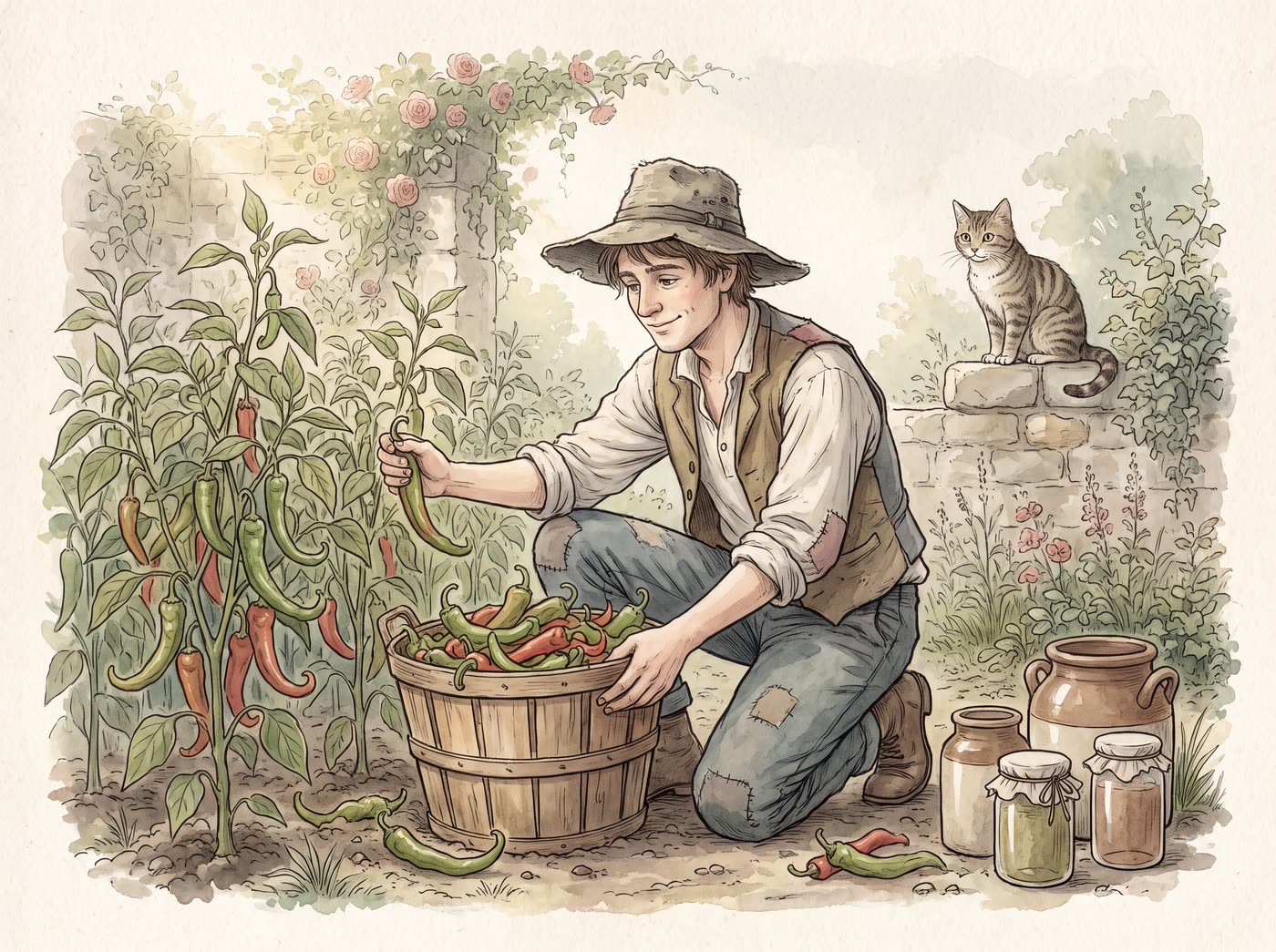
Peter Piper picked a peck of pickled pepper,
A peck of pickled pepper Peter Piper picked;
If Peter Piper picked a peck of pickled pepper,
Where’s the peck of pickled pepper Peter Piper picked?
Where the rhyme comes from
Peter Piper first appeared in print in 1813, in a small London children’s book with a gloriously alliterative title of its own: Peter Piper’s Practical Principles of Plain and Perfect Pronunciation, issued by the publisher John Harris (1756–1846). The book was an alphabet of tongue twisters — one for every letter, each built around a single name in exactly the same style — and Peter Piper was the entry for P. It was reprinted many times in Britain and appeared in American editions from the 1830s, but only Peter outlived the book that carried him.
Note the singular in the oldest printing: a peck of pickled pepper, not peppers. The plural crept in later, as did several modern rewrites that swap the final line for “How many pickled peppers did Peter Piper pick?” The Oxford Companion to Children’s Literature records that the rhyme was already known at least a generation before 1813, so Harris was almost certainly printing something children were already chanting rather than inventing it.
A “peck” is a genuine old measure — a unit of dry volume equal to a quarter of a bushel, about eight dry quarts. It was everyday language for anyone buying produce in 1813, though the word has since fallen out of use in British English, which is why the rhyme now sounds more nonsensical than it once did.
What does it mean?
Mostly, it means nothing at all — and that is the point. Harris’s book was a pronunciation drill, designed to make children articulate a single consonant cleanly and repeatedly. The verse exists to exercise the plosive p, not to tell a story.
The Pierre Poivre theory. The most repeated explanation is that Peter Piper was really Pierre Poivre (1719–1786), a one-armed French horticulturalist and colonial administrator of Mauritius, whose surname means “pepper” and who is said to have spirited clove and nutmeg seedlings out of the Dutch East Indies and assessed the Seychelles for spice growing. It is an irresistible coincidence, and several island histories repeat it — but there is no contemporary evidence linking Poivre to the rhyme, and it belongs in the folklore column rather than the history column.
The idle boaster theory. Another popular reading takes the final question literally: if Peter really picked all that pepper, where has it gone? On this view the rhyme gently mocks a workman who claimed a bigger haul than he actually gathered. It is a charming gloss, but it is a modern interpretation of a nonsense drill, not a documented origin.
There is also a genuine oddity that carries Peter’s name. Psychologists use the term “Peter Piper Principle” for our tendency to muddle up words — and especially people’s names — that begin with the same sound. Novelists avoid giving two characters names starting with the same letter for precisely this reason.
Sharing it with children
This is a speed challenge, so resist the temptation to race. Start absurdly slowly and say one line at a time, letting the child echo each line back before you add the next. Ask them to pop the p properly — hold a hand or a scrap of paper in front of the mouth and feel the little puff of air on Peter, picked, peck, pickled, pepper. Clear beats fast, every time.
Once the whole verse can be said cleanly, bring out a stopwatch and try to beat yesterday. Three tidy runs in a row is a far better target than one lucky sprint. Other ways to play: whisper it, then boom it; take alternate lines around the table; clap the rhythm as you speak; or count out a “peck” of pasta shapes into a jar so they can see how big an old measure really was. The tangles are the fun, so laugh at every one.
Extra verses to sing
These verses aren’t traditional — they’re ours. Add them once the first one is easy.
Peter Piper packed a parcel of prime pickles,
A parcel of prime pickles Peter Piper packed;
If Peter Piper packed a parcel of prime pickles,
Where’s the parcel of prime pickles Peter Piper packed?
Peter Piper peddled his peppers past the palace,
A pound of pickled peppers Peter Piper peddled;
If Peter Piper peddled all the peppers that he picked,
Why’s a peck of pickled pepper plainly on the porch?